President William Ruto has once again defended his decision to host large and diverse delegations at State House, dismissing criticism from opponents who have questioned the appropriateness of the meetings.
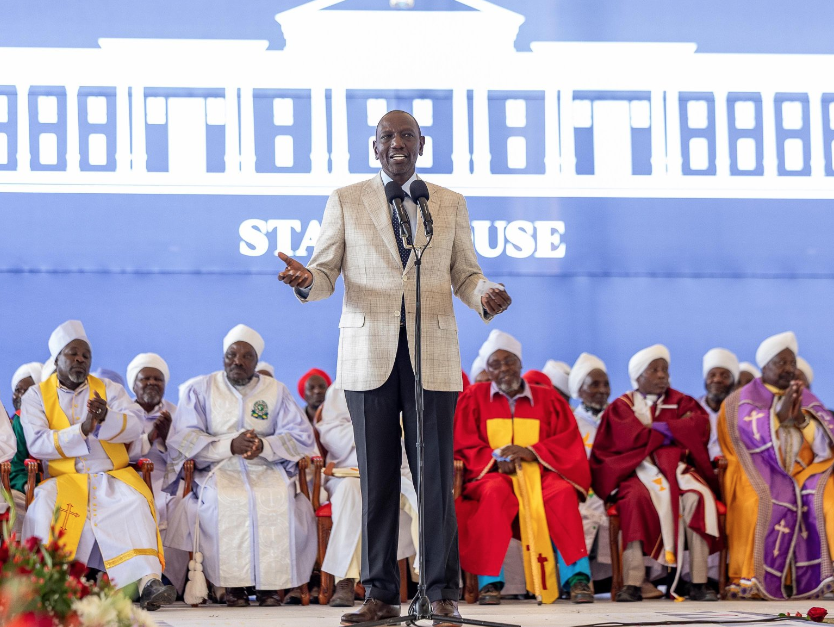
Speaking on Sunday when he hosted members of the Akorino faithful at State House Nairobi, the Head of State maintained that the official residence is open to all Kenyans, regardless of their social or economic status.
“State House is for all Kenyans,” Ruto said. “There are people who are not comfortable with me inviting ordinary Kenyans to State House.”
The President appeared to directly respond to critics who have accused him of lowering the prestige of the country’s most powerful office by hosting what they describe as informal or politically motivated gatherings.
“There was one who said I have lowered the standards of State House. He said this place should be visited by presidents of other countries, envoys and all those with means,” Ruto said.
“But I have told them that I have not lowered the standards at State House, it is just that I have uplifted ordinary Kenyans. They should get used to it, those opposed to the visits.”
Ruto insisted that no Kenyan should be questioned for accessing State House at his invitation, emphasising that his administration is committed to inclusivity and public engagement.
“Any Kenyan who gets an opportunity to come here should not be questioned by anybody,” he said. “And the people asking, they should know I am the President. I decide who should come and who should not come.”
In a sharp rebuke to his critics, the President also dismissed concerns about the logistics and costs of hosting the delegations, including questions surrounding meals provided during the visits.
“Those opposing speak as who, and you go to the extent of asking about food. The food is not yours, the one cooking it is not your wife, the person sending invites is not you,” Ruto said.
“Where people will convene is not your home, why are you questioning? I am the one to decide who comes here, and if they continue to make noise I will invite you again and we’ll see what they can do,” he added.
The remarks come against the backdrop of sustained criticism from opposition leaders, who have accused the President of turning State House into a political mobilisation hub ahead of future elections. In September last year, opposition figures claimed that the frequent meetings amounted to campaign rallies funded by taxpayers.
During that period, Ruto hosted a series of high-profile delegations, including regional caucuses, county leaders, professionals and grassroots groups. One of the most notable meetings brought together approximately 10,000 teachers on the day he marked his third anniversary in office.
Critics argue that such large-scale engagements blur the line between official government functions and political campaigning, raising concerns about the use of public resources at a time when many Kenyans are grappling with the high cost of living.
Opposition leaders have further alleged that the gatherings could be used as platforms for voter influence, describing State House as an emerging epicentre of political patronage.