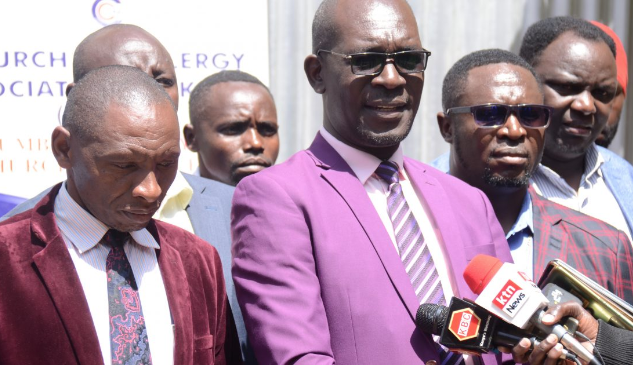
The Church and Clergy Association of Kenya has raised concern over what it describes as the growing negative influence of politicians on young people.
The association warned that the trend could have far-reaching consequences as the country approaches the 2027 General Election.
In a statement, the association’s national chairman, Hudson Ndeda, said the conduct of political leaders in recent months is setting a poor example for the youth, many of whom are closely observing and imitating their behaviour.
“The youth are watching and emulating bad behaviour by politicians,” Ndeda said. “I urge our leaders to exercise restraint and push for reforms and change in ways that align to the rule of law and adherence to common decency.”
Kenya is now less than fifteen months away from the next General Election scheduled for August 2027, a period that has traditionally been marked by heightened political activity.
Ndeda noted that the early onset of campaigns and political maneuvering is already raising the political temperature across the country.
“Our politicians know no bounds as they are busy campaigning and forming alliances and formations to the detriment of mwananchi,” he said.
The cleric pointed to recent public events as evidence of the deteriorating political culture, including an incident involving President William Ruto and his former deputy Rigathi Gachagua during the funeral of the late Ol Kalou MP David Kiaraho.
“The recent meeting of the president and his former deputy at the funeral was a clear indication of the current political picture,” Ndeda said. “Instead of mourning and respecting the family of the deceased, politicians took the stage and started attacking each other.”
He added, “It was sad to see that respected politicians took the opportunity to lash out at the president in a rather disrespectful way. This must stop because it is painting the country badly, especially to the international community.”
Ndeda cautioned that while the Constitution guarantees freedoms such as expression and political participation, leaders must recognise that such rights are not absolute and must be exercised responsibly.
“The Constitution of Kenya allows agitation and freedom of speech, but these politicians must understand that not all rights are absolute,” he said.
The clergy also expressed concern over rising rhetoric that could incite division and possible violence, warning against statements that seek to exclude leaders from certain regions based on political affiliation.
“When we see and hear a leader chest-thumping and threatening that some people should not go to a certain region because of their political ideology, we get worried because drumbeats of political violence are being invoked,” Ndeda said.
He called on the National Police Service to take firm action against leaders engaging in inflammatory rhetoric, urging law enforcement agencies to investigate and prosecute offenders.
“The police should be at the forefront to single out such politicians and charge them before a court of law,” he said.
Ndeda further criticised leaders who promote tribal politics, emphasizing the need for national unity.