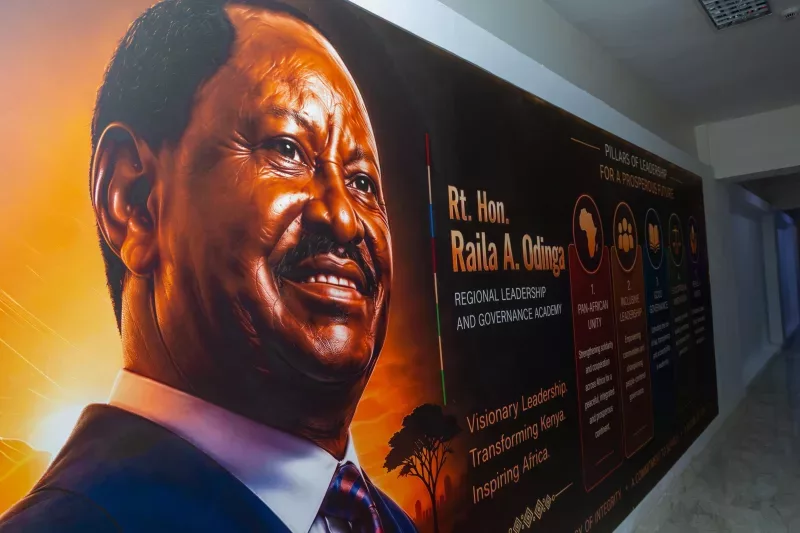
You wouldn’t hear it said loudly, especially when the enigmatic Raila Odinga was still alive, but in Luo Nyanza, the ODM party has sometimes been a tool of oppression, used to kill political careers, favour certain people and run a near-cartel where party primaries often ended in premium tears for many aspirants.
In fact, many people of Luo extraction who joined other parties, including UDA, did so following bitter disappointments with ODM nomination processes.
The second thing that is the worst-kept secret in that land is that following the death of Raila, no single individual now has the capacity or political skill to actually make decisions that will bind the community into a homogeneous political path.
Essentially therefore, those who run the party today will soon be rudely awakened to the reality that the perceived sins of ODM were easier to ignore when Raila reigned, because he enjoyed universal goodwill, but will not be accepted by the membership today.
This week, the trending debate revolved around a demand by some leaders in the broad-based faction of ODM that in their impending coalition deal with President Ruto’s UDA, ODM bases, specifically in their Luoland backyard, be zoned off in their agreement, so that UDA wouldn’t field candidates there.
This demand grew louder at a church function last Sunday, in Muhoroni constituency, Kisumu county, that was graced by ODM chairperson, Governor Gladys Wanga.
Even before the zoning demand caught more fire, that church function itself became a source of controversy, when local MP, James Onyango K’Oyoo, who had skipped it, issued a statement on a vernacular station, accusing Governor Wanga of disloyalty and ill motive, stating that the function was no more than an attempt by Wanga to install her brother as the next Muhoroni MP, adding that the ODM chairperson’s desire to create a “Nyasuna dynasty” in the mould of the Odinga one, would fall flat.
The Muhoroni MP, in a shocking escalation of the raging conflict in the broad-based wing of the party, concluded by warning the Luo community that Wanga would lead to its downfall, because of her brand of politics.
But beyond just the alleged desires of dynasties and zoning, this whole controversy soon included claims that the same cabal within the party was also demanding the sacking of Interior PS, Dr Raymond Omollo, as part of its growing list of pre-conditions for a deal.
Regardless of where the truth lay, all these emerging noises confirmed what many of us have always stated, especially on these pages. Following the death of Raila, a faction of the party moved with speed to install his brother, Dr Oburu Oginga, as the party leader.
There was no remarkable reason for this, other than that the Siaya Senator shares Raila’s surname, beside the fact that the party cartels wanted a soft avenue for self-perseveration, and Oburu offered the easy, malleable path to do that without creating the roadblocks that a younger individual, as party leader, would have.
This takes me back to my opening statement in this piece. The ODM party was formed twenty years ago from the momentum of the 2005 referendum, as a protest-fuelled pro-people social justice movement.
To its credit, and largely because of the larger-than-life profile of its departed leader, it sustained this role and grew into the biggest political movement in the country, with its peak performance being the 2007 elections, where, without forming a coalition, and depending on who you ask, it practically won the election.
But in its Luo Nyanza backyard, a common theme became what residents would later christen ting’ bada politics, in reference to the raising of the hand of sometimes weak candidates, by the party leader, or any of the myriad power brokers who supposedly had his ears.
In the process, many talented would-be leaders fell by the wayside, while some individuals of supremely embarrassing quality secured party tickets and went on to win elections. It is noteworthy that some of the victims of ODM’s violation of democratic tenets are today found in other parties, including President Ruto’s UDA.
It is therefore important to mention that for many of ODM leaders, zoning is merely a desire to create for themselves an enclave in which they and their close relatives would hoard party certificates and perpetuate a brand of political slavery that the new political order should and must overcome.
It is in fact inconceivable that the party would fall over itself trying to seek a marriage with UDA, then turn around and present a catalogue of conditions, while knowing well that it is the weaker partner in all this.
It is not as if the signs were never there. Even though Raila had run his party on a “gather all, scatter none” philosophy, after his death, the new sheriffs in town adopted a “discipline first” mentality, one in which divergent opinion was to be punished by removal from party positions.
Consequently, the new party leadership adopted an exclusion agenda which seemed geared towards the removal from the mainstream of anyone who didn’t agree with its positions.
The most famous face of the victims of this new method of running the party may be embattled secretary general, Senator Edwin Sifuna.
However, over the past few months, erstwhile dependable Raila servants like Governor Anyang’ Nyong’o of Kisumu, his Siaya counterpart James Orengo, Minority Whip in the National Assembly Millie Odhiambo, among others, have found themselves further and further away from the mainstream, as a small cabal tightens control.
The problem with any organisation where the strongest and most talented people are removed from the centre is that it soon finds itself left with weak loudmouths with no grassroots support or political backbone to sustain the rhetoric.
No less a person that the late Raila’s daughter, Winnie Odinga, spoke about this at the party’s recent SDC at the Jamhuri Showground, when she beseeched the party to be a movement that welcomes people instead of expelling them.
In my estimation, President Ruto, in negotiating with ODM, and specifically with the Luo community, has flatly been doing it with the wrong people. I hold that in the absence of Raila, Ruto should bypass ODM, use his own UDA networks and seduce the Luo vote directly.
In the alternative, he is better off engaging the truly respected community leaders like Governors Nyong’o and Orengo, who, at the risk of sounding monotonous, are the true ideological soulmates of Raila still standing.
In January, National Assembly Speaker Moses Wetangula told MPs that their attrition rate is about 56 per cent, meaning that more than half of MPs will not be returning to the next Parliament.
My assessment is that in Luoland, more than 80 per cent of them will not see the inside of Parliament after the 2027 elections. Which is to say that a large number of the MPs currently running around acting as broad-based government salesmen will soon be ex-MPs.
And it doesn’t stop there. Part of the alleged push by a faction of the ODM lawmakers for the removal of PS Omollo, quite shockingly, has to do with the national government projects, especially in Homa Bay county, usually attributed to his efforts, and which are said to make the local leaders who want to gatekeep elective politics very uncomfortable.
Indeed, the gripe the people have had for long with the broad-based faction is that at their meetings, the most regular rallying call is “we’ll stay in broad-based where Raila left us” without mentioning any progress made on key MOU agenda items.
In short, while President Ruto is said to be spending colossal amounts of money trying to sustain a semblance of colour and energy within his preferred ODM faction, the truth is that he is getting the short end of the stick.
The consensus from the ground on the zoning debate has been a firm no. There is a level of freedom enjoyed by the electorate right now, that broad-based ODM hasn’t noticed because it is still wrapped in Ruto’s state largesse and babysitting.
This freedom philosophy avers that with Raila gone, the Luo will pick their parties and leaders freely in 2027, and no one party will ever again be able to carve out the land for its own designs. The president will be well informed not to be swayed by weak blackmail from people who are just fifteen months away from political expiry.
Quite interestingly, ODM now suffers from its own mistakes. Not only did it push away some of its most popular leaders from the mainstream, but it began negotiations by weakening its own hands, in declaring early that it wasn’t interested in either the seat of President or Deputy President. With this lack of ambition, it turned itself into a wee movement whose party leader appeared content with being senator.
Coupled with the attempted removal of the party SG, the leadership effortlessly became an unwitting recruitment agent for Sifuna’s budding Linda Mwananchi Movement, whose luminaries have gleefully declared at every possible opportunity that they will field candidates for all seats, up to the presidency.
It beats logic why the Oburu-Wanga faction of ODM didn’t do the same, by declaring interest in the presidency then negotiating backwards. Indeed, the death of Raila has left behind a party bereft of ideas and strategy.
It is a wake up call to the new power brokers in ODM. They are not Raila Odinga. There are making promises they can’t keep, because they have no capacity.
Even with a zoning agreement, which would deny their partners UDA the opportunity to field candidates in perceived ODM zones but wouldn’t stop all other parties and independents from fielding, none of the leaders in the party will be able to defend their own seats while also moving across the land to defend others, like Raila would have done.
In short, they weakened their hands and lost the ability to present the lofty conditions they now attempt to. In the fullness of time, the people will teach them this simple lesson at the ballot. If Ruto bends to their whims and allows a zoning deal, there are many more parties waiting to harvest there.
At any rate, if the broad-based wing of ODM feels that it lacks the ability to face UDA in all ODM bases, perhaps its saving gracing will be to turn to the Linda Mwananchi faction of the party and ask Sifuna and his colleagues to take over and save the party’s soul. This option remains the most respectable.