Far from being an ordinary local race, the contest is evolving into a high-stakes political showdown that will test shifting loyalties and regional power dynamics.
Analysts and political observers say the outcome could redefine leadership in Mt Kenya and shape the trajectory of national politics ahead of future elections.
At the centre of the contest is a battle between Gachagua’s grassroots networks and Ruto’s incumbency advantage, backed by state machinery. The by-election is widely seen as a litmus test of whether Gachagua still commands significant loyalty in a region that was pivotal to Ruto’s rise to power.
Political analyst Fred Sasia argues that for the President, the Ol Kalou race goes far beyond the question of a single parliamentary seat.
“The President has been working to consolidate support through development pledges and strategic alliances, positioning himself as the region’s primary political anchor,” Sasia said.
“Meanwhile, Gachagua has framed the by-election as a resistance moment, urging voters to reject what he portrays as political betrayal and marginalisation of Mt Kenya interests in government.”
The rivalry between the two leaders has intensified in recent months following their political fallout, turning what was once a united front into competing centres of influence.
In Ol Kalou, that rivalry is expected to play out directly at the ballot box.
Recent political developments in Mbeere North have only heightened the stakes. In that by-election, Ruto and his current deputy, Kithure Kindiki, delivered a decisive victory against candidates associated with Gachagua’s camp.
The outcome was widely interpreted as a demonstration of the Ruto-Kindiki team’s organisational strength and ability to mobilise voters in Mt Kenya East, an area previously perceived to lean toward Gachagua.
The Mbeere North result not only boosted Kindiki’s profile as a regional mobiliser but also signalled a possible shift in the balance of power.
It emboldened Ruto’s allies, who now head into Ol Kalou with renewed confidence and a narrative that Gachagua’s influence may be waning beyond select strongholds.
Speaking ahead of the Ol Kalou contest, Kindiki struck a combative tone, directly challenging Gachagua’s political standing.
“He came chest-thumping in Mbeere North, I floored him. Just wait, there is a by-election coming in Ol Kalou, we will meet there,” Kindiki said. “I will floor him badly. That is where he will learn to respect me.”
Gachagua, however, has in the past dismissed suggestions that the Mbeere North outcome reflects his political strength, noting that his party did not field a candidate in that race despite his visible presence during the campaigns.
The former Deputy President has remained defiant, insisting that his support base in Mt Kenya remains intact, even strengthened, following his impeachment.
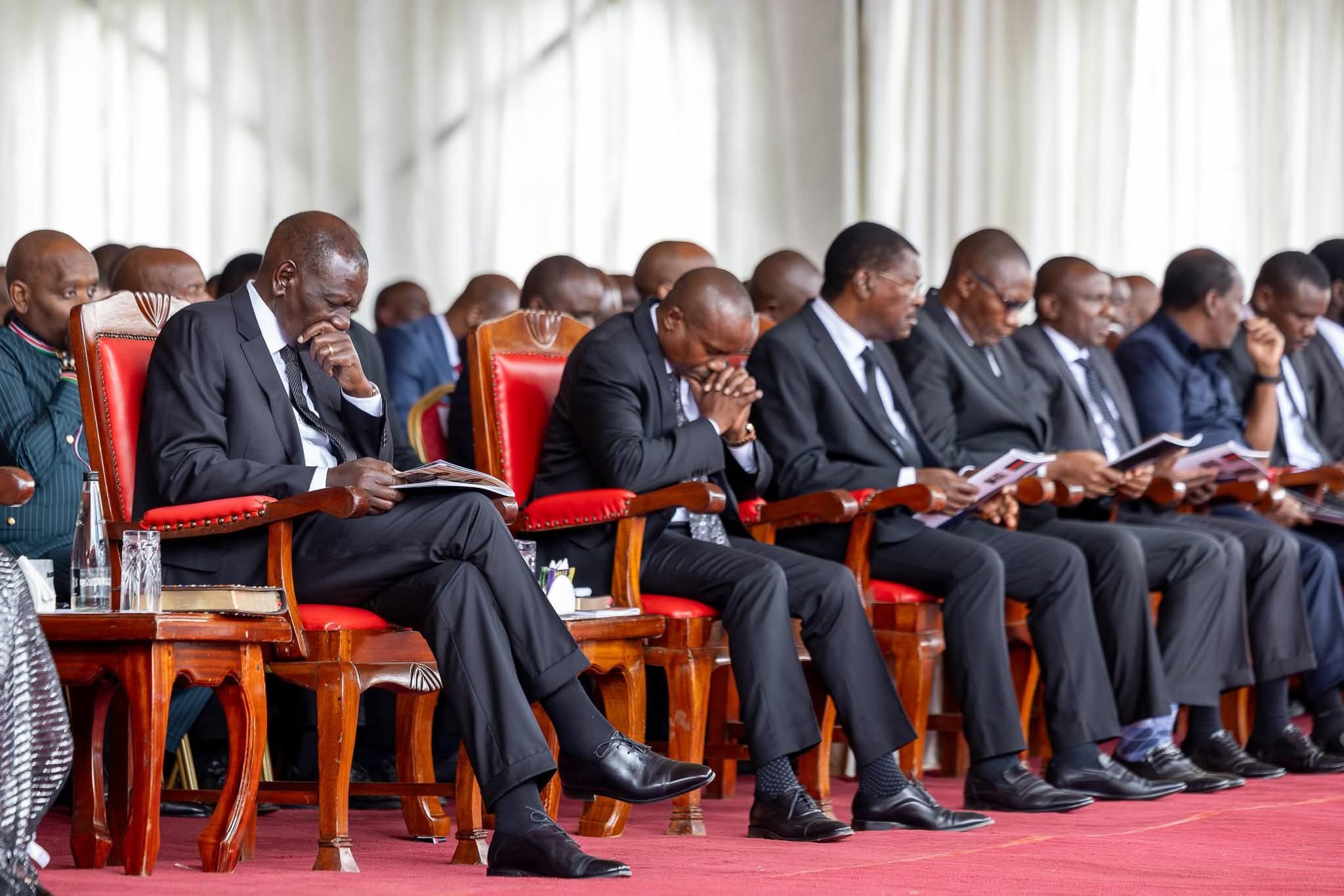
Speaking during the requiem service of the late Ol Kalou MP David Njuguna Kiaraho, Gachagua declared that his connection with the region’s electorate could not be erased.
“Mr President, you impeached me, but you did not remove me from the hearts of these people,” he said, in remarks that drew applause from sections of the crowd. “Mt Kenya people still love me, and even more after what happened.”
Ruto took a more restrained approach, choosing to emphasise development and service delivery over direct political confrontation. Addressing mourners at the same event, the President promised to prioritise infrastructure and healthcare projects in the constituency.
He pledged to complete stalled road projects and support the construction of a Level 4 hospital in Ol Kalou, responding to long-standing demands from residents.
“They have spoken on me, but I will not respond here. I will only come here to respond to development,” Ruto said.
He added that any political differences with Gachagua’s camp would be addressed in the appropriate forums, rather than at solemn public gatherings.
Despite this measured tone, analysts say the by-election remains a critical moment for both leaders.
According to political analyst Samuel Owida, the contest offers Gachagua a rare opportunity to directly confront Ruto’s dominance in the region.
“The Ol Kalou by-election will provide a perfect opportunity for Gachagua to prove that he has completely edged out President William Ruto politically at the heart of Mt Kenya,” Owida said.
“The task is to demonstrate that he has convinced residents of the region to abandon supporting the President.”
Gachagua’s recent political strategy has involved selective participation in by-elections. In Mbeere North, his DCP party ceded ground to Justin Muturi’s Democratic Party candidate, while in Malava he withdrew his candidate to support DAP K leader Eugene Wamalwa’s ally, Seth Panyako.
Ol Kalou, however, is expected to be different. Observers say Gachagua will likely field a candidate directly aligned with his camp, setting up a clear contest against Ruto’s UDA.
Political commentator Joseph Mutua describes the race as a “mini-referendum” on the country’s current leadership.
“For William Ruto, it is a test of national popularity,” he said. “A win for his aligned candidate suggests his support base is still solid, especially in the Mt Kenya region. But a loss could signal weakening influence in a region that was crucial to his 2022 victory.
“For Rigathi Gachagua, this is home turf pressure. The outcome reflects directly on his influence. A strong showing boosts his bargaining power in any future coalition negotiations.”
As campaigns loom, the Ol Kalou by-election is increasingly being viewed as more than a local political event. It is a defining moment that could either reaffirm Ruto’s dominance in Mt Kenya or signal the rise of Gachagua as a formidable force in the region.