
High financial demands are the leading reason citizens decline to pay bribes when accessing public services, according to findings from the National Gender and Corruption Survey 2025.
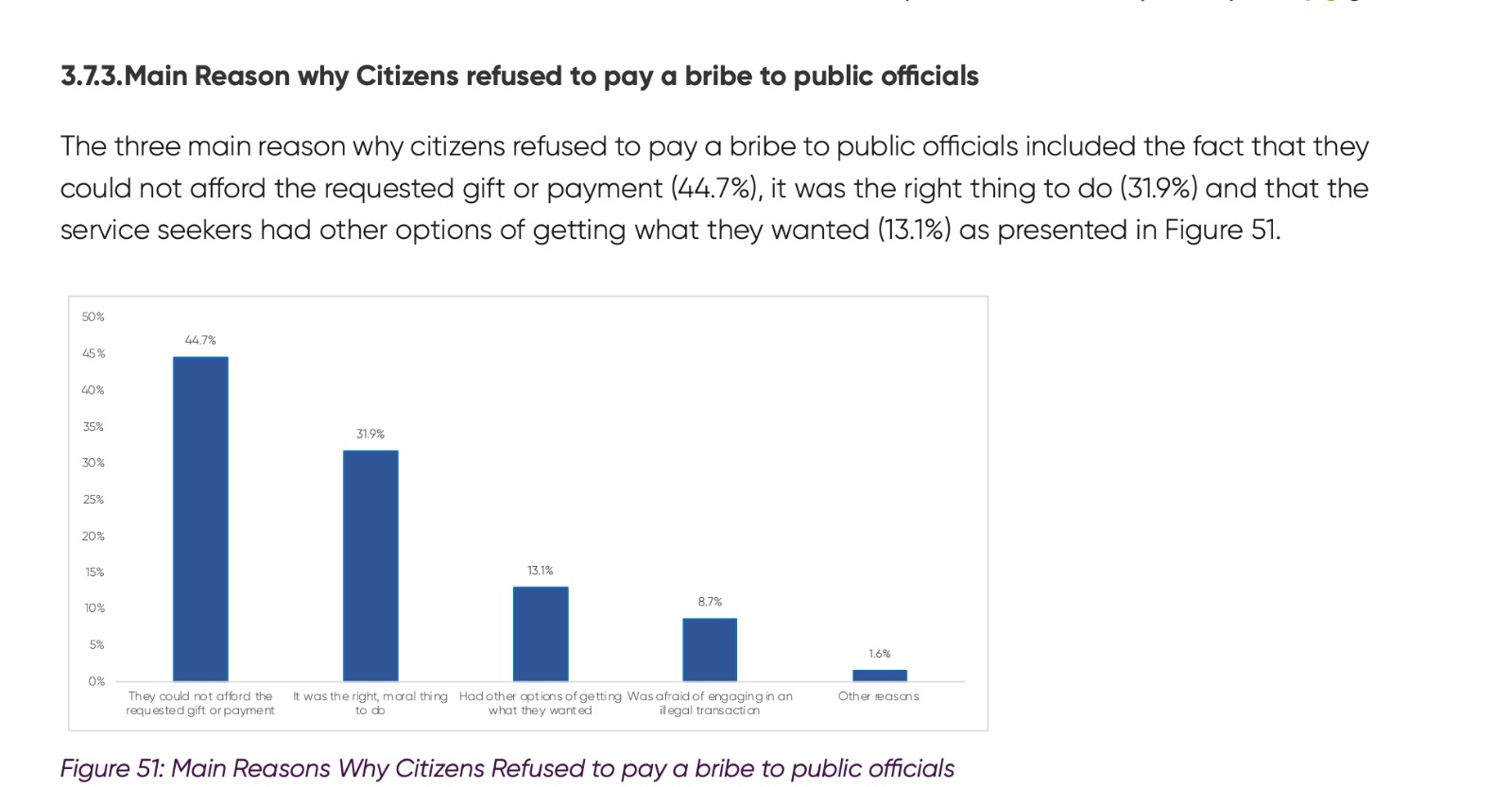
The survey indicates that 44.7 per cent of respondents who refused to pay bribes said they could not afford the requested amount or gift, making cost the most common deterrent to engaging in such transactions.
A further 31.9 per cent said they declined because they believed it was the right thing to do, reflecting what the report describes as a growing sense of civic responsibility and ethical resistance to corruption in public service delivery.
Another 13.1 per cent of respondents said they were able to access services through alternative channels without paying a bribe. This suggests that the availability of alternative service pathways or informal networks may reduce exposure to corrupt demands.
Fear of participating in an illegal transaction accounted for 8.7 per cent of responses, indicating that legal awareness and concern about possible consequences also influence decisions, although to a lesser extent than financial constraints and ethical considerations. A further 1.6 per cent cited other unspecified reasons for refusing to pay bribes.
The findings were released during the launch of the National Gender and Corruption Survey 2025, a nationwide study examining how citizens interact with public officials in the delivery of services across Kenya’s 47 counties.
The survey was conducted in collaboration between the Ethics and Anti-Corruption Commission (EACC), the United Nations Office on Drugs and Crime – Regional Office in Eastern Africa (UNODC-ROEA), the National Gender and Equality Commission (NGEC), the Kenya National Bureau of Statistics (KNBS), and Transparency International Kenya.
Data was collected through household questionnaires administered via face-to-face Computer-Assisted Personal Interviewing (CAPI).
The study used a nationally representative sample drawn from 1,467 clusters of Kenyan adults aged 18 years and above, selected proportionately from all counties based on the 2019 Population and Housing Census.
Out of 22,005 households sampled, 21,941 were reached, while 16,858 households completed interviews, providing a dataset used to analyse corruption trends and citizen behaviour.
The report notes that understanding why citizens refuse to engage in bribery is important in shaping anti-corruption strategies, particularly in designing interventions that strengthen ethical awareness, reduce financial pressure, and expand access to transparent public service delivery channels.
Researchers involved in the study say the findings point to a dual reality: while economic pressure remains a major barrier for many citizens, a significant proportion are increasingly guided by personal ethics in rejecting requests for bribes.







