The Kenya National Gender and Corruption Survey 2025 reveals that individuals seeking employment in government institutions pay the highest average bribe, estimated at Sh85,033, making public sector jobs the most costly interaction with state services.
This is followed by securing government contracts through public procurement, where applicants reportedly part with an average of Sh24,020, highlighting continued concerns over procurement integrity and access to state tenders.
Other high-cost services include obtaining a passport, where citizens pay about Sh12,514, reflecting persistent bottlenecks in critical identity and travel documentation systems.
The survey shows that even essential administrative processes carry unofficial costs.
Seeking a building permit costs an average of Sh5,933, while admission into a public school institution attracts about Sh5,418 in informal payments.
Those seeking release from jail or prison reportedly pay around Sh5,189, underscoring corruption pressures within the justice chain.
Tax-related services are also affected, with citizens paying an average of Sh4,696 for declarations or exemptions, while public utility services attract about Sh3,536 in bribes.
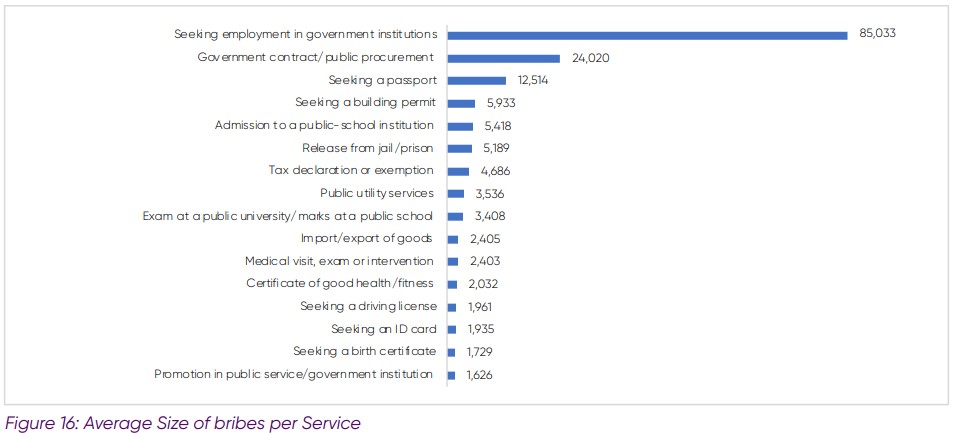
In education-related assessments, such as examinations at public universities or marks at public schools, the average bribe stands at Sh3,408.
Import and export processes cost about Sh2,405, while medical visits, examinations or interventions average Sh2,403, pointing to corruption risks even in health services.
Smaller but still significant payments are recorded in certification processes.
A certificate of good health or fitness costs around Sh2,032, while obtaining a driving license costs about Sh1,961.
At the lower end of the scale, administrative identity services remain relatively cheaper but are still burdened by corruption.
Obtaining a national ID card costs about Sh1,935, while a birth certificate averages Sh1,929.
The least expensive reported bribes are linked to promotion within government institutions, averaging Sh1,626, though the report notes that even these “small payments” reflect systemic weaknesses in public service delivery.
Experts say the variation in bribery amounts reflects both the perceived value of services and the level of gatekeeping involved.
High-demand opportunities such as government jobs and procurement contracts attract higher illicit payments due to competition and limited transparency.
The survey warns that these costs disproportionately affect low- and middle-income Kenyans, who are often forced to borrow or deplete savings to access essential services or opportunities.
Despite ongoing anti-corruption reforms, the findings suggest that bribery remains deeply embedded across both critical and routine public services, turning what should be rights-based access into a costly transaction system.
The survey was conducted by the EACC in collaboration with the United Nations Office on Drugs and Crime-Regional Office in Eastern Africa (UNODC-ROEA), the National Gender and Equality Commission (NGEC), the Kenya National Bureau of Statistics (KNBS), and Transparency International Kenya.
It examined citizens’ interactions with public officers in the delivery of public services across all 47 counties using household questionnaires administered through face-to-face Computer-Assisted Personal Interviewing (CAPI) with a nationally representative sample of 1,467 clusters of Kenyan adults aged 18 and above drawn proportionately from all counties based on the 2019 population census.
Out of 22,005 households sampled, 21,941 households were reached with 16,858 successfully interviewed.
The survey adopted a cross-sectional mixed-methods design, combining quantitative and qualitative approaches, with data collected at a single point in time from Kenyan adults aged 18 and above.