Kenyans are paying significantly higher bribes within the justice system compared to other public services, a new report has revealed.
According to the 2025 Kenya National Gender and Corruption Survey, commissioned by the Ethics and Anti-Corruption Commission (EACC), magistrates in courts receive the highest average cash bribes at Sh164,367, higher than all other public officials covered in the study.
The findings show that the amounts reported for magistrates are higher than those recorded in other sectors assessed in the survey.
In comparison, the lowest average cash bribe of Sh1,415 is paid to civil registration officials, indicating variation in bribery levels across government services.
Land registry officers rank second, receiving an average of Sh17,996 in bribes, followed by elected representatives from county governments at Sh13,038.
Immigration officers and prosecutors are also among public officials recorded as receiving relatively high average bribes, according to the survey.
The data further shows that police officers, teachers, and officials from the National Transport and Safety Authority (NTSA) are among those frequently reported to have been bribed, although the average amounts are lower than those recorded in the judiciary and land-related services.
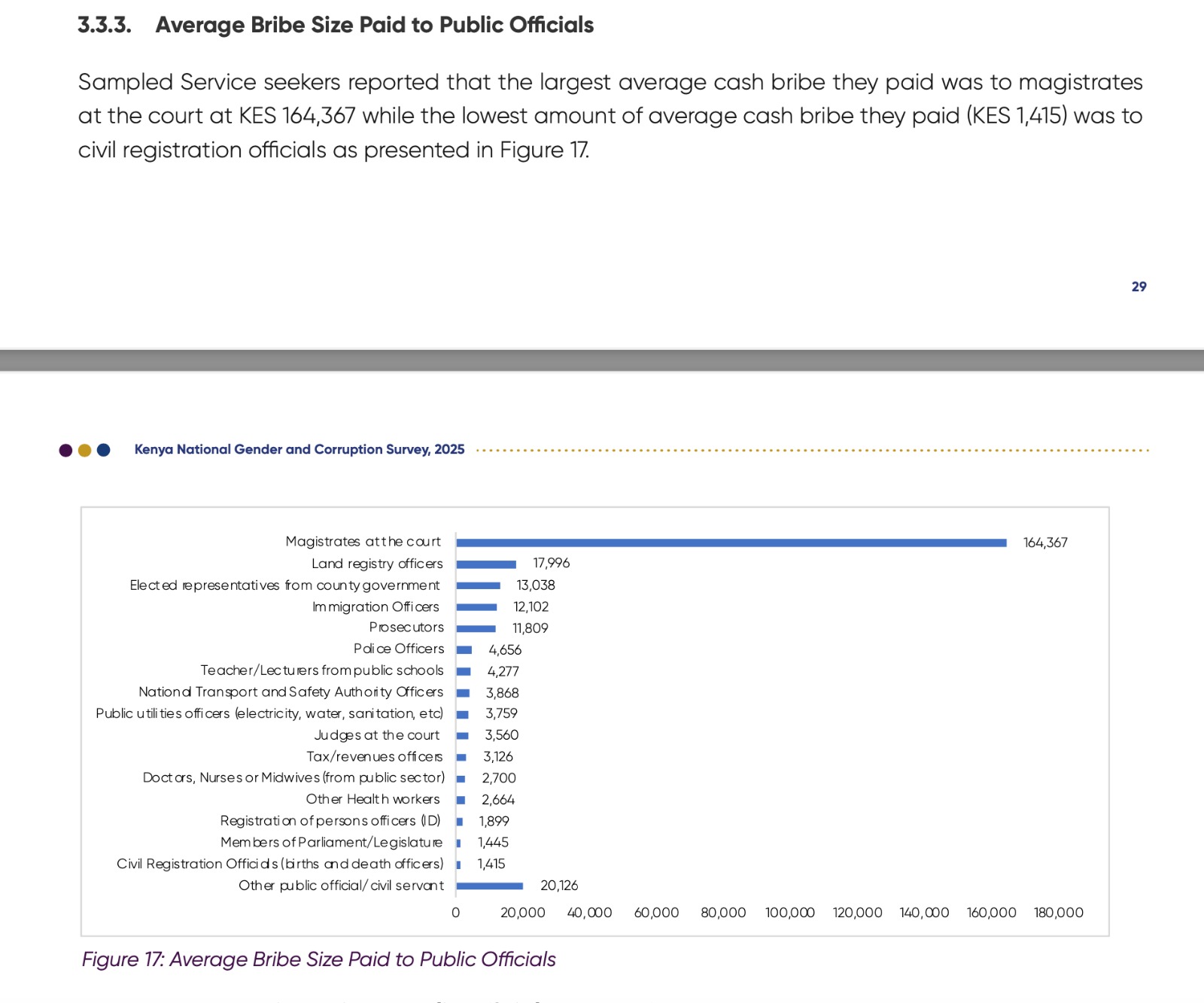
Judges, tax officials, public health workers, and utility service providers are also included in the survey findings, reflecting reported bribery across multiple sectors.
Despite these variations, the report indicates that the financial burden of bribery is nearly equal between men and women.
On average, men pay Sh6,748 while women pay slightly less at Sh6,702, suggesting minimal variation by gender in the reported cost of bribery.
Age differences are also reflected in the findings. Respondents aged 65 years and above reported the highest average bribe at Sh30,342, while those aged between 18 and 24 years reported the lowest at Sh3,256.
The report notes that these differences may relate to the types of services accessed by different age groups.
Geographical differences were also recorded, with rural residents reporting higher average bribes than urban residents.
Rural respondents reported an average of Sh7,502, compared to Sh5,603 among urban respondents.
In the private sector, the survey shows that doctors received the highest average reported bribes at Sh5,164, followed by teachers at Sh5,020 and nurses at Sh3,366.
Gender differences were also recorded in private sector interactions, with women more likely to report bribing employees in private insurance companies and banks, while men were more likely to report bribing teachers in private schools and medical staff in private hospitals.
The survey was conducted by the Ethics and Anti-Corruption Commission in collaboration with the United Nations Office on Drugs and Crime – Regional Office in Eastern Africa (UNODC-ROEA), the National Gender and Equality Commission (NGEC), the Kenya National Bureau of Statistics (KNBS), and Transparency International Kenya.
It examined citizens’ interactions with public officers in the delivery of public services across all 47 counties using household questionnaires administered through face-to-face Computer-Assisted Personal Interviewing (CAPI), with a nationally representative sample of 1,467 clusters of Kenyan adults aged 18 and above drawn proportionately from all counties based on the 2019 population census.