 ILLUSTRATION/AI
Kenyans seeking public services continue to grapple with a costly web of corruption, as new data exposes not only the sectors most affected but also the counties where bribery is most deeply entrenched.
The Kenya National Gender and Corruption Survey 2025 shows that corruption in the country is neither random nor evenly distributed.
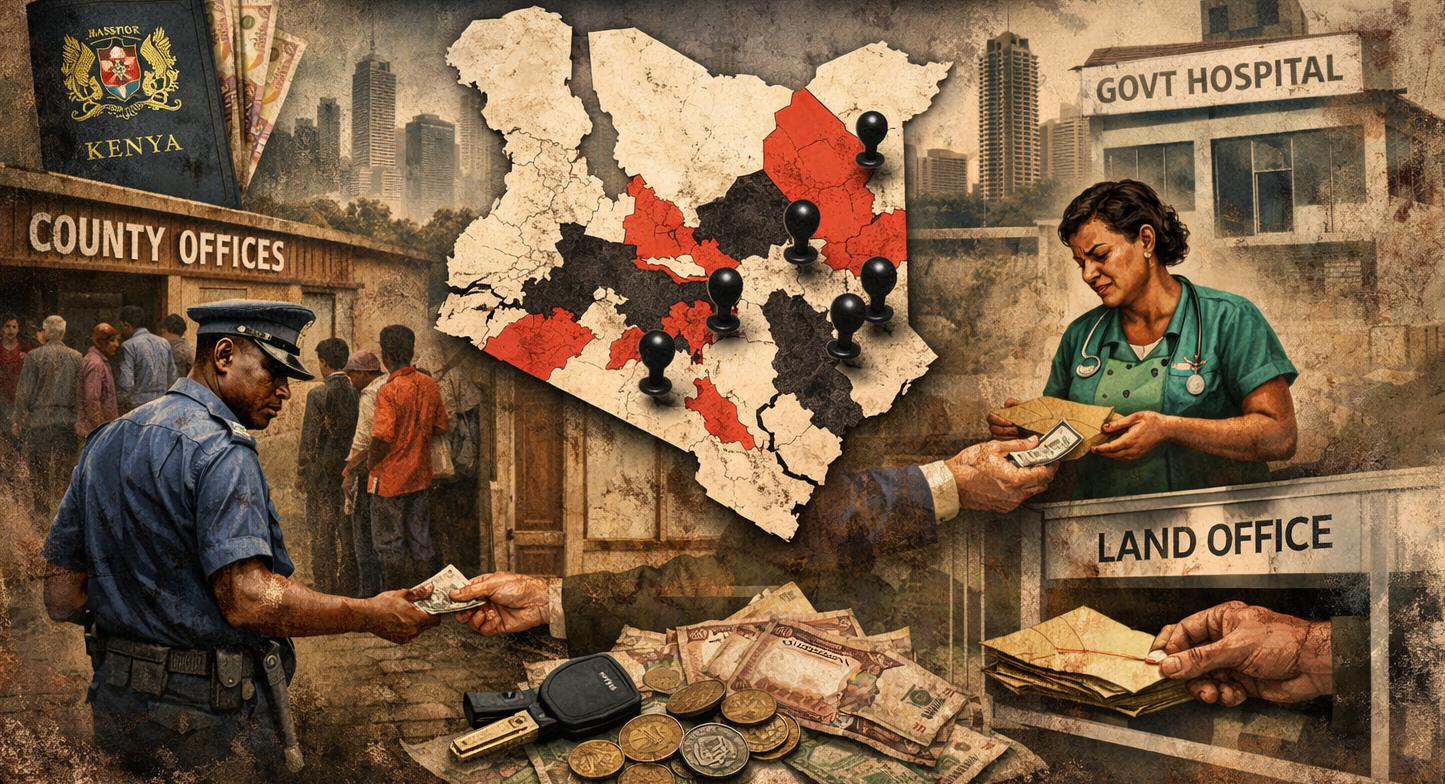
Instead, it is concentrated in critical service points, particularly law enforcement, land administration and health, where urgency, discretion and bureaucratic delays create fertile ground for bribery.
Police services top the list of bribery hotspots, accounting for a significant share of reported incidents.
Encounters with traffic officers, arrests and routine checks are among the most cited situations where informal payments are demanded.
For many motorists and ordinary citizens, bribery has become a near-normalised part of avoiding fines or expediting release.
Land offices follow closely, with citizens seeking title deeds, transfers and dispute resolution reporting some of the highest bribe values.
The report links this to complex procedures and long waiting times, which push applicants to “facilitate” services.
Health facilities, though essential, also feature prominently.
Patients report paying extra to access treatment, secure beds or bypass queues, an issue that disproportionately affects vulnerable households.
“Corruption is concentrated in sectors where citizens have limited alternatives and urgent needs,” the report notes.
Urban counties, particularly those with high population density and economic activity, record higher prevalence rates of bribery.
Major urban centres such as Nairobi, Mombasa and Kisumu emerge as key hotspots, largely due to the volume of interactions between citizens and public institutions.
However, some smaller counties also report high bribery incidence, especially in services tied to land and local administration.
In these regions, weak oversight and limited transparency in county systems have been cited as contributing factors.
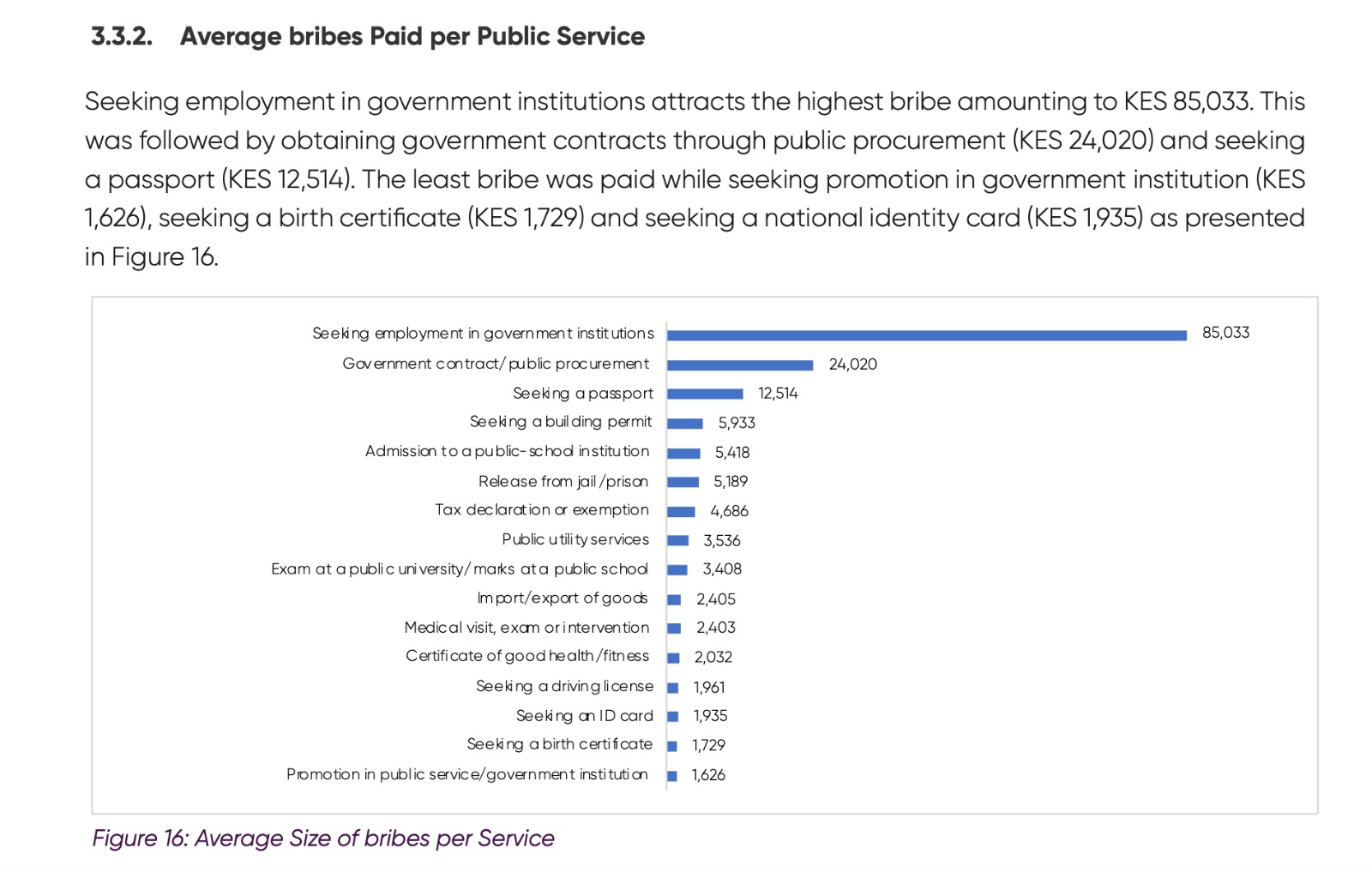
The data further shows that the average bribe size varies by sector, with land-related services and procurement-linked interactions attracting higher payments compared to routine services like licensing.
Meanwhile, the frequency of bribery is highest in policing, where repeated interactions increase the likelihood of demands.
“Where systems are complex and accountability is weak, corruption thrives,” the report observes, pointing to structural inefficiencies that enable rent-seeking behaviour.
For many Kenyans, the cost of bribery is not just financial but also social.
Low-income households bear a disproportionate burden, often spending a larger share of their earnings on informal payments.
In some cases, they are forced to forgo essential services altogether when they cannot afford to pay.
The survey also reveals that despite widespread awareness of corruption, reporting remains low.
Fear of retaliation, lack of trust in institutions and the perception that no action will be taken discourage many from coming forward.
Efforts to curb corruption through digitisation and policy reforms have shown some promise, particularly in reducing face-to-face interactions.
However, the report cautions that technology alone is not enough without strong enforcement and accountability mechanisms.
It recommends targeted interventions in high-risk sectors and counties, including streamlining procedures, strengthening oversight institutions and enhancing transparency at both national and county levels.
Equally important is protecting whistleblowers and rebuilding public confidence in reporting systems.
The survey was conducted by the EACC in collaboration with the United Nations Office on Drugs and Crime-Regional Office in Eastern Africa (UNODC-ROEA), the National Gender and Equality Commission (NGEC), the Kenya National Bureau of Statistics (KNBS), and Transparency International Kenya.
It examined citizens’ interactions with public officers in the delivery of public services across all 47 counties using household questionnaires administered through face-to-face Computer-Assisted Personal Interviewing (CAPI) with a nationally representative sample of 1,467 clusters of Kenyan adults aged 18 and above drawn proportionately from all counties based on the 2019 population census.
Out of 22,005 households sampled, 21,941 households were reached, with 16,858 successfully interviewed.
The survey adopted a cross-sectional mixed-methods design, combining quantitative and qualitative approaches, with data collected at a single point in time from Kenyan adults aged 18 and above.
The survey adopted a cross-sectional mixed-methods design, combining quantitative and qualitative approaches, with data collected at a single point in time from Kenyan adults aged 18 and above using CAPI on CSPro-enabled tablets, complemented by 20 Focus Group Discussions across 10 counties.
Seven Key Informant Interviews, and secondary data, while a two-stage stratified cluster sampling design based on the Kenya Household Master Sample Frame produced a nationally representative sample of 22,005 households, with data cleaned, validated, and triangulated to support gender-disaggregated analysis.