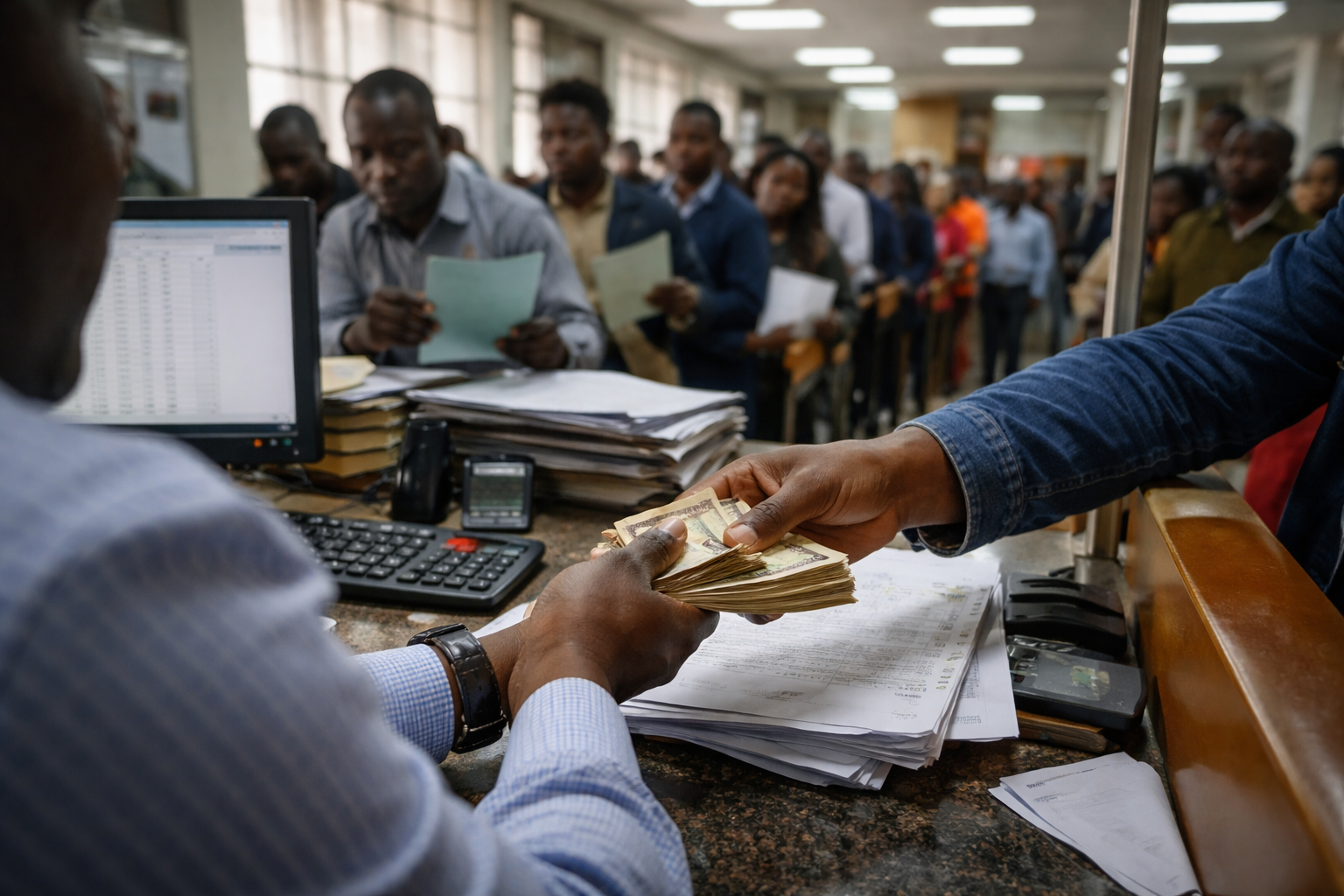
 The survey showed that male service seekers paid a slightly higher average bribe of Sh6,748 compared to women (Sh6,702). /AI ILLUSTRATION
The national average bribe paid to public officials in Kenya has more than doubled over the past two decades, from an average of Sh3,257 in 2005 to Sh6,724 in 2025, the National Gender and Corruption Survey 2025 shows.
The trend shows that the average bribe spiked to its highest level ever in 2023 to stand at Sh11,625 before dropping drastically to Sh4,878 in 2024.
The lowest average bribe was recorded in 2007 (Sh2,711) before it rose steadily to Sh7,081 in 2016, then dropped down to Sh3,833 in 2018.
It stood at Sh5,890 in 2021 and Sh6,865 in 2022 before shooting astronomically to the record Sh11,625 in 2023.
According to the survey, seeking employment in government institutions attracts the highest bribe of Sh85,033, followed by obtaining government contracts through public procurement at Sh24,020.
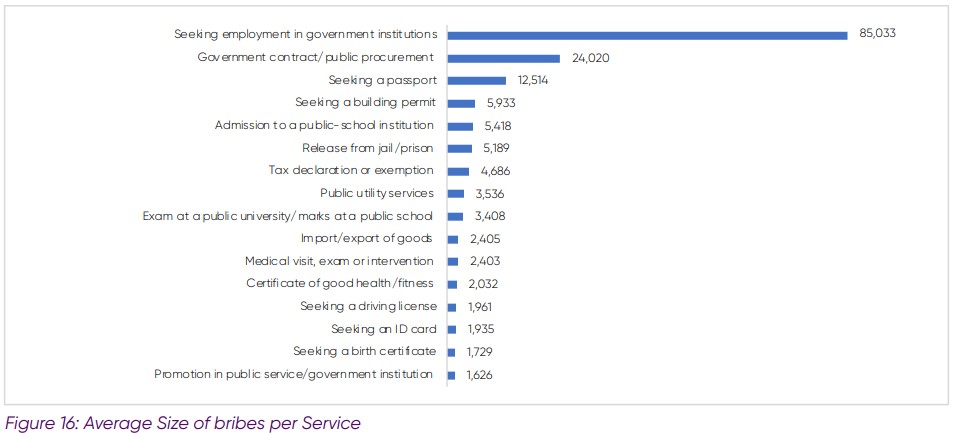
Respondents reported that they had to part with an average of Sh12,514 when seeking a passport, while the least bribe was paid when seeking promotion in a government institution (Sh1,626).
They claimed civil registration officials demanded an average of Sh1,729 for a birth certificate and Sh1,935 for a national identity card, while those seeking a driving licence had to part with an average of Sh1,961.
The average bribe, by size, paid to National Transport and Safety Authority (NTSA) officers was Sh3,868.
Respondents said school principals and head teachers demanded an average of Sh5,418 to secure admission for their children to a public school, while students said they had to part with at least Sh3,408 to be allowed to sit an exam at a public university or receive their marks.
Teachers and lecturers in public schools and universities demanded an average of Sh4,277.
Individuals being released from jail were not spared either. Their freedom, even after serving time or paying requisite fines, reportedly attracted an average of Sh5,189.
The survey was conducted by the Ethics and Anti-Corruption Commission in collaboration with the United Nations Office on Drugs and Crime – Regional Office in Eastern Africa (UNODC-ROEA), the National Gender and Equality Commission (NGEC), the Kenya National Bureau of Statistics (KNBS), and Transparency International Kenya.
It examined citizens’ interactions with public officers in the delivery of public services across all 47 counties using household questionnaires administered through face-to-face Computer-Assisted Personal Interviewing (CAPI).
A nationally representative sample of 1,467 clusters of Kenyan adults aged 18 and above, drawn proportionately from all counties based on the 2019 population census, was used in the survey.
Out of 22,005 households sampled, 21,941 households were reached, with 16,858 successfully interviewed.
In terms of the average bribe size paid to public officials, sampled service seekers reported that the largest average cash bribe they paid was Sh164,367 to magistrates, while the lowest amount of average cash bribe they paid was Sh1,415 to civil registration officials.
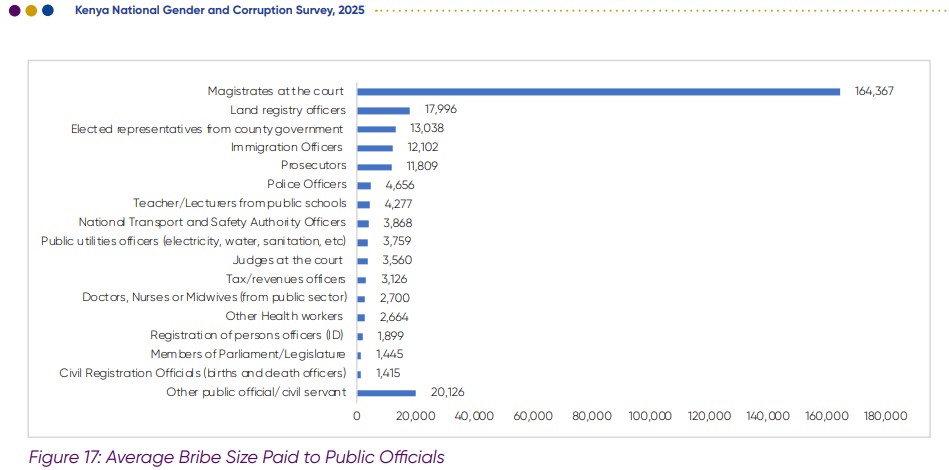
Land registry officers demanded an average bribe of Sh17,996, the second highest after magistrates, judges, Sh3,560; prosecutors, Sh11,809; police officers, Sh4,656; and revenue officers, Sh3,126.
Surprisingly, Members of Parliament asked for an average bribe of Sh1,445 compared to Sh13,038 demanded by elected representatives from county governments.
The survey shows that immigration officers, on average, asked for Sh12,102, while public utilities officers entrusted with offering services like electricity, water and sanitation demanded Sh3,759.
Doctors, nurses and midwives in public health institutions demanded an average of Sh2,700, while other health workers asked for Sh2,664 to render services.
The survey showed that male service seekers paid a slightly higher average bribe of Sh6,748 compared to women (Sh6,702).
Respondents aged 65 years or more reported paying the largest average cash bribe of Sh30,342, while young persons aged 18–24 reported paying the lowest amount, estimated at Sh3,256.
More than half of bribes (51.8 per cent) paid in 2025 were below Sh1,500. Eighteen per cent ranged between Sh1,500 and Sh2,499, and 11.7 per cent ranged from Sh2,500 to Sh4,999.
Nine per cent of bribes ranged from Sh5,000 to Sh9,999, 8 per cent from Sh10,000 to Sh49,999, while 1.1 per cent of the bribes were between Sh50,000 and Sh99,999, and about one per cent were more than Sh100,000.
The three main reasons why service seekers paid bribes were to speed up procedures (32.1 per cent), the fact that it was the only way to access the service (27.8 per cent), and to avoid problems with authorities (12.2 per cent).
The desire to make finalisation of procedures possible was another motivator at 11.1 per cent, followed by avoiding paying fines at 5.7 per cent.