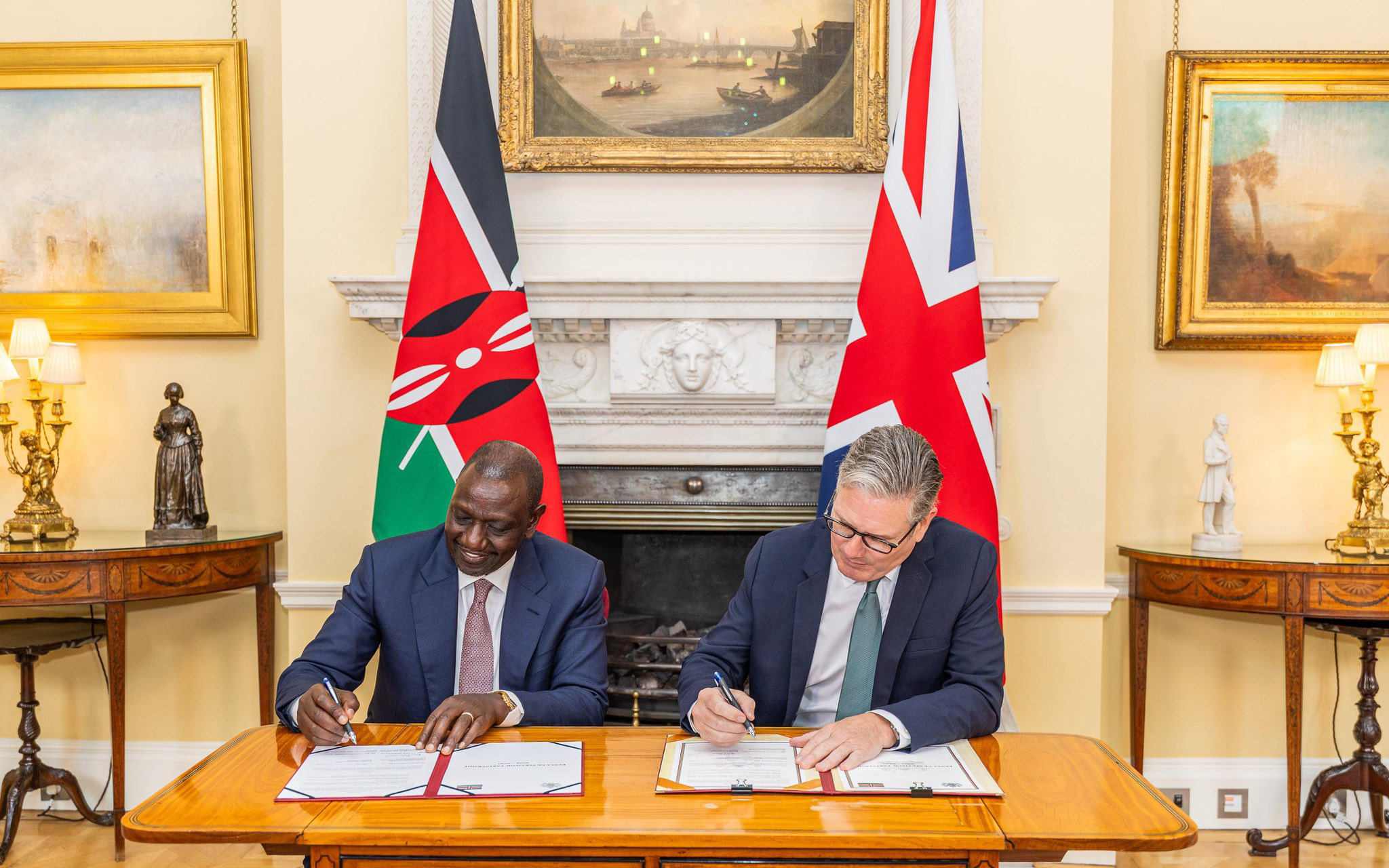
 President William Ruto and UK Prime Minister Keir Starmer signing the pacts in London during the bilateral meeting /PCS
It may not yet rank among the top-tier global financial hubs like London, New York or Singapore, but Nairobi is often viewed as a rising investment destination due to its strategic location, expanding economy and vibrant entrepreneurial ecosystem.
The city is a leading African emerging market, particularly in sectors such as technology, finance, real estate and infrastructure.
Knight Frank’s Africa Report 2023, highlights Nairobi as a major real estate destination, with strong growth in commercial and residential property markets.
But congestion and chaos have characterised Nairobi for decades. The city is often hot or flooded, crowded, untidy and noisy.
An afternoon drizzle on a weekday can bring one of Africa’s most important metropolises to a near standstill.
Now, these conditions are about to change as the capital city is on the cusp of a major transformation that will significantly raise its profile. The Central Business District will soon be turned into a gleaming, ultra-modern centre for business, transport and residence.
This ambitious vision is rooted in the Nairobi Railway City (NRC) project, which has been in development for over six years.
On January 20, 2020, former President Uhuru Kenyatta and former British Prime Minister Boris Johnson met to discuss the initiative at the UK-Africa Investment Summit in London.
Since early 2020, the UK government has funded a team of urban development experts to assist Kenyan agencies in realising the NRC. Their support includes a review of the master plan, land due diligence, identification of priority projects, a feasibility study, detailed design, engineering and cost analysis.
President William Ruto discussed the project with UK Prime Minister Keir Starmer during a high-level meeting in London last July, following Cabinet approval in June.
“This will create wealth and jobs, delivering tangible economic benefits. It will be transformative; improving mobility, stimulating growth and fostering prosperity across the Nairobi Metropolitan area,” the President said after the meeting.
Kenya Railways Corporation managing director Philip Mainga told the Star preparations are underway, with the contractor ready to commence work on the Sh30 billion project.
“The railway city will be built. There is no turning back.”
The project is of strategic national importance and forms part of the core strategy for regeneration of Nairobi, creating a balance between social benefits for the city and economic returns.
The NRC will occupy 438 acres adjacent to Nairobi’s Central Business District. Its goal is to establish a sustainable, transit-oriented urban hub that revitalises underutilised railway land.
Designed as a model for inner-city renewal, the project aims to enhance economic and social development while addressing congestion and housing shortages. It aligns with Kenya’s Vision 2030 and other national urban and transport master plans.
The Nairobi Railway City centres around the historic Nairobi Central Railway Station, a key node in the country’s rail network. The project includes modernising the station to accommodate an estimated 400,000 daily passengers by 2030, rising to 600,000 by 2045.
Designated as a Special Planning Area in February 2020 and gazetted as a Project of Strategic National Importance in May 2021, the master plan was approved in August 2023.
The NRC incorporates sustainable urban planning, multimodal transport systems and climate resilience strategies.
According to the plan, the new city aims to decongest Nairobi by expanding and restructuring the CBD.
It will generate new trading opportunities, stimulate real estate development, and create jobs—5,000 during construction and a further 5,000 in the initial phase.
Transport integration will be a key feature, with facilities for commuter rail, public service vehicles, Bus Rapid Transit, Light Rail Transit, and non-motorised transport such as pedestrian walkways.
The project aspires to serve as a model for climate-resilient urban regeneration, incorporating low-carbon buildings, green spaces and sustainable infrastructure.
The NRC is organised into six precincts, each with distinct functions:
MICE Core: Covering 66.72 acres, this zone will host Meetings, Incentives, Conferences, and Exhibitions facilities, alongside high-grade offices, retail outlets, hotels, and apartments. The first phase will span 14 acres, fulfilling 15 per cent of projected demand for MICE services.
Central Station Back: A vibrant commercial hub designed to promote land value appreciation, job creation and economic growth.
Sustainable Housing: Providing 10,000 affordable housing units, complemented by community centres, fire stations, recreational areas and mixed-use commercial spaces.
West Core: A centre for culture, innovation, research and employment, featuring mixed-use developments, student accommodation and cultural heritage sites.
Central Station Front: A multi-modal transport and employment centre incorporating a modern railway station, open public spaces, and retail services.
Market Core: An inclusive market precinct that emphasises social integration, infrastructure, and economic opportunities, while preserving heritage and green spaces.
The new Central Station, the project’s flagship development, is scheduled for completion by July 2027.
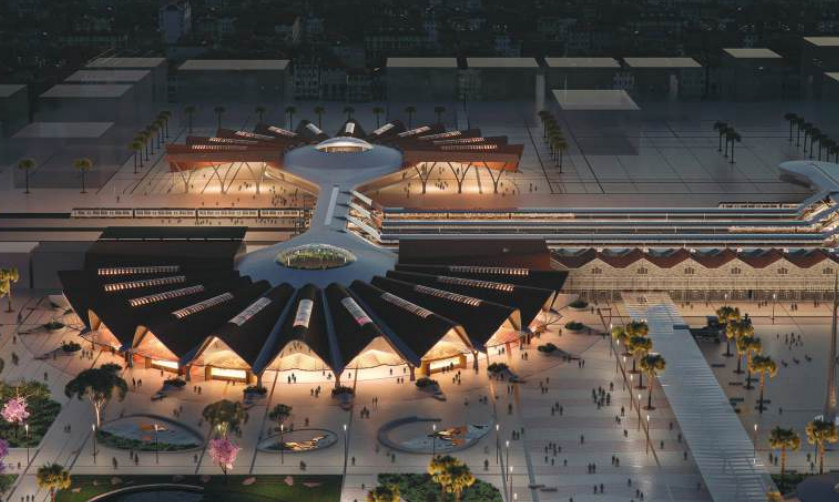 An architectural impression of the Nairobi Railway City project
It will integrate commuter rail, BRT, pedestrian bridges, and non-motorised transport corridors.
The development will deliver 10,000 housing units, including social housing for low-income groups, middle-income urban dwellings and high-end homes for professionals.
It will also feature purpose-built student accommodation for 2,500 students on 1.57 acres within the NRC, alongside transit-oriented housing options for Nairobi’s expanding young professional population.
A government precinct will comprise 500,000 square feet of modern office space to house ministries, departments, agencies, SMEs, NGOs and corporate entities.
The BRT system is a vital component of the integrated transport framework, designed to alleviate traffic congestion. It includes the 80km Line 3 (Tala-Dandora-KNH-Ngong) and the 30.8km Line 4 (from Mama Lucy Hospital to Kikuyu via the CBD).
Funding for the construction of the new Central Station and public realm development is provided by the government under a memorandum of understanding with UK Export Finance.
Supporting infrastructure, including wider rail and BRT lines, is financed through various development partners, including the World Bank Group, European Investment Bank, Agence Française de Développement, African Development Bank and the Japanese International Cooperation Agency.
The Kenyan government has allocated about Sh12.3 billion for preparatory works at the Central Station site and the construction of a new commuter rail line. Additional funding commitments include Sh91 billion for upgrading existing rail lines and Sh117 billion for the BRT network.