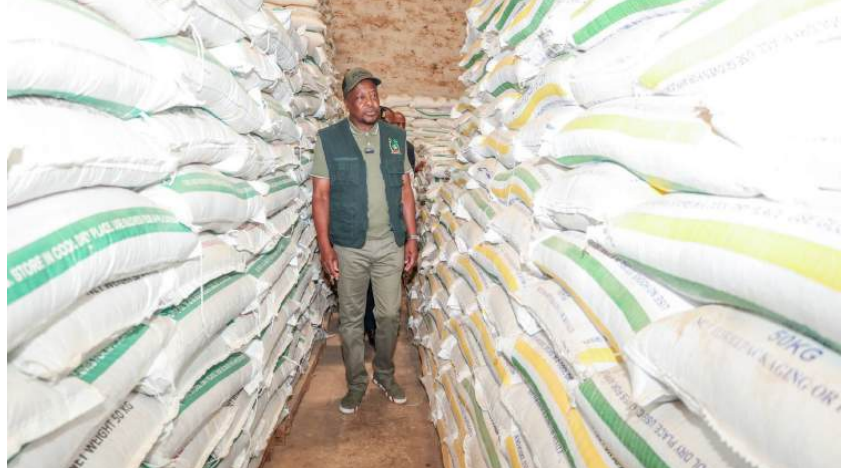
 Agriculture and Livestock Production Cabinet Secretary Mutahi Kagwe, during a tour of the National Cereals and
Produce Board depot at Sagana Complex on January 26 /KNA
Agriculture and Livestock Production Cabinet Secretary Mutahi Kagwe, during a tour of the National Cereals and
Produce Board depot at Sagana Complex on January 26 /KNA
Agriculture Cabinet Secretary Mutahi Kagwe, in an interview with the Star, has outlined a raft of measures the government is rolling out to cushion the country against potential food supply disruptions stemming from ongoing conflict in Middle East.
Read Also
Kagwe details targeted interventions to safeguard national food security, stabilising prices and protecting local farmers, even as global supply chains face uncertainty. He also highlights policy reforms designed to boost local production, reduce reliance on imports and position Kenyan farmers at the centre of the country’s long-term agricultural resilience strategy.
Kenya imports food worth about Sh500 billion annually, according to the Kenya Economic Survey. What concrete measures is the government implementing to reduce the country’s food import bill and boost local production?
Kenya’s high food import bill reflects gaps in local production, storage and supply chains. The government has been rolling out a mix of short-term interventions and longer-term structural reforms to reduce imports and strengthen domestic agriculture.
The 3FS (Food Systems Financial Flows) pilot study in Kenya (2023–2024) was not a typical “field trial” with crops. It was a financial and policy diagnostic tool used by the government, with support from IFAD, the World Bank and UN agencies, to track how money flows into the food system and identify gaps.
This is now being used to redirect spending to high-impact areas, reduce inefficiencies and support policies aimed at lowering food imports and boosting production.
The government’s strategy therefore includes making local agriculture more productive, resilient and commercially viable. However, success depends on consistent implementation, tackling corruption, improving infrastructure such as roads, storage and markets, and ensuring farmers benefit from these programmes.
Key sector measures include subsidised farm inputs. The government continues to provide subsidised fertilisers and certified seeds to farmers. Through these interventions, farmers can access inputs at lower costs to increase yields of staples such as maize, rice, potatoes and wheat. The government has also expanded irrigation and mechanisation of agriculture.
You recently warned that traders selling counterfeit seeds should face severe penalties. How widespread is the fake seed problem in Kenya, and what specific actions is the government taking to eliminate it?
Counterfeiting across sectors in Kenya is massive, estimated at 9.3 per cent of GDP (Sh 829 billion) by the Kenya Anti-Counterfeiting Authority. Agricultural inputs, including seeds, fertilizer and chemicals, are among the affected categories, meaning fake seeds are part of a much larger underground economy.
I have previously described fake seeds as a “national security issue” and a form of economic sabotage that can “destroy a nation’s food system”.
The fake seed problem is widespread and economically damaging, affecting multiple counties and thousands of farmers. Government agencies and regulators acknowledge that fake seeds are circulating, with identified hotspots and active court cases.
At least 15 cases of fake seed or seedling distribution have already been prosecuted, showing this is not an isolated issue but a systemic problem. It directly reduces yields, worsens food insecurity and contributes to Kenya’s reliance on imports.
The government is escalating from routine enforcement to a full-scale crackdown. This includes tougher laws, criminal prosecutions, market surveillance and technology-based verification.
The key test now is consistent enforcement. Kenya has had laws before, but weak implementation allowed the problem to persist. We are also keen on seed verification systems using anti-counterfeit technology and public awareness campaigns. Others are strengthening collaboration with the private sector and seed companies for joint surveillance to monitor distribution channels and detect counterfeit packaging and branding.
Can you give an update on the farmer registration exercise and how it is improving the targeting and accessibility of subsidised fertiliser to genuine farmers?
Kenya’s farmer registration exercise, anchored on the Kenya Integrated Agriculture Management Information System (KIAMIS), has significantly expanded and is now central to how subsidised fertiliser is distributed.
As of 2025–2026, the registry has captured over 7.1 million farmers, making it one of the largest agricultural databases in the country.
Registration is now mandatory for accessing subsidised fertiliser. Farmers must be in the KIAMIS database. The system captures national ID, farm size (acreage), crop type and location through geo-tagging.
The farmer registration exercise has fundamentally transformed Kenya’s fertiliser subsidy system from a manual, leak-prone process into a data-driven, targeted programme.
By linking subsidies to verified farmers through KIAMIS and e-vouchers, the government has significantly improved targeting, transparency and efficiency, ensuring that fertiliser increasingly reaches genuine farmers rather than middlemen.
With global geopolitical tensions, including the ongoing war in Iran, what impact is this having on Kenya’s food security and how is the government mitigating any risks?
The ongoing war involving Iran is already negatively affecting Kenya’s food security, mainly through global price shocks and supply chain disruptions.
The conflict is indirectly but significantly raising the cost of food production and distribution in Kenya, mainly through fuel and fertiliser shocks. While the government is responding with subsidies and local production strategies, prolonged conflict could deepen food inflation and strain food security, especially for low-income households.
The government is cushioning Kenyans through subsidies on key inputs and continued fertiliser subsidy programmes to offset rising global prices. It has also set up strategic food reserves and is pushing for increased local production to reduce reliance on imports.
In addition, the government has diversified import sources, especially for fuel, fertilizer and food, by sourcing from alternative markets to reduce dependence on Middle East routes.
There have been longstanding concerns about underfunding of agricultural research. What is being done to strengthen research institutions and innovation to support increased productivity and climate resilience?
The guiding policy is to allocate two per cent of GDP to research, but the actual allocation is much lower.
Kenya’s agricultural research funding is guided by the Kenya Agricultural and Livestock Research Act, which established the Kenya Agricultural and Livestock Research Organisation and the Agricultural Research Fund to provide coordinated and predictable financing.
Historically, key cash crops such as tea, coffee and sugar operated under their own Acts with commodity-based levies until 2013, when the levies were abolished.
However, the post-2013 shift to a centralised system under KALRO, combined with the removal of many commodity levies, weakened dedicated funding streams. This has left research underfunded and heavily reliant on government budgets and donors.
As a result, Kenya now operates a hybrid model, partly centralised and partly commodity-funded, but still falls short of its policy targets. The main challenge is not the absence of legal frameworks, but inconsistent implementation and inadequate, sustainable financing.
Kenya is now shifting from underfunded, fragmented research to a more coordinated, climate-focused and application-driven system. This includes increasing funding to institutions such as KALRO, the Sugar Research Institute and the Tea Research Institute, partnering with global research organisations, and investing in climate-smart innovation.
Farmers, particularly in the dairy sector, continue to face high feed costs. What interventions are in place to cushion livestock farmers and stabilise production?
Kenya’s dairy sector has been heavily affected by rising livestock feed costs, which can account for up to 70 per cent of production expenses.
To cushion farmers and stabilise milk production, the government and its partners have rolled out several interventions. In summary, the approach is a mix of subsidies, promotion of local feed production, research, credit support and price stabilisation.
These interventions aim to reduce the cost burden on dairy farmers, maintain milk production levels and enhance resilience against both seasonal feed shortages and global price shocks.
There has been increased focus on soil health in recent years. What concrete steps is the government taking to address soil degradation and improve long-term agricultural productivity?
In May 2024, Kenya hosted the Africa Fertilizer and Soil Health Summit (AFSH 2024) in Nairobi under the theme “Listen to the Land”. The summit brought together heads of state, ministers, farmers, scientists, private sector actors and development partners to address widespread soil degradation and low fertiliser use across the continent.
The summit culminated in the Nairobi Declaration on Fertilizer and Soil Health and agreement on a continental 10-year Africa Fertilizer and Soil Health Action Plan, as well as the Soil Initiative for Africa (SIA) framework. These aim to mobilise policy, investment, and coordinated action to restore soil fertility, modernise fertiliser markets, build soil information systems, and scale sustainable soil management practices across Africa.
Leaders also committed to operationalising the Africa Fertilizer Financing Mechanism (AFFM) to improve production, affordability and distribution of both organic and inorganic fertilisers and to expand soil health monitoring and holistic soil management programmes.
At the national level, the summit reinforced momentum behind the government’s efforts to prioritise soil health. A key milestone is the development and finalisation of the Agricultural Soil Management Policy (ASMP) 2023.
The policy provides a comprehensive framework to guide sustainable soil use, restoration, and conservation. It recognises soil as a critical national resource under threat from erosion, nutrient depletion, acidity, and poor management.
It seeks to integrate soil fertility management, water conservation, agroforestry, soil rehabilitation, technology development, research and extension and institutional coordination into both national and county planning.
The policy sets out objectives to enhance soil productivity, mainstream soil management across sectors, support research and adoption of appropriate technologies, establish governance and legal frameworks and incentivise investment in soil health practices.
Importantly, the ASMP and the summit outcomes align with wider continental agendas, including the Abuja Declaration targets on balanced fertiliser use. Both emphasise evidence-based, multi-stakeholder action to reverse declining soil health, improve nutrient availability and enhance agricultural productivity and climate resilience.
Kenya’s strategy combines scientific, policy and on-farm interventions. These include digital soil mapping, tailored fertiliser recommendations, conservation farming, organic amendments, and reforestation.
These measures aim not only to halt degradation but also to restore soil fertility, improve water retention and secure long-term agricultural productivity, particularly in regions vulnerable to erosion, overuse, and climate shocks.
We proudly invite you to Kenya’s fertiliser and soil health strategy launch, which will take place in May 2026.