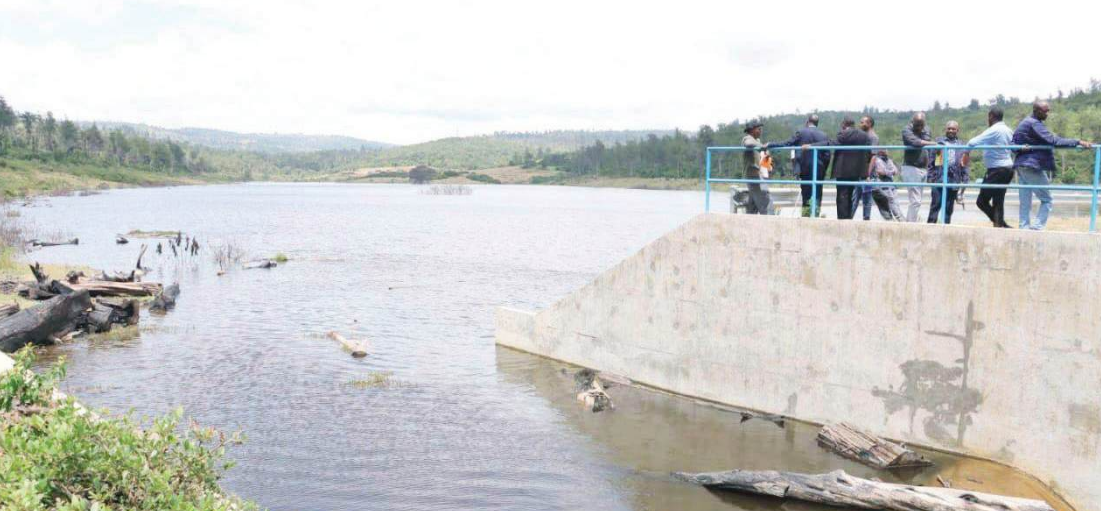
 Yamo Dam in
Samburu
/FILE
Yamo Dam in
Samburu
/FILE
The sight of lush green crops is a rare exception in the often drought-ravaged Turkana County.
At Katilu Irrigation Scheme along River Turkwel, traditionally pastoral communities are now cultivating maize, beans, green grams, sorghum, tomatoes and watermelons.
“As a pastoralist, I lived constantly watching my back, always fighting over livestock. Farming has provided more peace and stability,” farmer Joseph Natapar told the Star.
In Garissa county, a similar transition is underway as pastoralists turn to irrigated agriculture to cope with the harsh realities of climate change.
The Bulla Adeey/Cadey Irrigation Scheme, launched last August, spans 1,500 acres and supports at least 500 smallholder farmers in its first phase.
This transformation points to the future of food security in Kenya. Much of the country comprises arid and semi-arid lands, and with climate change intensifying in an already water-scarce nation, irrigation is a strategic necessity.
Under the five pillars of the Bottom-Up Economic Transformation Agenda (BETA), the Kenya Kwanza administration aims to shift agriculture from subsistence to a productive, technology-driven sector. The goal is to enhance food security, raise farmers’ incomes and expand exports through irrigation, subsidised inputs and improved market access.
The government is currently overseeing the construction of 10 major dam projects across the country, representing a combined investment of Sh184 billion.
“These projects collectively are expected to deliver about one billion cubic metres of additional water storage, support irrigation over about 73,500 acres, generate about 22 megawatts of hydropower and provide water supply to an estimated 5.95 million households,” Water and Sanitation PS Julius Korir told the Star.
The projects include Thwake Dam in Makueni and Kitui counties; Mwache Dam in Kwale; Soin Koru Dam in Kisumu; Siyoi Muruny Dam in West Pokot; Umaa Dam in Kitui; Badassa Dam in Marsabit; Makamini Dam in Kwale; Itare Dam in Nakuru; Keben Dam in Nandi; and Bute Dam in Wajir county.
Korir said these projects form the backbone of the government’s strategy to enhance water storage, expand irrigation and strengthen resilience in both high-potential and arid regions.
They also constitute the first phase of a broader national programme targeting the development of 50 large dams and more than 200 medium and small dams.
Several additional large dams have already been identified and are at various stages of preparation, including High Grand Falls, Londiani, Bosto, Yatta, Galana, Thuci, Radat and Lowaat. A wider pipeline of medium-sized dams has also been developed to support water supply, irrigation and livestock needs, particularly in arid and semi-arid areas.
The major dams under construction are at different stages of progress.
“Thwake Dam is at an advanced stage, having achieved about 94 per cent completion, with most of the civil works substantially finalised, including embankment filling and spillway construction. The remaining works are largely mechanical and finishing components," the PS said.
"Mwache Dam is at about 76 per cent completion, with significant progress recorded in structural works.”
The remaining dams are at varying stages, from early construction to procurement and the resolution of contractual or implementation constraints.
In addition to the ongoing projects, the government has completed several dams in recent years that are already contributing to water supply and irrigation.
These include Karimenu II Dam in Kiambu, which supplies bulk water to the Nairobi metropolitan area, and Thiba Dam in Kirinyaga, which supports irrigation, particularly in the Mwea scheme.
Yamo Dam in Samburu serves domestic water needs in Maralal town, while the Pemba intake dam in Kwale supports water supply through a treatment capacity of about 3,000 cubic metres per day.
A number of smaller dams have also been constructed in arid and semi-arid areas, including Forole Dam in Marsabit, Na’keitum Dam in Turkana and Keses Dam in West Pokot.
These are designed to support community water supply, livestock and local drought resilience, complementing larger national investments.
Completion timelines vary depending on progress, financing arrangements and project-specific conditions.
“For Thwake Dam, once additional financing is secured, the remaining works are expected to be completed within approximately eight months, with impoundment targeted during the October to December 2026 rainy season,” Korir said.
“Mwache Dam is projected to reach construction completion around October 2026, although the broader project, which includes associated components such as catchment management, resettlement and livelihood restoration, is expected to close by August 2028.”
For the other dams, timelines will depend on procurement, financing availability and the resolution of technical and administrative issues.
Implementation is being undertaken progressively, with schedules aligned to project readiness and resource availability.
In January, the government announced it would prioritise six dams currently at pre-construction stage, including feasibility studies, detailed design and financing arrangements.
Lowaat Dam in Turkana is at feasibility stage; Galana Dam in Tana River and Kilifi counties is at detailed design stage; Basalinga Dam in Isiolo is at a preliminary stage; Radat Dam in Baringo is undergoing geotechnical investigations; while High Grand Falls Dam and Thuci Dam are being structured under public-private partnership frameworks.
“This reflects a deliberate and structured approach to project development. Large dam projects are capital-intensive and require rigorous preparation to ensure they are technically sound, environmentally compliant and financially viable,” Korir said.
“The ministry is therefore focusing on completing feasibility and design studies, undertaking environmental and social impact assessments, and structuring these projects as bankable investments under public-private partnership frameworks and other financing mechanisms.”
The government has also strengthened institutional arrangements to ensure long-term sustainability. Bulk water infrastructure is operated by water works development agencies acting as bulk service providers, supplying treated water to licensed utilities under a regulated tariff framework.
This model ensures cost recovery, supports loan repayment and ring-fences revenues for operation and maintenance. It also provides predictable revenue streams, which are critical to making large dam projects financially viable and attractive to private sector participation.
However, implementation faces several challenges. Financing constraints remain significant, given the high capital requirements and funding gaps in the sector. Projects have also been affected by cost escalation due to exchange rate fluctuations, global supply chain disruptions and rising construction input costs.
Technical challenges have included design modifications following updated hydrological data and unforeseen geological conditions requiring additional engineering work.
Land acquisition and social safeguards — including compensation, resettlement and livelihood restoration — have further contributed to delays and increased costs.
The Auditor General and MPs have questioned some projects where delays have led to cost overruns. Thwake Dam, initially projected to cost Sh36.97 billion, has seen its budget revised.
Korir said such variations are typical of large-scale infrastructure projects.
“In the case of Thwake Dam, these include design modifications following updated hydrological studies, which led to an increase in the dam height from approximately 77.5 metres to 80.5 metres, the introduction of two saddle dams, and the enlargement of the spillway to accommodate a higher probable maximum flood, as well as unforeseen geotechnical conditions that required extensive excavation and specialised foundation treatment.”
As a result, the revised project cost stands at Sh47.2 billion, not Sh49 billion as previously reported.
Global disruptions, including the Covid-19 pandemic, have also driven up costs, alongside exchange rate fluctuations and expanded environmental and social safeguards. These factors necessitated additional financing to ensure completion and protect the investment already made.
“Ultimately, these dams are multi-purpose national assets that deliver long-term benefits, including water supply, irrigation, hydropower generation and climate resilience. The associated costs reflect the scale and complexity of the infrastructure and the long-term value they provide to the economy,” Korir said.