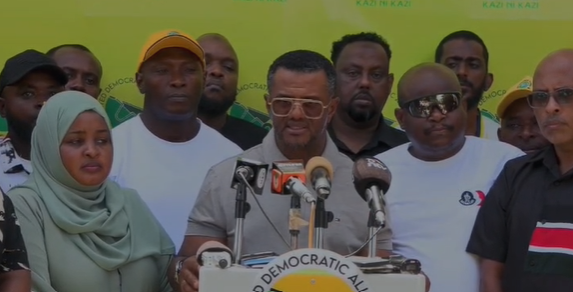
 UDA Secretary General Hassan Omar speaking on April 6, 2026 / SCREENGRAB
 The United Democratic Alliance (UDA) has called for strict enforcement measures and punitive sanctions following the importation of substandard fuel cargo, warning that any lapse in oversight would amount to gross negligence.
In a statement, UDA Secretary General Hassan Omar said adequate safeguards have already been put in place to mitigate risks posed by the consignment.
He added that the government will make public the results of mandatory quality tests conducted at the point of discharge.
“There will be no waiver of such testing protocols as any such action would amount to gross negligence and unacceptable dereliction of duty,” Omar said.
Omar revealed that surcharge and recovery proceedings against the importers have commenced, in a move aimed at shielding Kenyan taxpayers from financial loss.
He proposed punitive sanctions equivalent to five times the projected loss, estimated at Sh3 billion, bringing the total penalty to Sh15 billion.
He said the recovered funds should be ring-fenced and redirected towards strengthening Level Six referral hospitals across the country.
“We propose punitive sanctions amounting to five times the projected loss—that is, three billion multiplied by five, amounting to 15 billion. These recovered funds should be ring-fenced and channelled towards strengthening Level Six referral hospitals, thereby converting a potential crisis or loss into a long-term public health investment,” Omar said.
According to the UDA official, such an approach would transform a potential financial loss into a long-term investment in public health infrastructure.
Energy Cabinet Secretary Opiyo Wandayi said that fuel supplies remain stable and that the government has taken steps to protect consumers from potential losses.
Wandayi acknowledged the recent developments within the Ministry of Energy and Petroleum and its agencies.
He was citing the exit of several senior officials following the oil import saga, but maintained that the situation is firmly under control.
He revealed that the government halted the delivery of a second fuel cargo after new information emerged about an earlier shipment now under investigation.
The move, the CS said, was aimed at safeguarding public interest and preventing a repeat of questionable transactions.
“We have sufficient stocks of petroleum products to meet current demand,” Wandayi said.
He moved to reassure motorists and businesses amid fears of possible shortages or price spikes. The CS also defended the government-to-government (G-to-G) fuel procurement, describing it as stable and resilient despite the controversy.
The arrangement, which was introduced to cushion the country from global oil price volatility, particularly in the wake of geopolitical tensions in the Gulf, has been under scrutiny lately.
Wandayi said the G-to-G system continues to shield Kenyans from immediate shocks linked to instability in global oil markets, even as investigations into specific cargoes proceed.
The dispute is centred on pricing discrepancies between shipments handled under different arrangements.
For the CS, invoices from one supplier indicated a landed cost of Sh198,855 per metric ton for petrol, compared to Sh140,111 per metric ton for a similar product under the G-to-G framework.
The difference of Sh58,744 per metric ton translates to about Sh43.4 per litre, with the G-to-G cargo deemed as significantly cheaper. The revelation is likely to intensify scrutiny over procurement practices in the petroleum sector, particularly amid concerns about possible inflation of profits and inefficiencies.
Wandayi warned against what he described as entrenched interests seeking to exploit the fuel situation.