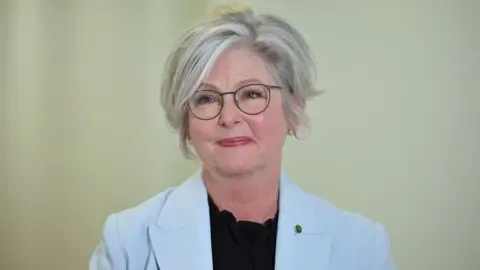
 Communications Authority of Kenya chairperson Charles Karondo addressing residents of Marewa area in Kiharu constituency on April 3, 2026/ ALICE WAITHERA
The Communications Authority of Kenya (CA) has assured Kenyans that the directive requiring all new electronic devices to adopt USB Type-C charging ports will not affect mobile phones already in circulation.
The commission’s chairperson, Charles Karondo, dismissed reports circulating on social media and in sections of the media suggesting that the directive targets low-end phone users, terming the claims inaccurate.
He said the regulation has been interpreted in a manner suggesting that affordable phones will be rendered unusable.
Karondo clarified that the directive only applies to devices seeking approval to enter the Kenyan market from now on, noting that existing phones, as well as those already in transit, will not be affected.
“Phones already in the market, the ones we are using and those on ships or planes coming into the country will not be affected by the change,” he said.
Karondo, who spoke at Marewa village in Kiharu constituency during the handing over of a house he built for a destitute family, explained that CA has engaged global manufacturers and agreed that all new devices imported into Kenya must be equipped with USB Type-C ports.
“Any phone or device that will be imported into Kenya and is seeking approval to enter the market from now on must be manufactured with Type-C charging ports,” he stated.
The move, he added, is intended to standardise charging systems across devices, making it easier and more convenient for users.
The chairperson noted that once implemented, Kenyans will be able to use a single charger to charge numerous devices including their mobile phones, laptops, iPads and torches, among others.
The Type-C directive aligns the country with global trends aimed at reducing electronic waste, a growing environmental concern linked to climate change.
By harmonising charging ports, he stated, fewer chargers will be discarded when consumers switch devices, reducing e-waste that often ends up in landfills and contributes to greenhouse gas emissions through improper disposal and recycling processes.
Kenya produces 51,300 metric tonnes of electronic waste annually from data processing devices like computers, monitors, entertainment and household equipment such as vacuum cleaners, and communication gadgets, among others.
Electronic waste contains hazardous substances such as mercury, lead and cadmium that can pollute soil and water, while also releasing harmful emissions when burned.
Globally, about 62 million tonnes of e-waste were generated in 2022, an equivalent of 7.8 kilograms per person, with only 22 percent recycled.
At the same time, CA maintained that the directive will not affect device pricing, noting that mobile phones will continue to be available across different price ranges despite the uniform charging standard.
Karondo also cautioned against politicising the issue, urging Kenyans to rely on official communication from the regulator.
“This has nothing to do with existing phones, and people should not bring politics into this issue or create unnecessary divisions,” he said.