The government has unveiled an ambitious Sh47.2 billion Flood Resilience Masterplan aimed at addressing persistent flooding challenges in Nairobi.
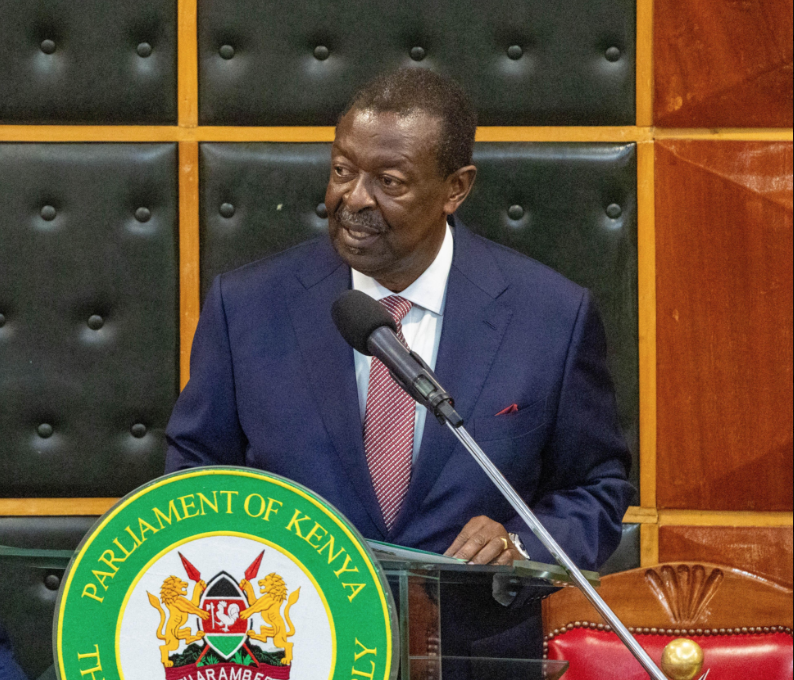
Prime Cabinet Secretary Musalia Mudavadi presented the long-term strategy, developed under the Nairobi Rising Programme, to Parliament.
He said the plan seeks to deliver a coordinated and climate-resilient transformation of the city’s urban systems.
Mudavadi told the National Assembly that the plan is designed to improve water drainage, flood control and climate-resilient infrastructure through a shift in how stormwater is managed.
According to the PCS, the strategy is anchored on a “Sponge City” design philosophy, an approach that prioritises absorption, retention and controlled reuse of stormwater instead of rapid drainage, which has historically worsened flooding in urban areas.
“The strategy is structured in three progressive phases to ensure both immediate response and long-term sustainability,” Mudavadi said.
The first phase, set for implementation in 2026, will focus on emergency stabilisation.
This will include rapid rehabilitation of critical drainage systems, establishment of flood early warning mechanisms, development of flood risk mapping, and strengthening coordinated emergency response capacity across the city.
Phase II, covering the period between 2026 and 2028, will transition to structural resilience.
It will involve the delivery of comprehensive drainage solutions across all river sub-catchments, rehabilitation of key river corridors such as Mathare and Ngong rivers, and construction of underground flood retention infrastructure.
The phase will also see the integration of green infrastructure into the city’s layout to reduce runoff and enhance water absorption.
In the third phase, scheduled for 2028 to 2032, the government plans to advance long-term climate adaptation through the city-wide deployment of resilient infrastructure systems.
This will include expansion of green corridors along river networks and the establishment of a dedicated Climate Resilience Investment Fund to sustain ongoing interventions.
Mudavadi noted that the National Government and the Nairobi City County Government are jointly implementing key infrastructure projects under an existing cooperation agreement.
These include large-scale road and drainage upgrades, expansion of sewer and sanitation infrastructure, and integration of flood mitigation systems within transport and housing developments.
At the same time, the Nairobi Rising Programme is rolling out transformative investments such as expansion of stormwater drainage and sewer systems, regeneration of the Nairobi River, and strengthening of urban planning and zoning frameworks.
Efforts are also underway to expand water and sanitation services to support Nairobi’s rapidly growing population.
Mudavadi emphasised that beyond infrastructure, the government is prioritising the enforcement of existing legal and planning frameworks.
These include full operationalisation of the Nairobi Integrated Urban Development Master Plan, strict protection of riparian reserves, establishment of a public compliance register for development approvals, and introduction of mandatory flood risk disclosure requirements.
“It is important to underscore that the challenge facing Nairobi is not the absence of policy or legal instruments, but the historical lack of enforcement. The current approach, therefore, prioritises compliance, institutional accountability, and coordinated implementation across all levels of government,” he said.