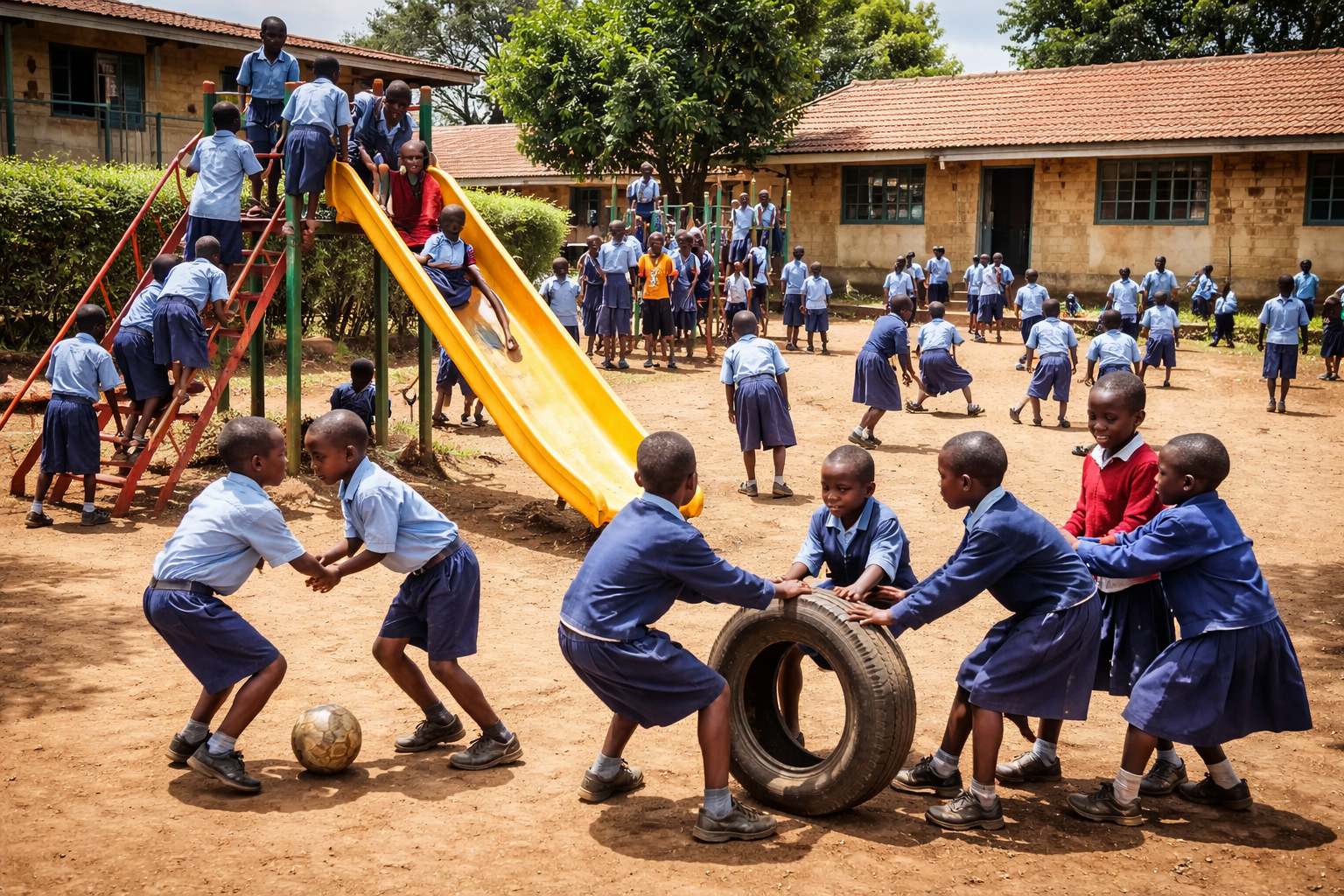
 The safety of schools depends to a large extent on measures taken to organise and manage such safety. /AI ILLUSTRATION
The Ministry of Education has directed heads of both public and private educational institutions to strictly implement the school safety protocols put in place by the ministry to guarantee learner safety.
The directive follows the death of a three-year-old learner who drowned in a fishing pond at Gilgil Hills Academy in Nakuru County on Friday.
Education Cabinet Secretary Julius Ogamba described the death as painful and sorrowful and ordered a thorough investigation into the tragic incident.
"The ministry, working together with the relevant investigative agencies, has commissioned an inquiry into the circumstances that led to the unfortunate incident, for appropriate action," he said in a statement Sunday.
The death of the young pupil came as the deaths of several other learners in the past few months under avoidable circumstances still ring fresh in the minds of many.
These include the death of a Grade 10 pupil who died after being run over by a faulty school water truck within the school compound, two learners who drowned in River Tana during a school activity, and a Form 3 student who died after reportedly ingesting a toxic chemical from a chemistry laboratory.
The tragedies point to institutions' failure to uphold learner safety as mandated by the Safety Standards Manual for Schools in Kenya.
The incidences raise concerns about weaknesses in risk assessment, learner supervision, unsafe infrastructure, and poor emergency response in educational institutions, a systemic breakdown that requires urgent corrective action to avert further loss of lives.
According to the Safety Standards Manual for Schools, learner safety is central to the provision of quality education and is particularly critical for learners at the basic education level in view of their relatively tender ages.
Children of this early age are very vulnerable to threats such as bullying by their older colleagues, intimidation, verbal and physical abuse, and all manner of harassment.
Insecurity for children can also emanate from inappropriate school facilities and infrastructure such as poorly constructed classrooms and playing grounds, insufficient and broken-down toilet facilities, gender-insensitive location of toilet and bathroom facilities, and inadequate and inappropriate desks and other furniture.
As such, the School Safety Standards Manual serves as a blueprint for enhancing the safety of learners across both public and private schools.
The manual states that threats to learners should be addressed through carefully thought-out measures and strategies because accidents can lead to disability or death, while emotional and psychological trauma can result in lack of self-esteem and ultimately lead to poor performance of tasks and responsibilities.
Threats to School Safety
Threats to school safety can emanate within the school environment or from the wider community.
Key among the threats are accidents caused through carelessness, inattentiveness, ignorance, irresponsibility, or negligence on the part of the learners, staff, or other stakeholders in general.
Accidental injuries can be caused by slippery surfaces, wet greasy spots, clutter on the floor, poorly placed furniture such as desks, benches, and tables, weak railings, and insufficient lighting.
Violence and harassment in schools are also threats to safety, where some learners physically attack their peers or sexually assault and bully them.
"Some teachers also emotionally abuse learners through verbal abuse and harassment, taunts and belittling. These abuses and harassments affect the learners’ ego and self-esteem," the manual notes.
Lack of adequate healthcare and nutrition are indispensable to effective learning, without which ailments could have major implications for school attendance, retention, and participation.
Of concern also is the fact that children suffering from ill health and malnutrition are susceptible to accidents or bodily injury.
Safety Standards and Guidelines
The indicators that a school is safe for your child include clearly demarcated school grounds with proper fencing and secure gates and boundaries.
Adequate and well-maintained facilities such as toilets and sanitation facilities, low incidences of indiscipline, and an environment that's free from illegal hawking, activities that are usually susceptible to infiltration by drug and substance trafficking.
The safety of schools depends to a large extent on measures taken to organise and manage such safety.
School management committees and board members, the head teacher, teachers, learners, parents, and local communities have important roles to play in facilitating and enhancing safety in schools.
Nonetheless, the direct responsibility of overseeing school safety should fall within a specific school safety committee headed by the head teacher or school management committee or board chairperson.
The head teacher shall be responsible for ensuring proper implementation of school safety policies and coordinating the efforts of the committee.
According to the school safety manual, the specific functions of the committee include identifying the safety needs of the school with a view to taking the necessary action and to mobilise resources required by the school to ensure a safe, secure, and caring environment for learners, staff, and parents.
The team will also monitor and evaluate the various aspects of safety risks with a view to enhancing school safety, as well as form sustainable networks with all stakeholders to foster and sustain school safety.
The committee will also constantly review issues of child safety in and around the school and keep learners, parents, and other stakeholders informed about school safety policies and implementation activities.
Schools should also ensure that learners are conversant with the basic road safety rules as pedestrians, such as walking in the direction of oncoming traffic in order to minimise traffic accidents.
Schools are also advised to exercise disaster risk reduction by creating mechanisms and procedures that ensure learners are conversant with measures needed to prevent occurrence of disasters and steps required to reduce the impact.
This includes posting evacuation maps at every entrance and exit to buildings, classrooms, enclosed hallways, stairways, and offices, and scheduling practice drill sessions for fire, earthquake, lockdown and other situations that the safety committee deems necessary to practice.
"Fire drills are required once a month. It is recommended that other drills follow the same format," the safety manual states.