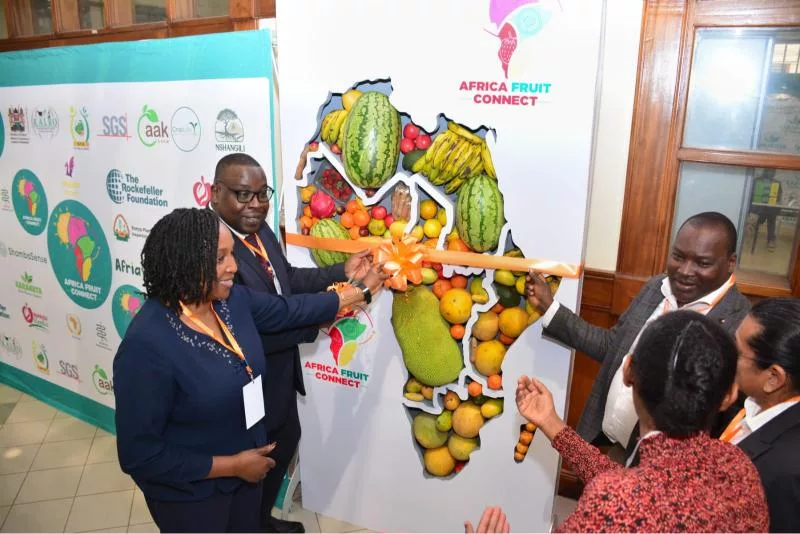
 Participants during AGRA high level event on food agrisystems / GILBERT KOECH
Senior government officials from across African countries have called for a decisive shift from policy and strategy formulation to implementation in order to accelerate the transformation of the continent’s agri-food systems.
The sentiments were made as a high-level Leadership Retreat for Permanent Secretaries from ministries of agriculture, convened in Limuru, Kenya.
Hosted by AGRA in partnership with the Government of Kenya, the meeting brought together permanent secretaries, policymakers, and technical partners from 15 African states under the theme “Delivering CAADP 2026–2035: From Commitment to Government-Led Execution and delivery.”
Countries represented included AGRA focus countries; Ethiopia, Nigeria, Kenya, Uganda, Rwanda, Zambia, Tanzania, Mozambique, Malawi, Mali, Burkina Faso, Senegal, and Sierra Leone. Somalia also participated as a non-AGRA-focused member country, underscoring the breadth of shared challenges and the growing continental momentum to advance agrifood system through coordinated actions.
Opening the retreat, Alice Ruhweza, President of AGRA, emphasized that Africa’s agricultural challenge is no longer about policy design, but about delivery.
“The problem is not policy or strategy. The problem is policy and strategy implementation,” she stated.
“Too often, well-designed policies and strategies lack the financing, coordination, and institutional alignment required to translate them into tangible outcomes for farmers.”
Marking AGRA’s 20th anniversary, Ruhweza underscored the organization’s evolving role as a partner in enabling execution at scale, rather than a driver of policy reform and strategy development. She called for greater alignment between financing and policy ambition, stronger institutional coordination, and deeper engagement with technical partners, the private sector, and regional actors.
The retreat comes at a critical time, as African countries work to operationalize the Comprehensive Africa Agriculture Development Programme (CAADP) 2026–2035 framework, which prioritizes food security, resilience, and inclusive agrifood system transformation.
Principal Secretary in Kenya’s State Department for Agriculture Kipronoh Ronoh reaffirmed the country’s commitment to agricultural transformation through government-led execution and strong partnerships.
He highlighted Kenya’s Agriculture Sector Transformation and Growth Strategy (ASTGS) as a blueprint for building a modern, commercial agricultural sector, with priorities including farmer-facing SMEs, irrigation expansion, access to quality inputs, value addition, and climate resilience.
Dr. Ronoh also outlined Kenya’s alignment with key continental “Big Bets” to accelerate agricultural transformation, saying, “We are deliberately aligning Kenya’s agricultural transformation with the continent’s ‘Big Bets’ by investing in climate-resilient crops, restoring soil health, expanding irrigation in our most vulnerable regions, strengthening livestock systems, and harnessing digital technologies to put better decisions directly in the hands of farmers,” said Dr. Ronoh.
Notably, he reported significant progress in farmer digitization through the Kenya Integrated Agriculture Management Information System (KIAMIS), with over 7.2 million farmers registered to date.
Various speakers stressed that underinvestment in agrifood systems represents a major missed economic opportunity for African economies, limiting job creation, trade, and resilience.
While acknowledging priority areas of support, AGRA should continue to support countries. President Alice Ruhweza challenged leaders to focus on actionable outcomes within the next three farming seasons, posing a central question:
“What can you, as permanent secretaries, do within the next three farming seasons to materially improve farmer prosperity?”
The two-day retreat is designed to foster candid dialogue cross-country learning, and practical solutions to accelerate implementation.
Participants are expected to identify key bottlenecks in financing, coordination, and delivery systems while defining the role of partnerships in bridging these gaps.
The meeting also reinforced a shared vision for Africa’s food future, one that goes beyond production to building resilient, market-driven systems that create jobs, empower youth, and improve livelihoods.
Coming out of this exchange, a central message emerged on the need to build mutual trust between governments and the private sector, as a necessary condition to better leverage efficiency, improve coordination, and unlock gains in Africa’s agrifood systems.
In his closing remark, Ephantus Kimotho, Principal Secretary, State Department of Irrigation, underscored the critical role of irrigation in translating policy ambition into tangible production outcomes.
“Our partnership with AGRA is central to delivering the ambitions of the National Irrigation Sector Investment Plan, which targets bringing 3.5 million acres under irrigation to boost food production and significantly reduce Kenya’s annual food import bill, currently estimated at USD 4 billion.”
He noted that the Plan envisions investments of approximately Sh600 billion, reflecting the scale of resources required to unlock irrigation-led transformation.
“A corporate agribusiness approach is essential, where government invests in enabling infrastructure, and the private sector drives mechanization and innovation thus leveraging blended finance models to address the realities of shrinking development financing.”
The meeting concluded with reflections from Permanent Secretaries representing the participating countries, grounded in their respective national priorities and experiences.
Across these reflections, there was a consistent emphasis on strengthening delivery systems through mechanisms such as Agricultural Transformation Offices, improving data use and coordination, and scaling practical approaches including mechanization, seed systems, and value chain integration.
Delegates also underscored the importance of deeper private sector engagement, more effective financing models, and continued cross-country learning as a means of accelerating implementation. These proposed priority areas clearly build the case for making agriculture the backbone of Africa’s prosperity.
As Ruhweza highlighted, “When farmers prosper, Africa prospers.”