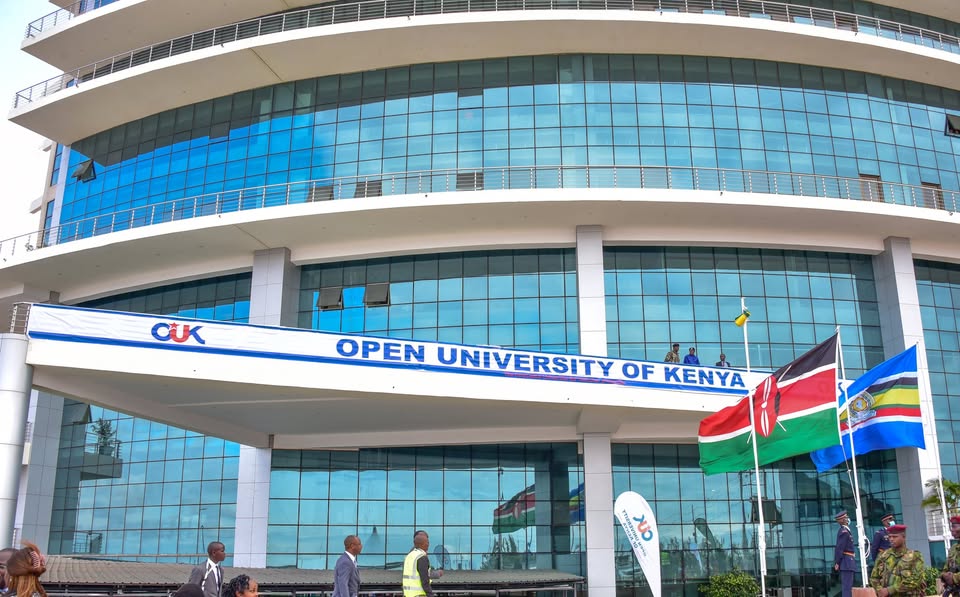
 The Open University of Kenya
The Open University of Kenya is racing against time to grow its student population to 100,000 by December 2026, an ambitious target anchored on the push to widen access to higher education for learners constrained by distance, cost or social barriers.
Located at Konza Technopolis in Machakos County, the Open University of Kenya (OUK) was established in August 2023 to offer both undergraduate and postgraduate programmes at a subsidised cost.
It seeks to boost university enrolment by removing traditional barriers to university education and replacing them with flexible, technology-driven pathways that meet learners where they are.
As Kenya’s first public university dedicated to virtual, distance and e-learning, OUK operates without the conventional burden of expansive physical infrastructure.
At the core of its academic curriculum are courses such as data science, cybersecurity and entrepreneurship, signalling a deliberate shift toward skills that speak directly to the evolving needs of the modern economy.
Granted its charter in August 2023, OUK was conceived to help absorb the growing demand for university education while supporting the government’s goal of achieving a 100 per cent transition rate from secondary to tertiary education.
By June 2025, enrolment stood at 3,500 students, a modest figure when measured against the Ministry of Education’s directive that the institution enrol 100,000 learners by December 2026.
The 2026 intake is currently underway, underscoring the intensity of the recruitment drive now in motion.
The State Department for Higher Education has outlined that attaining the enrolment target will come with increased financial demand.
In its 2025–26 financial year Supplementary Estimates I, tabled before the Departmental Committee on Education, the department indicated that the university requires Sh185 million in recurrent expenditure to recruit essential staff.
“To achieve this target within the limited timeframe requires enhanced resource allocation to support intensified enrolment initiatives,” the department noted.
“The university is appealing for an additional Sh185,289,620 in exchequer grants for recurrent expenditure to enable the recruitment of essential staff.”
Higher Education Principal Secretary Beatrice Inyangala told the committee that the request follows an upward revision of recurrent expenditure to Sh665 million, up from an approved budget of Sh480 million.
The adjustment reflects both the scale of the enrolment target and the operational demands that come with rapid institutional growth.
Beyond staffing, the university is also seeking an additional Sh35 million to meet a revised budget of Sh167 million earmarked for tuition support and the expansion of learning infrastructure.
The funds will go toward accelerating curriculum and content development, digitising course material and ramping up marketing efforts to attract prospective students.
A breakdown of the revised allocations shows personnel emoluments taking the largest share with an additional Sh149 million, followed by curriculum development at Sh17 million, content development at Sh27 million, content digitisation at Sh21 million and marketing and publicity at Sh6 million.
Altogether, the adjustments push the total proposed revised budget for the critical expenditure items to Sh220 million.
At the same time, the university is under pressure to grow its own revenue streams. According to the supplementary budget estimates, OUK has been tasked with generating Sh131 million in appropriations-in-aid (A-I-A), funds it is authorised by the National Treasury to retain and use to meet its operational costs.
This target has since been revised upwards to Sh211 million, representing a variance of Sh79 million. Unlike exchequer allocations, A-I-A revenue is generated internally through avenues such as tuition fees from self-sponsored programmes and other service-based charges.
For a university built on affordability, striking the balance between accessibility and financial sustainability remains a delicate but necessary equation.
Education Cabinet Secretary Julius Ogamba said last year that the university had already reduced the cost of programmes by up to 30 per cent, a move aimed at opening the doors wider to learners from less privileged backgrounds.
The price cut is part of a broader strategy to accelerate enrolment growth without compromising access. Ogamba noted that expanding student numbers at OUK is also central to the government’s plan to make universities more financially self-sustaining and less dependent on National Treasury funding.
In essence, higher enrolment is being positioned not just as an access issue, but as a sustainability strategy. Initially, the university had been tasked with enrolling more than 50,000 students by the end of 2026, with an interim milestone of 10,000 learners by the end of 2025.
The revised target of 100,000 significantly raises the stakes, turning what was already a stretch goal into a full-scale institutional sprint.
Speaking in Naivasha on June 7, 2025, during a University Council meeting, Ogamba reiterated the government’s commitment to supporting public universities, many of which are grappling with mounting financial strain and rising debt levels.
According to the supplementary budget, Kenya’s 37 public universities and six constituent colleges had accumulated pending bills amounting to Sh98 billion as at December 31, 2025, a stark reminder of the fiscal pressures facing the sector.
Against this backdrop, the Open University of Kenya’s rapid expansion is both an opportunity and a test of whether scale, quality and sustainability can be achieved all at once—and within time.