

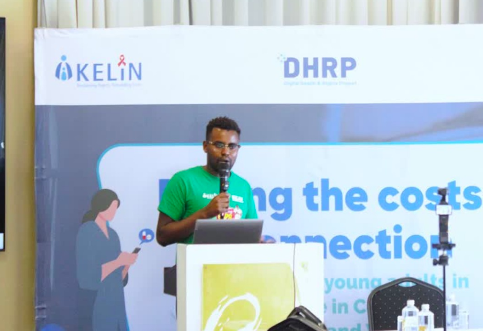
Research Assistant from Kenya Community Advisory Team James Kiilu makes presentations during the release of the findings of a report March 25 at Eka Hotel.
Digital platforms continue to hinder marginalised groups such as people living with HIV and those with diverse sexual orientations from accessing health information and services, the latest report shows.
The study ‘The future of human rights in the digital age: Youth perspective on digital empowerment, inclusion and governance in Kenya’ also affected transgender people.
Employing a participatory action research approach, the study engaged 109 participants aged 18–30 across Nairobi, Mombasa, Kitui, and Migori counties, selected for their diverse geographic and demographic profiles, internet penetration and key population organisations.
Kenya’s digital landscape, characterised by a 92 per cent internet penetration rate and a youthful population (over 60% under 25), is at the forefront of Sub-Saharan Africa’s technological revolution.
This transformation offers significant opportunities for enhancing access to health information and services, particularly for young people.
However, persistent inequalities—gender disparities, rural-urban divides, and socioeconomic barriers—exacerbate the digital divide, disproportionately affecting marginalised groups such as people living with HIV, sex workers and others.
Overall, the participant pool comprised 53 males, 47 females, 5 transgender individuals, and 4 non-binary individuals.
Kitui had 27 participants, with a near-equal split between 13 males and 14 females, and no gender-diverse participants.
Nairobi County had the highest number of participants (30), with 14 self-identifying as male and 16 as female.
Migori presented a similar binary structure with 14 males and 13 females but had one participant self-identifying as non-binary.
Mombasa stood out with a uniquely diverse sample of its 24 participants: 12 participants self-identified as male, 4 as female, 5 as transgender, and 3 as nonbinary.
Researchers from Warwick University and Kenya Legal and Ethical Issues Network on HIV and AIDS (KELIN) conducted the study between April and June 2024 and published it last year.
A similar study was also conducted in Colombia, Ghana and Vietnam.
Research Assistant from Kenya Community Advisory Team James Kiilu said digital inclusion plays a vital role in enhancing the access to health information and services, including access to sexual and reproductive health and rights information and services for young people.
“Access to these resources is not evenly distributed, resulting in digital exclusion,” Kiilu said.
Kiilu said their study found three primary categories of barriers that hinder young people’s involvement in accessing health information on digital platforms, including stigma, economic hardship, and educational and cultural constraints.
Kiilu said stigma remains a significant barrier to achieving digital inclusion, particularly in the context of sexual and reproductive health and rights.
“It manifests as the fear of judgement, discrimination and potential exposure, often stemming from entrenched societal norms and perceived digital surveillance. Young people navigating sexual and reproductive health and rights issues are discouraged from seeking or sharing health information online due to stigma,” Kiilu said.
He said other issues include digital privacy, shared device use, and the risk of online harassment, particularly for vulnerable groups such as young women, those with diverse orientations, and individuals living with HIV.
In Kitui, stigma results from social isolation triggered by exposure of health information or sexual orientation on digital platforms, especially among key populations.
In Migori, participants were more afraid of being outed online or blackmailed for their sexual orientation, leading to self-censorship.
Female participants in Nairobi reported high levels of stigma that often stemmed from fear of privacy breaches and reputational damage, especially among young women.
Sex workers in Kitui highlighted the danger of not being able to afford bundles to communicate with colleagues when in unsafe situations. Without reliable access to data, their safety and livelihood were compromised.
In Nairobi, youth reported high data costs and app subscription fees as hindrances to essential digital health services access.
This results in many resorting to risky alternatives like home deliveries due to inability to afford urgent care or mobile airtime.
The report calls for the strengthening and enforcement of the Data Protection Act to address surveillance, biometric misuse, and algorithmic profiling.
The report says legal reforms should close loopholes that allow non-consensual data sharing and unauthorised monitoring.
The report also calls for targeted digital literacy and privacy training, particularly for marginalised youth, covering topics like data protection, recognising online threats, and securing devices.
Already, a new global online learning module developed under the Digital Health and Rights Project is now available on Coursera, designed to equip journalists, health professionals, and policymakers with the knowledge to navigate these issues responsibly.
A team from Colombia developed the free four-week online course.






