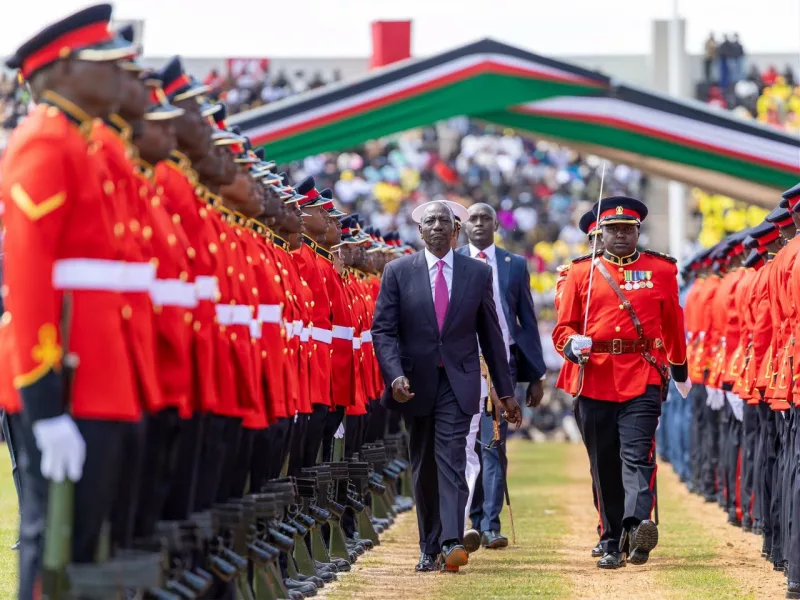
President
William Ruto
and China
Communications
Construction
Company
chairman
Song Hailiang
during the
launch of the
construction of
the Naivasha-Kisumu-Malaba
standard gauge
railway line
in Narok last
week /PCS
When Eunice
Adhiambo heard that President William Ruto had launched the extension of the
Standard Gauge Railway from Naivasha to Kisumu and onward to Malaba on the
Ugandan border, she immediately began planning for a food business.
“I want to
prepare all kinds of food — ugali, chapati, omena, fish, meat and chicken — to
serve the workers who will be here every day,” the Kisumu resident said.
She is among
thousands of Kenyans set to benefit from the transport project designed to
transform the Rift Valley, Nyanza, and Western regions. The impacts of the SGR
extension are expected to be felt throughout Kenya and East Africa through
improved transport, job creation, and expanded trade opportunities.
Advertisement
Advertisement
Peter
Otieno, a food wholesaler in Kisumu, said the influx of workers and improved
transport will increase demand for goods. “Once construction starts, we expect
more people in the city. That means higher demand for food, water, and basic
supplies. For us traders, this is an opportunity to grow our businesses.”
He added
that enhanced rail transport will also reduce the cost of moving goods from
other parts of the country. “Transport has been expensive. If the SGR reaches
Kisumu, it will be easier and cheaper to bring in goods in bulk. That will
increase our profit margins,” he said.
“We are
expecting more customers, especially during construction. Even after that,
better transport will bring more visitors to Kisumu. This will boost business
for hotels, restaurants, and entertainment venues,” said Mary Achieng, who runs
a restaurant in the lakeside city.
John Mwangi,
a hardware store owner, noted that the project would open up regional markets.
“With the railway reaching Malaba, it will be easier to move goods to and from
Uganda. That means more business opportunities not just for big companies, but
also for small traders like us,” he said.
David Gitahi
said many young people are waiting for construction jobs. “The construction
will give most idle people around here an opportunity to work and earn a
living. We have been told everyone will have a chance depending on their
skills,” he said.
President
William Ruto last week launched the construction of the extension of the
SGR from Naivasha to Kisumu, and on Saturday was joined by Ugandan President
Yoweri Museveni to inaugurate the Kisumu-Malaba stretch.
The proposed
Phase 2B and 2C of the SGR will cover a total of 369km. Phase 2B passes through
Narok, Bomet, Nyamira, Kericho, and terminates at Kisumu city, while Phase 2C
will traverse Kisumu, Siaya, Vihiga, Kakamega, Bungoma, and Busia counties.
Project
components include the construction of a modern SGR line, development of
passenger and freight stations, construction of a new Kisumu port, railway
bridges, culverts, drainage works, and the installation of signalling and
telecommunications systems.
It is
expected to be completed in the next 20 months. “This milestone marks a major
step forward in infrastructure development, opening up new opportunities for
growth, connectivity, and regional integration,” said Kisumu Governor Anyang’
Nyong’o ahead of the launch.
Safety.
Speed. Comfort. That is what awaits travellers. But there is more — farmers,
traders, and manufacturers will benefit from lower transport costs and
efficient access to broader markets.
Towns along
the route are anticipated to enjoy a business boom. Land values are expected to
appreciate, and additional social amenities such as water, electricity, and
feeder roads will enhance residents’ quality of life.
The
Naivasha-Kisumu stretch will feature six intermediate stations in Narok, Mulot,
Bomet, Sotik, Sondu, and Ahero, with an 8.69km branch line to the new Kisumu
port. The line will include 17 crossing stations and three freight stations.
Kenya’s
current railway infrastructure comprises 2,778km of metre gauge line. In 2006,
the East African Community adopted the East Africa Railway Master Plan, which
included SGR technology. Today, Kenya has 592km of SGR from Mombasa to
Naivasha. Completion of the Naivasha-Kisumu-Malaba line will bring total SGR
coverage to 961km.
Several
other proposed SGR lines are at the feasibility stage, including Lamu–Isiolo
(544.4km), Isiolo–Nakodok on the South Sudan border (753.2km), Isiolo–Nairobi
(278.6km), Isiolo–Moyale (476km), and the Lamu–Mariakani SGR line (325.3km).
Kenya
Railways Corporation managing director Philip Mainga stated that residents along the route
will be the primary beneficiaries of the Naivasha-Kisumu-Malaba SGR project.
“The construction materials used by the contractor will be mined along the
route from various counties. Everything, including steel and cement, will be
sourced locally,” he said.
“We will not
import steel or cement. This will boost local businesses in these sectors,”
Mainga added.
He noted
that professionals such as drivers, construction machinery operators, and other
workers will find employment opportunities.
Mainga said
the project has strengthened Kenya’s ties with Uganda, as evidenced by the
presence of President Museveni in Kisumu. The SGR line will facilitate
connectivity to Uganda and improve trade and logistics across East Africa.
“In Narok,
we have produce such as hens, hides and skins, livestock, and wheat. In Bomet,
there is tea, milk, and timber. Kericho is known for tea. We plan to establish
logistics centres in each county based on local production,” Mainga explained.
Local
produce will be pooled at county logistics centres connected to the railway,
enabling farmers to export their products more easily. Kenyan millers in
sugar-producing regions will benefit from cheaper, more efficient transport to
both local and regional markets.
“We will
also have refrigerated wagons to move fish from Kisumu directly to markets in
Nairobi, Mombasa, or even for export,” Mainga added.
Malaba, the
final Western point of the SGR in Kenya, will feature a dry port for cargo
destined for Uganda, the Democratic Republic of Congo, South Sudan, and Rwanda.
“We are
creating buffer zones, connecting roads, and services such as water and
electricity. We are developing a corridor where towns will grow,” Mainga said.
The Western
SGR will significantly reduce travel times, ease congestion, and lower traffic
accidents on highways. Railway travel is generally safe. “Having overseen this
system for many years, I can say I have never lost a customer, except those
already unwell,” Mainga said.
Western leaders
have welcomed the extension of the SGR to Malaba in Busia.
Khwisero MP
Christopher Aseka said the project will transform the region in terms of connectivity
and ease of transport.
Aseka said the
project would reduce congestion on the Northern Corridor and road accidents by shifting cargo transport to the railway.
“The railway
will create jobs during construction and spur the rural economies in the
region, especially where there are stations,” he said.
Kakamega Deputy
Governor Ayub Savula said the project will boost trade between Kenya and Uganda.
“The
extension of the railway and dualling of the Northern Corridor will, without a doubt,
boost the economy, especially in Western Kenya,” he said.
Vihiga
county government spokesman Frank Matika said the project will help revitalise
the dormant Western tourism circuit.
“Western
being an agricultural zone, the railway will ease movement of farm produce to
the markets and do away with middlemen who have been fleecing them by buying
their produce at throwaway prices and selling in Nairobi and other counties at
abnormal profits,” he said.
Luanda MP Dick
Maungu said the project will position Luanda town as a key trade hub in Western
Kenya, allowing traders to move goods quickly and efficiently to Kisumu,
Malaba, and beyond.
He said it
will improve connectivity and lower transport costs and open new markets for
farmers and small businesses.
“A station
in Luanda means more employment, more business for traders, and more revenue
for the county. The railway’s impact will touch nearly every sector of our
local economy, from the open-air market to small-scale manufacturers and agribusinesses,”
he said.
“Luanda is
already home to a modern market and an industrial aggregation park, designed
with a railway in mind. Having the SGR station here will ensure Luanda
continues to grow, attract investment, and support the livelihoods of our
people for generations to come,” he said.
The MP also
highlighted the social benefits for residents, including easier access to
education and healthcare. With a station in town, students and patients can
travel faster and more safely to Kisumu or other regional towns.
“It is not
just about business; it is also about making life easier for our people,
getting goods, services, and opportunities closer to home,” he said.
Reported by Henry Makori in Nairobi, Faith Matete in Kisumu, and Hilton Otenyo in Kakamega.

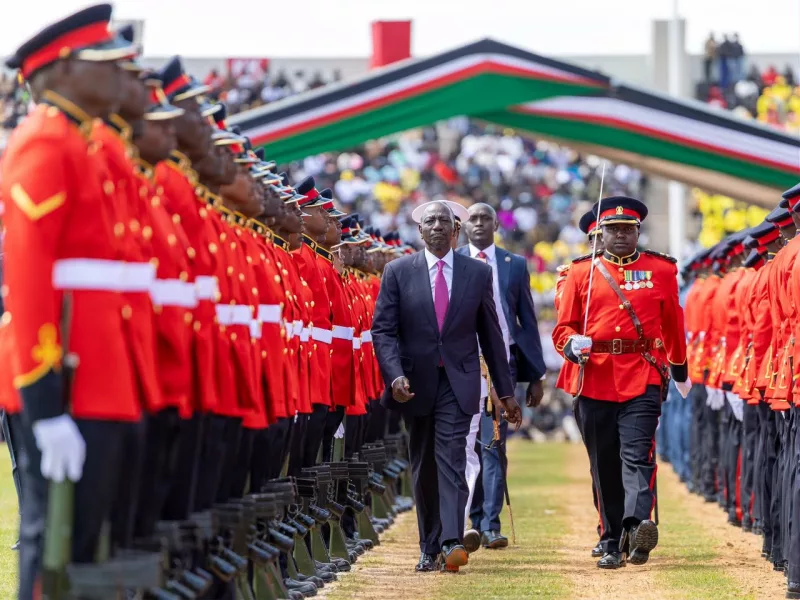
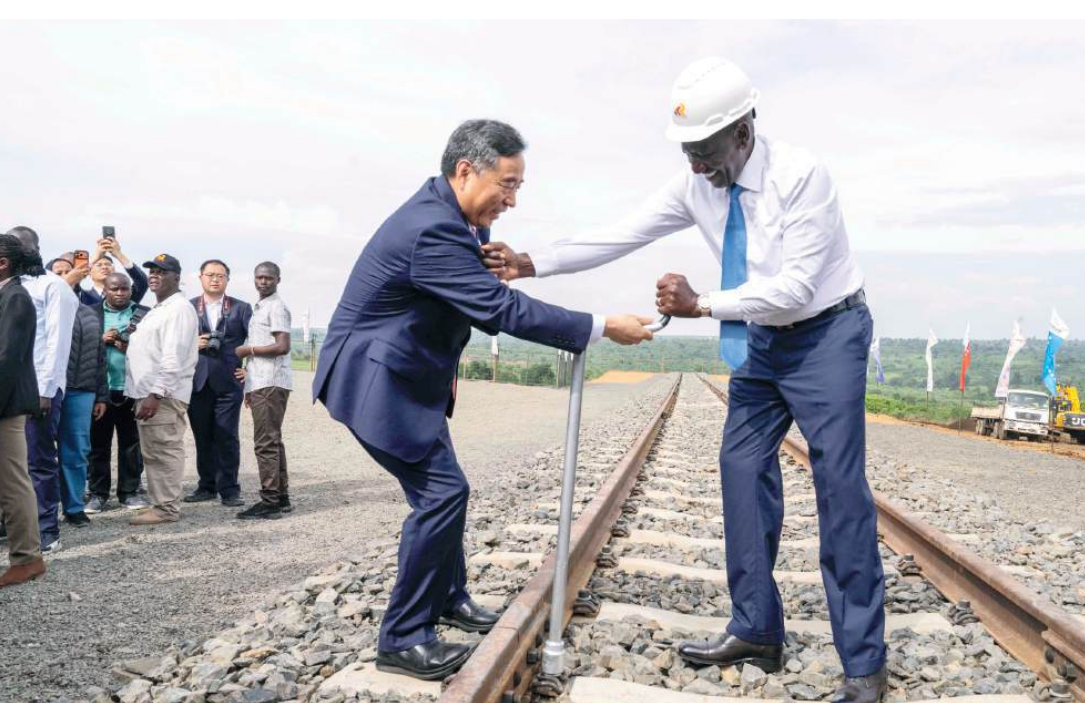 President
William Ruto
and China
Communications
Construction
Company
chairman
Song Hailiang
during the
launch of the
construction of
the Naivasha-Kisumu-Malaba
standard gauge
railway line
in Narok last
week /PCS
President
William Ruto
and China
Communications
Construction
Company
chairman
Song Hailiang
during the
launch of the
construction of
the Naivasha-Kisumu-Malaba
standard gauge
railway line
in Narok last
week /PCS