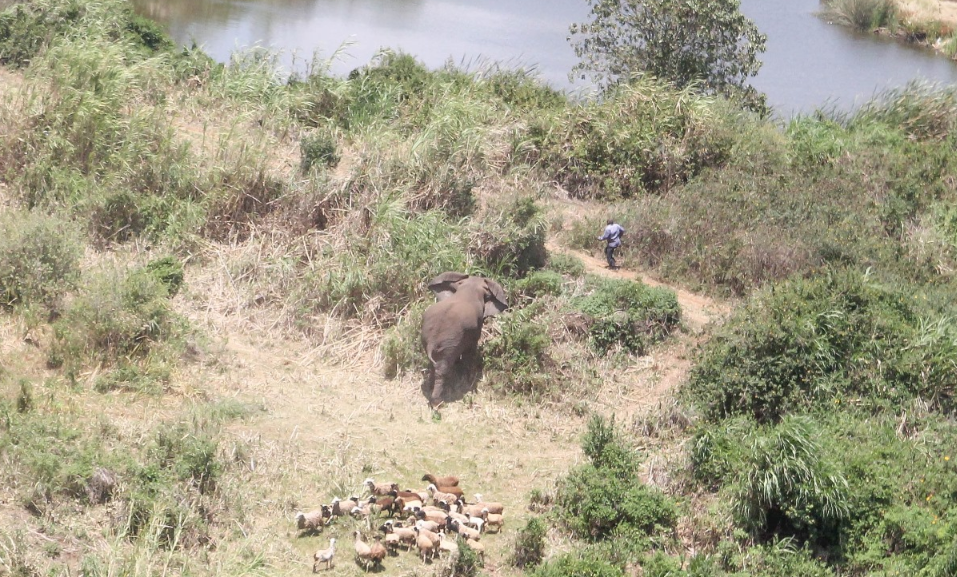
 Addressing human-wildlife conflict remains a key priority for the Kenya Wildlife Service, especially as expanding agricultural activities increasingly encroach on traditional wildlife habitats. /KWS
Kenya’s wildlife has long been a source of national pride and economic strength, anchoring a tourism industry that draws global attention.
But beneath that image lies a growing and politically charged crisis: human-wildlife conflict.
Across the country, communities living near parks and reserves continue to report cases of crop destruction, livestock killings, and fatal encounters, particularly involving elephants and snakes.
What was once seen as a conservation challenge has evolved into a governance issue—one that now sits squarely at the intersection of law, policy, livelihoods, and justice.
A recently developed Bench Book by the Judiciary on wildlife, forest, and fisheries crimes offers a revealing lens into how Kenya has structured its response.
It lays out a comprehensive legal and institutional framework designed to protect biodiversity while addressing offences linked to natural resources.
But it also exposes rifts between law and enforcement, policy and outcomes, and conservation and community survival.
The Bench Book was developed as a practical and accessible reference tool for judges and magistrates in addressing crimes that affect the environment.
"It aims to support judicial officers in effectively adjudicating wildlife, forest and fisheries-related cases by providing concise legal guidance, contextual understanding, and best practices relevant to these complex cases," Supreme Court Judge Smokin Wanjala says in the foreword, endorsing its content.
The question now is not whether Kenya has the tools to manage the crisis. It is whether those tools are working.
What has worked
Kenya’s response to wildlife-related conflict and crime is anchored in a robust legal framework that has evolved significantly over the past decade.
At the core is the Wildlife Conservation and Management Act of 2013, which strengthened protections for endangered species and introduced tougher penalties for offences such as poaching, illegal trade, and habitat destruction.
The law marked a turning point, triggering what the Bench Book describes as “a dramatic rise in the prosecution of wildlife crimes.”
It operates alongside a broader framework that includes the Forest Conservation and Management Act of 2016, the Fisheries Management and Development Act of 2016, and the Environment Management and Coordination Act.
Together, these laws create a wide net covering offences ranging from illegal logging and charcoal burning to unregulated fishing and pollution.
The framework is reinforced by the Constitution, which guarantees the right to a clean and healthy environment and obligates the state to ensure “sustainable exploitation, utilisation, management, and conservation of the environment and natural resources.”
To enforce these laws, the Kenya Wildlife Service (KWS), Kenya Forest Service, and Kenya Fisheries Service work alongside the Office of the Director of Public Prosecutions (ODPP) and the Judiciary to investigate and prosecute environmental crimes.
The Bench Book underscores that these frameworks are not merely symbolic; they create a wide range of offences whose sanctions include forfeiture and seizure, in addition to fines and imprisonment.
Criminal liability is structured to target actors at different levels of the chain—from poachers and illegal loggers on the ground to traffickers and organized criminal networks operating across borders.
Wildlife crime, the document notes, is often “transnational” and linked to money laundering and corruption, requiring a coordinated legal response, including extradition of suspects to face prosecution within the jurisdictions where crimes were committed.
The justice system has also developed procedural depth. Investigations now incorporate digital evidence, structured case management, and clearer rules on searches, seizures, and arrests.
Courts are guided on how to weigh evidence, determine guilt, and issue sentences that reflect the gravity of offences.
For serious offences involving endangered species, penalties include mandatory prison terms without the option of a fine.
Courts are also empowered to impose forfeiture of assets and compensation orders.
Another notable development is the incorporation of Alternative Justice Systems (AJS). The Constitution encourages the use of such mechanisms, and the Bench Book highlights their relevance in resolving disputes tied to natural resources.
These systems can help address community-level conflicts—particularly those arising from human-wildlife interactions—by offering more flexible, locally grounded solutions.
The policy was informed by the results of a Justice Needs Survey of 2017, which indicated that only about 10 per cent of the population utilises courts to resolve disputes.
"AJS is premised on the restorative justice approach, which seeks to restore harmony and equilibrium in society and the achievement of “win-win” outcomes for all concerned parties," the book notes.
Beyond the courtroom, the government has taken policy steps to address the human side of the crisis.
The National Human-Wildlife Coexistence Strategy (2024–2033) outlines interventions such as fencing, rapid response units, and community sensitisation.
Compensation has also been a central pillar in resolving a considerable portion of the cases. Between 2022 and early 2025, the government paid approximately Sh2.8 billion to victims of wildlife attacks, with death compensation ranging between Sh3 million and Sh5 million, and permanent disability set at Sh3 million.
In March 2026, the state released an additional Sh950 million for the third phase of payouts. These measures reflect a system that, on paper, is comprehensive—combining law enforcement, judicial processes, and policy interventions aimed at coexistence.
What has failed
Despite this elaborate framework, the crisis persists—and in some areas, it is worsening.
The Bench Book provides a diagnosis of underlying weaknesses, the most significant being corruption, described as a factor that “permeates not just the private sector but also government agencies, including those that are supposed to lead the fight against such crimes.”
This erosion of integrity undermines enforcement, allowing illegal activities like poaching and logging to continue despite strict laws.
Poverty and unemployment further complicate the picture. The document notes that economic hardship drives some individuals into wildlife crime, as they “resort to criminal activities that involve the killing of wildlife species and selling their parts.”
In the context of human-wildlife conflict, this economic pressure intersects with daily survival.
When wildlife destroys crops or kills livestock, affected communities often bear the immediate cost, creating resentment toward conservation efforts.
The compensation system, meant to ease this burden, has become one of the most visible points of failure.
As of early 2025, more than 20,000 compensation claims dating back to 2014 remained unresolved. Parliament’s Public Accounts Committee flagged bureaucratic red tape and budget shortfalls as key obstacles, with some victims waiting over a decade for payouts.
Even as the government disbursed billions, over Sh1.84 billion in claims from 2021 to 2023 was still unpaid, while older backlogs from 2014 to 2016 were only beginning to be addressed.
This delay undermines trust in the system because compensation is not just a financial mechanism; it is a signal that the state recognises and responds to the risks communities face.
When it fails, it fuels perceptions that conservation is prioritised over human life, fuelling retaliatory attacks and exacerbating human-wildlife hostilities.
The legal framework itself, while strong, also faces implementation challenges. The Bench Book acknowledges that some crimes persist due to “perceived low risks” and a “lack of fear for consequences.”
This points to a gap between statutory penalties and actual deterrence.
Enforcement is further complicated by the evolving nature of wildlife crime. While large-scale ivory trafficking remains a concern, recent cases have involved smaller, less conspicuous items, such as attempts by foreign nationals to smuggle mountain ants and other protected insect species.
These cases highlight how criminal networks adapt, exploiting gaps in monitoring and regulation.
Institutional coordination also remains uneven. Wildlife, forest, and fisheries crimes often involve multiple agencies, yet fragmented responses can weaken overall effectiveness.
The Bench Book notes that these crimes involve “intricate supply chains that can span across continents,” requiring coordinated disruption at multiple levels.
While Alternative Justice Systems offer promise, their potential to resolve community-level disputes remains underutilised in a context where conflict is often localised and recurring.
What must change
If Kenya is to move from containment to resolution, several shifts are necessary—many of which are already implied within the existing framework.
First is enforcement. Laws alone are insufficient without consistent and credible application.
This means addressing corruption within enforcement agencies and ensuring that penalties are not only severe on paper but also certain in practice.
Second is coordination. Wildlife crime and human-wildlife conflict cut across sectors—environment, security, justice, and community development.
A more integrated approach is needed, linking agencies and aligning their mandates.
Third is deterrence through sentencing. Courts are already guided to impose penalties that reflect the seriousness of offences, but consistency is key. The Bench Book emphasises the need for sentences that “send a clear message to society that WFF crime is unacceptable.”
Fourth is strengthening the compensation system. The current backlog is not just an administrative issue—it is a structural weakness. Faster processing, adequate funding, and transparent mechanisms are essential to restore public confidence.
The government has signalled urgency on this matter, with the Principal Secretary for Wildlife, Silvia Museiya, stating that compensation must happen “by hook or by crook,” elevating it to the level of flagship national priorities. Translating that commitment into timely payouts will be critical.
Fifth is community integration. Conservation cannot succeed without local support. This means aligning wildlife protection with livelihoods—ensuring that communities living on the frontlines of conflict see tangible benefits—fewer attacks and faster compensation.
Alternative Justice Systems could play a larger role here, offering culturally grounded mechanisms to resolve disputes and reduce tensions.
Finally, there is a need to adapt to evolving threats. As wildlife crime becomes more sophisticated and diversified, enforcement strategies must keep pace—whether dealing with large-scale trafficking or niche illegal trade in lesser-known species.
Until that gap is closed, Kenya’s model will remain a work in progress.