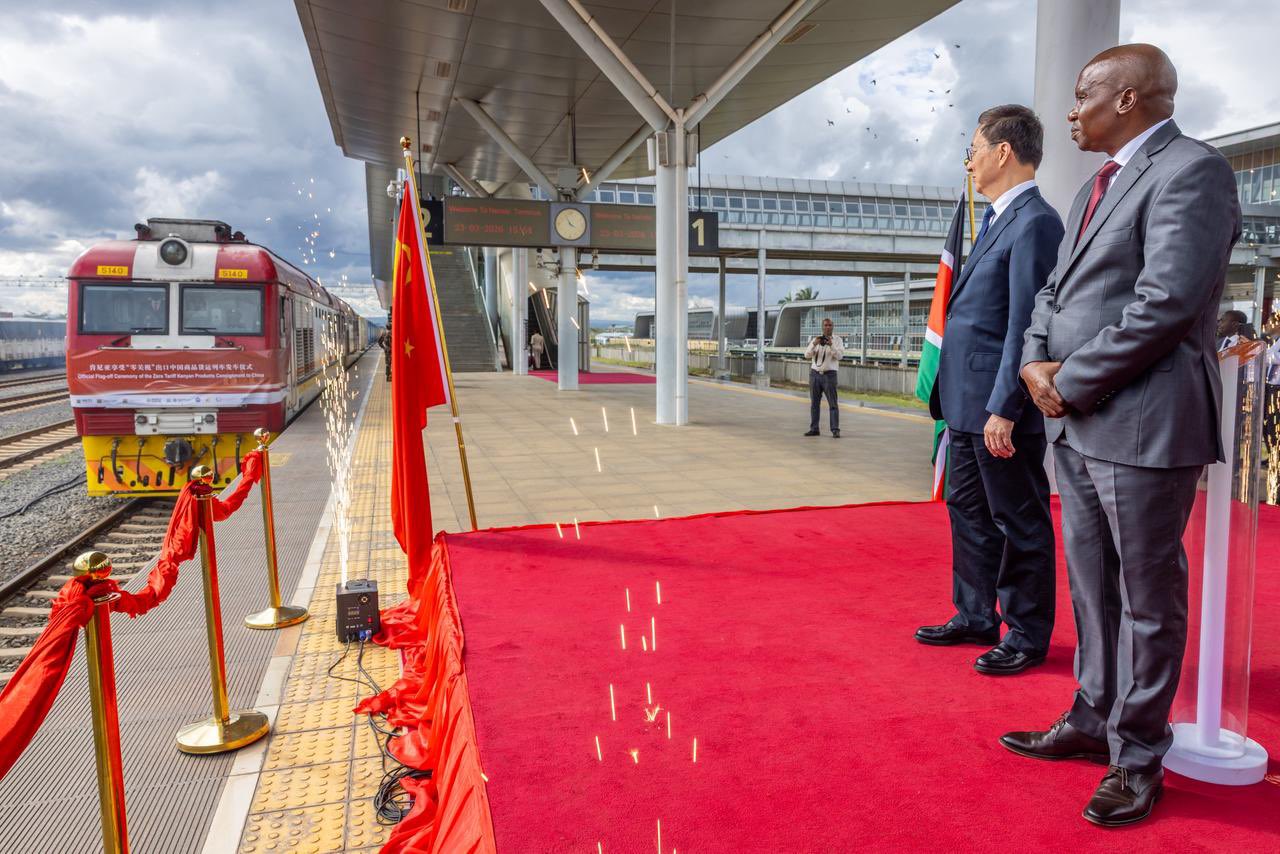
 Deputy President Kithure Kindiki and China Vice President Han Zheng flag off the first consignment of exports to China under the Zero Tariff Agreement at SGR Nairobi terminus on March 23, 2026/DCPS
The US State Department on Monday reported a phone call between Secretary of State Marco Rubio and President William Ruto, on the same day, China Vice President Han Zheng visited Kenya to advance a major trade agenda.
Rubio and Ruto discussed bilateral cooperation and regional security.
“Secretary Rubio thanked President Ruto for his public condemnation of Iranian aggression against Gulf states and discussed the objectives of Operation Epic Fury.
“He also expressed his gratitude for Kenya’s significant contributions to peace and security in Haiti and Kenya’s commitment to ensuring a smooth transition to the Gang Suppression Force,” the department said.
Notably, the two leaders also discussed “commercial opportunities and how to further strengthen the enduring partnership”.
The simultaneous engagements highlight Kenya’s growing importance as both a security ally and an economic partner in a shifting global order.
The messaging reflects the US strategy of strengthening alliances with stable African countries to counter China and maintain influence in critical regions.
At the same time, China is consolidating its economic footprint in Kenya through trade, investment and infrastructure deals aimed at deepening bilateral ties.
Vice President Han Zheng and his Kenyan counterpart Kithure Kindiki on Monday presided over the flagging off of the first consignment of goods destined for export to China under a new zero-tariff framework.
The agreement, reached between President Ruto and his Chinese counterpart Xi Jinping, will allow Kenyan products, including coffee, tea, avocados, macadamia, flowers and leather, to access the Chinese market duty-free from May 1, 2026.
The Early Harvest Agreement between Kenya and China provides Kenyan exporters with an opportunity to access one of the world’s largest consumer markets ahead of a full Free Trade Agreement.
Kindiki described the deal as a major step towards correcting a long-standing trade imbalance, noting that Kenya currently imports goods worth more than $4.3 billion annually from China while exporting only about $200 million.
Trade officials said the arrangement offers Kenyan exporters access to a vast consumer base of over 1.4 billion people and is expected to boost value addition, create jobs and expand foreign exchange earnings.
Trade CS Lee Kinyanjui termed the deal an unprecedented breakthrough in Kenya’s export journey.
“This is more than a policy shift; it is a game changer that opens the door to one of the world’s largest consumer markets and positions Kenya for a new era of trade growth and value addition,” Kinyanjui said.
Speaking at the Kenya–China High-Level Business Forum Trade PS Regina Ombam said the agreement will bridge the trade deficit, enhance Kenya’s competitiveness, diversify export markets, incentivise value addition, and attract investments.
China’s involvement in Kenya’s infrastructure from the SGR to roads, energy and water projects, has already cemented its position as Nairobi’s leading economic partner. This has deepened with the extension of the railway line to Malaba and the construction of the Rironi-Mau Summit highway.
On the other hand, the US has also intensified ties with Kenya, granting it the non-NATO ally status, and including it in the Agoa trade framework extension.
Deputy Secretary of State Christopher Landau also visited Nairobi in late January 2026 to strengthen bilateral ties.
During the visit, Landau met President Ruto and Prime CS Musalia Mudavadi. Their talks centred on security, particularly the Kenya-led Haiti mission transition, trade, and regional stability and security.
The convergence of high-level US and Chinese engagements reflects Kenya’s delicate balancing act as it seeks to leverage relationships with both powers without being drawn into geopolitical rivalry.
On one hand, the US views Kenya as a reliable security partner in Africa, particularly in counterterrorism, regional stability and international peacekeeping missions.
On the other hand, China remains central to Kenya’s economic ambitions, offering financing, infrastructure development and now expanded market access.
Foreign policy experts describe this approach as “strategic hedging,” where Kenya maximises benefits from both sides while avoiding outright alignment with either bloc.
Dr Kemoli Sagala opines that Kenya, as a low-level power, has strategic finesse in how it orchestrates its regional anchor role in global power competition.
“And as an actor, Kenya has rationally maximised its utility calculations,” Dr Sagala says.
However, the dual engagement also presents risks.
Growing economic dependence on China, coupled with deepening security ties with the US, could expose Kenya to pressure from both sides as global tensions rise.