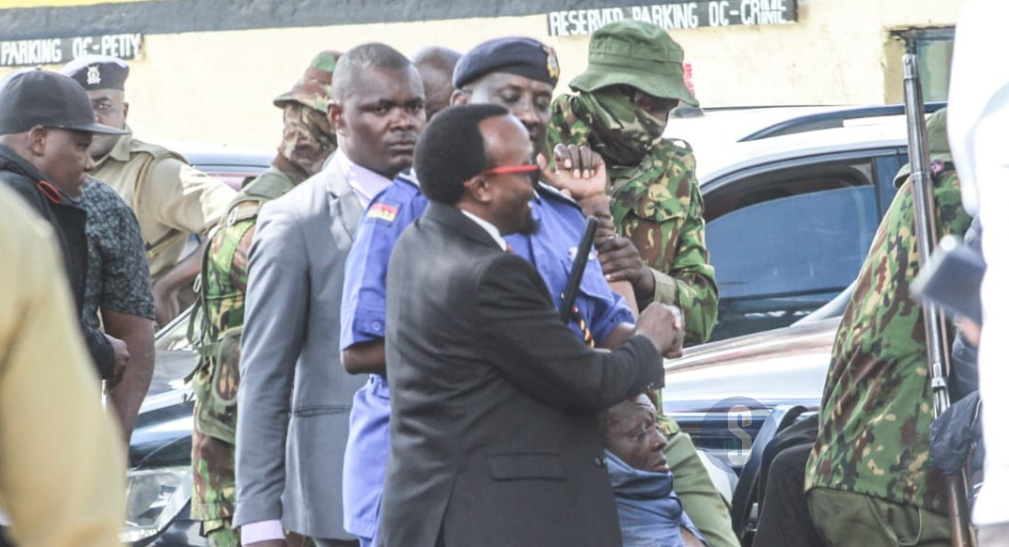
 Former Cabinet Secretary Raphael Tuju is carried away by police officers after his arrest at Karen police station in Nairobi in connection with an alleged self-abduction case, March 23, 2026. /ENOS TECHE
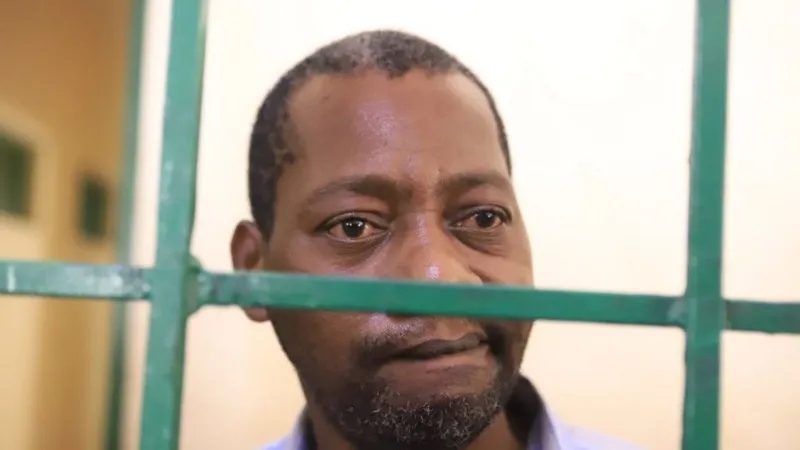
Dramatic events unfolded on Monday evening when officers from the Directorate of Criminal Investigations arrested former Cabinet Secretary Raphael Tuju after he resurfaced at his Karen home, more than 36 hours after being reported missing.
Tuju addressed the media at his residence, stating that he had not been abducted as earlier claimed by his family, but had gone into hiding fearing for his life.
He said the decision on Saturday evening followed a sequence of events he believed posed a threat, adding that he had been trailed by a vehicle with unknown occupants since Friday.
By Saturday, he claimed, the situation escalated after he noticed the Land Cruiser following him had no number plates.
Tuju said he sought refuge with a family in Kiambu. However, the Directorate of Criminal Investigations maintains that he staged his abduction.
Speaking during a Monday evening press briefing, DCI Director Mohamed Amin said Tuju had been at his Karen residence since Friday, citing what he described as inconsistencies and lack of cooperation from those close to him.
“A family member reported Tuju missing for several hours yet was initially reluctant to cooperate fully with police and share critical information with investigating officers,” Amin said.
He added that following the report, the National Police Service deployed a coordinated multi-agency response involving uniformed and plain-clothes detectives.
Tuju’s arrest, captured by media and bystanders, was swift and physical.
“We acted after establishing that the claims of Tuju’s disappearance were not genuine. The provision of false information is a serious offence and poses a risk to national security,” Amin said.
Tuju is currently hospitalised at The Karen Hospital after his condition worsened while in custody at Karen Police Station.
Staging one’s own kidnapping, commonly referred to as self-abduction, is treated as a criminal offence in Kenya, though it is not defined as a standalone charge.
Suspects may be prosecuted under related offences such as extortion, conspiracy to commit a felony, or giving false information to a person employed in the public service.
Such incidents are treated as a misuse of police resources and often trigger large-scale operations to rescue non-existent victims. Accomplices may also face charges, including conspiracy and abduction-related fraud.
In Tuju’s case, the Office of the Director of Public Prosecutions has approved charges, paving the way for his arraignment at the Kibera Law Courts.
Police intend to charge him with giving false information to a person employed in the public service, contrary to Section 129(a) of the Penal Code.
According to the charge sheet, prosecutors allege that on March 21, Tuju informed a police officer at Karen Police Station that he had been trailed and abducted by unknown assailants, claims they say were false and knowingly made to prompt police action.
While suspects in such cases may also be cited for creating public disturbance or breach of peace, Section 95(1)(b) of the Penal Code, which criminalised creating a disturbance likely to cause a breach of peace, was declared unconstitutional by the High Court in February 2026 for being overly broad, vague and infringing on freedom of expression.
Where self-abduction involves financial gain, such as ransom demands, it may be treated as extortion or fraud, offences that carry significant penalties.
In December 2024, a man was arrested after staging his own kidnapping, inflicting injuries on himself and demanding a Sh100,000 ransom.
Tuju, who went missing alongside his aide Steve Mwanga had moved to court seeking anticipatory bail.
In his urgent application, he had listed the Inspector General of Police, the Directorate of Criminal Investigations and the Office of the Director of Public Prosecutions as respondents.
Through his lawyers, Tuju had sought orders to restrain police and other state agencies from arbitrarily summoning, arresting, detaining or interfering with his freedom of movement.
His legal team also argued that continued police presence at his hospital bedside violated his dignity, liberty and right to medical care, as he awaited a court ruling on his anticipatory bail application.
Tuju maintained that he is a law-abiding citizen willing to cooperate with investigators and attend court whenever required, and argued that anticipatory bail was necessary.
And on Tuesday evening, he secured a legal reprieve after the High Court granted him anticipatory bail of Sh200,000 following his arrest.
The orders were issued by Justice Martin Muya after Tuju and his co-applicant, Louiza Korros, through their lawyer Gregg Ndege, filed an urgent application seeking to block his arrest and continued detention by police.
Delivering the ruling on Tuesday, Justice Muya directed that the applicants be released on anticipatory bond and that the matter be mentioned for further directions on April 7, 2026."That the applicants are hereby admitted on an Anticipatory bond of Sh200,000 with one (1) surety each or cash bail of similar amount," Muya ruled.
The court certified the matter as urgent and directed that the application be served on the respondents, who include the Inspector General of Police, the Director of Criminal Investigations and the Director of Public Prosecutions.