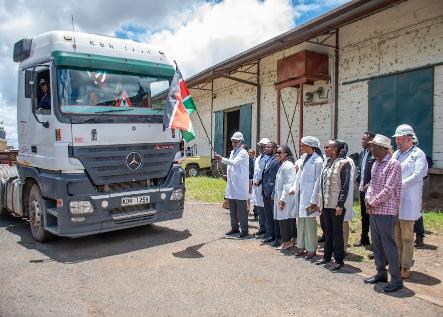
Kenya has flagged off its first shipment of 320 bags of European Union Deforestation Regulations (EUDR)-ready coffee to Poland.
The European Union Deforestation-free Regulation (EUDR), adopted in June 2023, is a law that requires companies selling certain products in the EU to ensure they are not linked to deforestation. Companies must show that their goods are produced legally and can be traced back to where they were sourced.
This was achieved through a collaborative effort led by the New Kenya Planters Cooperative Union (NKPCU), in partnership with the Alliance of Bioversity International and CIAT, Global Coffee Platform and the Kenya Coffee Platform, with support from German cooperation under the DIASCA programme.
Speaking during the flagging-off of the EUDR-ready coffee container, Principal Secretary in the State Department of Cooperatives, Patrick Kilemi, said the 320 bags of coffee, each weighing 60kg were sourced from 13 cooperative societies.
Kilemi said smallholder farmers are central to EUDR compliance, adding that Kenya is ready to adapt to a rapidly changing global trading environment where environmental accountability is no longer optional but essential.
“The government ensures that no farmer is excluded from international markets due to compliance challenges and that farmers are equipped with the knowledge, tools, and digital systems for compliance,” the PS said, adding that special attention is being given to youth, women and persons with disabilities (PWDs) to ensure full inclusivity in the coffee value chain.
According to data from the Coffee Directorate of Kenya and the Central Bank of Kenya, coffee remains one of Kenya’s top export earners.
The country exported about 51,000 tonnes of coffee valued at about Sh35–40 billion in 2023, with the EU accounting for a significant share of the market. The EU is Kenya’s largest coffee destination, taking more than 50 per cent of total exports.
NKPCU managing director Timothy Mirugi said the move will enhance farmer incomes while strengthening Kenya’s position in global markets.
“It also reflects our alignment with international sustainability standards, particularly in the context of climate action and responsible trade,” he added.
According to Kevin Onyango, senior research associate at the Alliance of Bioversity International and CIAT, the organisation, in partnership with NKPCU and under appropriate confidentiality arrangements, supported the use of farm-level data shared by cooperatives that produced the coffee in this shipment.
Onyango said with farmer consent and strictly for the purpose of enabling market access, the initiative applied publicly available tools to assess deforestation risk, confirming very low to no risk while also beginning to align these processes with Kenya’s regulatory context.
He said this approach demonstrates that Kenyan coffee can meet emerging global requirements while respecting farmer agency and data sovereignty, allowing for shared analysis and transparency where appropriate.
“The experience shows that the tools and technologies required for compliance already exist; what matters most is how stakeholders come together to apply them,” Onyango said. “What this journey has shown is that the real innovation is not just in the technology itself, but in how we collaborate, bringing together science, partnerships, and trust to build systems that work for everyone across the value chain.”
George Watene, programmes manager at Global Coffee Platform said one of the lessons they have realised along the journey is how expensive it can be, especially when mapping farmers.
“We have therefore been working with strategic partners not just for financing, but also to inform and integrate the right technologies. Collaboration has brought in resources and science to ensure we are doing things the right way throughout the process,” he said.
Joseph Waweru, a farmer and chairman of Rwarai factory in Nyeri, said EUDR is a positive shift for the coffee sector, noting that the regulation is not just about compliance, but also about safeguarding the natural resources that sustain farmers’ livelihoods.
“As farmers, we are very happy about the EUDR regulations because we understand the need to conserve the environment. We cannot destroy forests to grow coffee, instead, we are learning and training others to conserve trees while still producing quality coffee, especially now with EUDR requirements,” he said.
Across coffee-growing regions, farmers are increasingly adopting practices that align with sustainability requirements while also improving productivity and resilience. Agroforestry, in particular, has emerged as a key approach, offering both environmental benefits and practical advantages for smallholder farmers managing limited land sizes.
Kekilia Muthoni, a farmer from Gakundu in Embu county, said coffee farming is the foundation of her livelihood and she ensures integration of tree planting with coffee, especially given her small farm size.
“The trees shed leaves which act as mulch for my coffee. When they dry, the leaves turn into manure, enhancing soil fertility. Additionally, the trees offer shade, protecting my coffee from harsh sunshine. They also act as windbreakers,” said Muthoni.
The EUDR regulation targets seven key commodities linked to deforestation: cattle, cocoa, coffee, oil palm, rubber, soya and wood. It also covers derived products such as leather, chocolate, furniture, paper and palm oil derivatives.