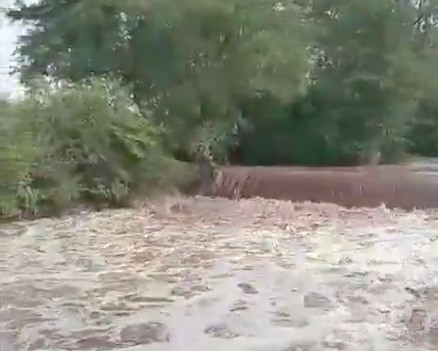
Motorists using the Eldama Ravine–Maji Mazuri–Molo Road have been urged to seek alternative routes after Kenya National Highways Authority (KeNHA) announced that a section at Molo River has been rendered impassable due to flooding.
In a statement, KeNHA Director General Luka Kimeli said the river burst its banks following heavy rainfall in upstream catchment areas, leading to a sharp rise in water levels and making the road unsafe for motorable traffic.
“The Molo River located along the Eldama Ravine - Maji Mazuri - Molo Road has flooded, rendering the affected section unsafe for motorable traffic,” Kimeli said. “The situation has been occasioned by heavy rainfall in the upstream catchment areas, resulting in a significant rise in water levels.”
The authority cautioned motorists against attempting to cross the flooded section, emphasising the need to follow directions issued by police officers and traffic marshals stationed at the site.
“Motorists are strongly advised to exercise caution and strictly adhere to instructions issued by police officers and traffic marshals on site to ensure their safety,” Kimeli added.
KeNHA further advised road users to consider alternative routes to avoid disruption.
Motorists travelling from Eldama Ravine have been directed to use the Eldama Ravine–Mogotio–Salgaa–Nakuru route or the Eldama Ravine–Kabarnet–Marigat–Mogotio road.
Those approaching from Nakuru have been advised to use the Nakuru–Salgaa–Ravine route.
The authority said it is closely monitoring the situation and will take further action should water levels continue to rise.
“KeNHA is closely monitoring the situation and will take appropriate action should water levels continue to rise. The Authority appreciates your cooperation as we work to ensure the safety of all road users,” the statement read.
The development comes even as the Ministry of Interior and National Administration reported that the flood situation in Kano Plains is gradually stabilising, although challenges remain in several affected areas.
In its update, the Ministry said earlier fears had painted a more severe picture, but ongoing assessments now indicate a more controlled situation.
Nonetheless, extensive flooding continues to affect large parts of the plains, especially in low-lying areas where homes, farms, and access roads remain submerged.
“The flooding situation in Kano Plains, while requiring continued monitoring, presents a more measured picture than initial assessments suggested,” the Ministry said. “Significant portions of the plains remain inundated, with low-lying homesteads, farms, and access routes still affected.”
The Ministry noted that displacement persists in the hardest-hit zones, with many families still unable to return home. It added that livelihoods, particularly for smallholder farmers, have been significantly disrupted.
“Displacement in the worst-affected pockets persists, and livelihoods, particularly for smallholder farmers, continue to bear the burden of the seasonal inundation,” the statement added.
Public health risks have also emerged as a growing concern, with authorities warning of potential disease outbreaks linked to contaminated water sources and compromised sanitation.