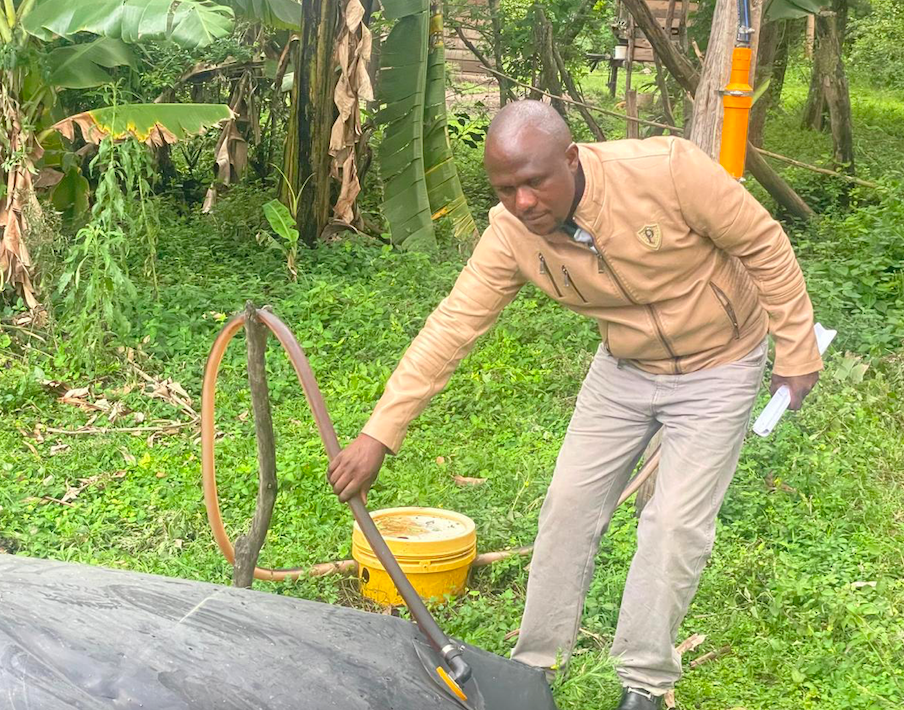
Kipsirat youth group secretary Mike Cheruiyot checks a biogas unit/Gilbert Koech.
A community group adjacent to Siongiroi Forest has adopted biogas as a primary strategy to reduce its reliance on fuel wood and protect the local environment.
Kipsirat Youth Group member Floncy Cheruiyot explained that the transition to biogas has brought significant benefits, most notably by eliminating the need to forage in the forest for fuel.
Because biogas is smoke-free, it has transformed the domestic environment.
Before the system was installed, Cheruiyot used 40 pieces of wood per day at a cost of Sh10 per piece, totalling approximately Sh 8,000 per month. Those funds have since been diverted to essential household expenses and school fees.
In her home, the biogas system now provides clean energy for both cooking and lighting.
The youth group was originally formed in 2007 and registered under the Ministry of Social Services with 15 members, consisting of seven men and eight women.
The group’s secretary, Mike Cheruiyot, noted that their objectives range from environmental conservation and strengthening cohesion to livelihood improvement.
To date, the group has successfully raised and sold over one million tree seedlings. Part of their strategy for enhancing livelihoods included a merry-go-round system, which enabled the group to buy 11 local-breed heifers for its members.
As the organisation grew, they learned about the Green Zone Development Support Project through the Kenya Forest Service (KFS), eventually submitting a successful proposal for funding in 2022.
The African Development Bank Board approved the second phase of the Green Zones Development Support Project (GZDSP II) in December 2019. This KFS-led initiative was designed to rehabilitate degraded forests and ensure that forested lands are protected in a sustainable manner through forest conservation and inclusive value chain development.
Under this project, the group received specialised training on Sahiwal cattle feeding and management from a service provider.
Four members even travelled to Cheborarwa Farm to deepen their expertise. This livestock component is central to their energy production, as the cow dung powers the biogas plant, while the resulting bioslurry is used to improve the nutrient content and structure of the soil in the group’s greenhouse.
According to Green Zones project manager Jerome Mwanzia, the project provided 10 Sahiwal cows and one bull, constructed the biogas unit, and established fodder crops at a cost of Sh1.25 million.
Since then, the herd has increased to 24 cattle, and milk production has risen by approximately 10 litres per day.
Beyond the economic gains, the project has addressed a critical health crisis. Mwanzia highlighted that the shift to biogas helps avert deaths resulting from woodsmoke. The Kenya Medical Research Institute reported over 26,000 deaths in the country last year attributed to hazardous air pollution, warning that this figure will continue to rise without such clean energy interventions.
On a global scale, exposure to air pollution is linked to roughly eight million premature deaths annually.
The World Health Organization (WHO) warns that household air pollution leads to non-communicable diseases such as stroke, heart disease, and lung cancer.
Women and children, who are typically responsible for cooking and wood collection, bear the heaviest health burden.
The WHO emphasises the necessity of expanding access to clean fuels like biogas and solar to meet emission targets.
Currently, around 2.1 billion people worldwide still cook using open fires or inefficient stoves fuelled by kerosene and biomass. At current rates, nearly 1.8 billion people will still lack access to clean cooking solutions by 2030, leaving millions at risk of respiratory illness and premature death.