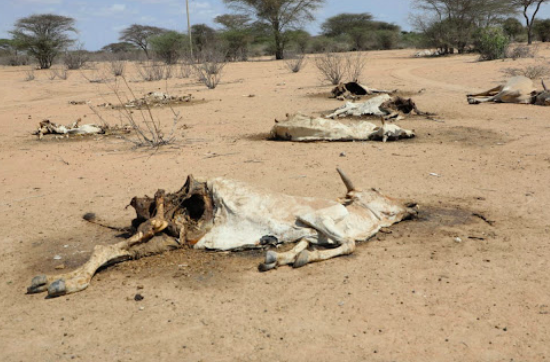
Livestock carcasses /file
Read Also
Kenya has near zero chances of eliminating hunger by 2030, with 3.7 million people in dire need of food.
Progress to make the country food secure have stalled since 2016, the 2025 Global Hunger Index report says.
The report was jointly unveiled at the Norfok Hotel by Welt Hunger Hilfe, Concern Worldwide and the Institute for International Law of Peace and Armed Conflicts. It is a tool for comprehensively measuring and tracking hunger at global, regional and national levels.
It uses indicators such as undernourishment, child stunting, child wasting and child mortality.
The report ranks Kenya 103 out of the 123 countries placed in the serious hunger category with an alarming score of 25.9 in 2025.
The report says that despite decades of progress in the fight against hunger in the country, the status has not changed since 2016.
“Africa south of the Sahara continues to record the highest hunger levels globally. The region has made some progress since 2000, with hunger moving from alarming to serious. Furthermore, 35 out of the region’s 47 countries have moved to a lower Global Hunger Index (GHI) category since 2000, and Cape Verde has become the first to reach low hunger,” the report says.
The report notes that since 2016, progress has slowed sharply with hunger rising in 10 countries.
It says the reversal is primarily driven by the rising number of undernourished people, reaching extremely alarming levels in six countries including Kenya.
The others are the Democratic Republic of Congo, Liberia, Madagascar, Somalia and Zambia.
“Despite two decades of decline, child stunting remains at extremely alarming levels and has even increased in Angola, the Democratic Republic of Congo and Niger.”
The report says 4.5 per cent of children in the country were wasting, with 740,000 children needing treatment.
It shows that despite progress, 17.9 per cent of children under five are stunted, limiting their growth, learning ability and future productivity.
The report shows that climate shocks are worsening food insecurity.
This is because over 80 per cent of Kenya’s agriculture is rain-fed, making food production highly vulnerable to drought and floods.
The report shows that hunger is unequal, as it is concentrated in arid and semi-arid counties, coastal regions and urban informal settlements.
The highest food-insecure counties include Wajir, Turkana, Marsabit and Mandera.
Kenya has also fallen short of the 10 per cent agricultural spending commitment under the Maputo and Malabo declarations.
Past study in 2018 showed that the government spending as a share of GDP was 1.6 per cent for food systems, 4.8 per cent for education and 4.2 per cent for the health sector.
This is despite agriculture contributing over 20 per cent to the GDP.
Irrigation secretary Joel Tanui said the government has put in place measures to address hunger.
"We have developed a 10-year national irrigation sector investment plan. This plan seeks to put in over Sh519 billion in this sector,” Tanui said.
He said the government will work closely with the private sector to unlock the funds.
Tanui said the plan has five very critical pathways.
He said small-scale irrigation schemes in the country will be modernised to enhance production.
Tanui said the schemes have been mapped out.
He said the government will also enhance smallholder community irrigation programmes across all the country.
Currently, we have around 2,500 smallholder irrigation schemes, he said.
Tanui said the third pathway is to open up the arid and semi-arid areas.
He said 80 per cent of the country falls in the arid and semi-arid areas.
The government has made deliberate efforts to open up these areas for irrigation and water harvesting.
The areas under target include Mandera, Tukana, Isiolo and Tana River.
Tanui said more than 300,000 acres will be put under irrigation in Mandera County for the very first time.
The secretary said the fourth pathway is on the farmer-led irrigation development.
He said smallholder farmers will access irrigation equipment at the small scale level.
Tanui said the government will ensure that the majority of the smallholder farmers access affordable credits to be able to buy irrigation equipment.
'We are creating a de-risking fund, whereby we are telling the private sector to play a critical role in ensuring these farmers have access to irrigation equipment," he said.
He said there are more than 7.5 million small-scale farmers in the country, and less than 20 per cent have access to irrigation.
Tanui said idle land will be used for food production.
This, he said, will be done by allowing the private sector to utilise idle land.
"If you go to the coastal belt, cutting across the river, we have more than two million acres which have been lying idle for long. Therefore, we are opening up that space for private sector investment to be able to develop irrigation and be able to carry out agricultural production in those areas. We are doing so also through the Land Commercialisation Initiative, which we have been able to put on all idle land across the country,” he said.
He said the idle land will be advertised soon.
Tanui said 2.5 million acres are targeted for irrigation.
He said that in order to put 2.5 million acres under irrigation, some 50 mega-dams were being constructed in the country in addition to 200 small irrigation dams and 1,000 smaller ones.
The report recommends that a number of measures be undertaken to ensure that the country is free from hunger.
It calls on the governments at all levels to commit to building inclusive, resilient, sustainable and peace-orientated food systems that address all forms of malnutrition and involve the full scope of those food systems, from production to disposal.
The report also calls for the promotion of sustainable, climate-resilient agricultural development as a long-term solution to food insecurity.
It also calls for adequate, flexible and accountable financing from diversified sources, including humanitarian, development, climate finance, domestic mobilisation and the private sector.
The report also calls for the strengthening of national-level political commitment and prioritisation of localised implementation that includes the establishment of inclusive accountability mechanisms and empowerment of local governance.
It also calls for prevention and mitigation of the impact of conflict on hunger.