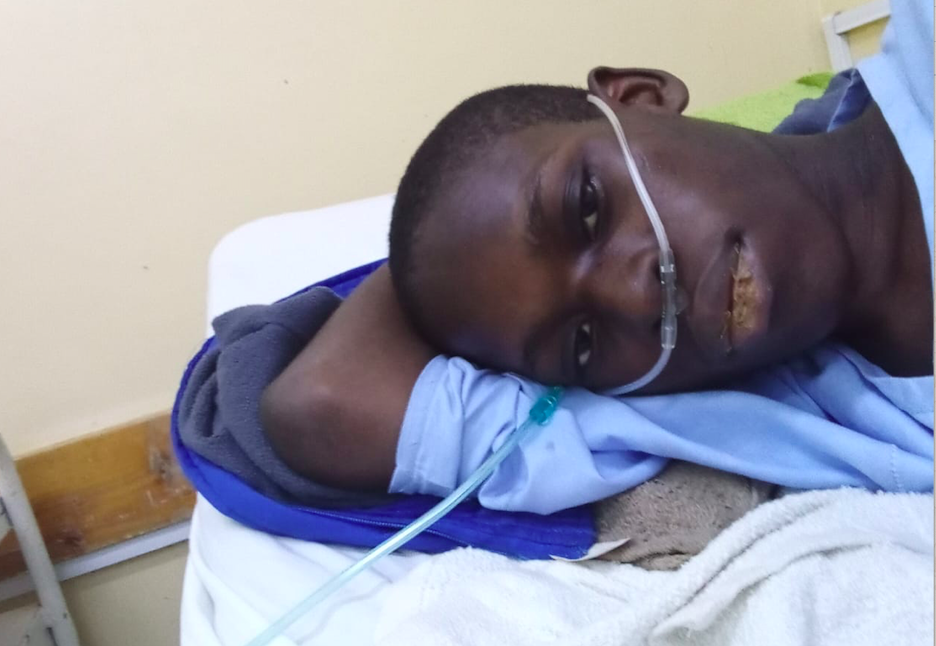
 Collins Wafula/Handout
Three years ago, a small growth appeared on Collins Wafula’s neck, an event that changed the course of his life.
At the time, he was in Form 2 at St Juliana Secondary School in Narati, Bungoma, and the condition forced him to drop out of school.
Now 20 years old, Wafula was diagnosed with malignant neoplasm of the nasopharynx at stage four—a rare and aggressive cancer that accounts for less than one per cent of all cancers globally.
"He was taken to several hospitals in Kiminini and Kitale when a small growth emerged in his nose," Wafula’s sister, Charity Awinja said.
The ongoing challenges Wafula faces include difficulty breathing, hair loss, loss of appetite, and significant weight loss. He has also required oxygen therapy three times, as well as three blood transfusions. Additionally, he has suffered from electrolyte imbalances on three separate occasions.
As his health continued to deteriorate, his family made the difficult decision to transfer him to Nairobi for specialised care in 2023. He was admitted to Kenyatta National Hospital, where he was diagnosed with malignant neoplasm of the nasopharynx.
According to the Cleveland Clinic, nasopharyngeal cancer (NPC), also known as nasopharyngeal carcinoma, is a rare form of head and neck cancer. It affects the tissue connecting the back of the nose to the back of the mouth, in an area known as the nasopharynx, located just above the roof of the mouth and at the base of the skull.
When a person breathes in through their nose, air travels through the nasopharynx and into the throat before reaching the lungs. NPC begins when abnormal cells in the nasopharynx grow uncontrollably, forming cancerous tumours that can spread to the lymph nodes, liver, lungs and bones.
Treatment is typically nonsurgical due to technical challenges and is determined by the stage of the disease. For early-stage disease (I and II), radiation therapy may be used alone, while chemotherapy is added for more advanced stages (III and IV).
Following Wafula’s diagnosis, his family was devastated.
Awinja explained they were referred to MP Shah Hospital, which has specialised equipment for cancer treatment. However, the cost of treatment has become overwhelming, and the family is struggling to find the funds to cover his care.
"The cost of one chemotherapy session is up to Sh45,000, though some of it is covered by the SHA," Awinja said.
"In some cases, Wafula has had to be admitted to the hospital due to complications like low oxygen and blood levels."
The family has sold a portion of their land and three cows to help fund the treatment.
A treatment plan shared by the family indicates that one of Wafula’s procedures will cost Sh237,500. The plan also outlines that a 3D CRT scan, which helps oncologists target cancerous tumours while protecting healthy organs, will cost Sh8,500, and the associated CT scan and planning will amount to Sh20,000.
However, the treatment plan also notes that the initial diagnosis and planned investigations are based on Wafula’s medical reports, which means the final treatment costs may vary after further tests.
Having exhausted their financial resources, the family is now appealing to well-wishers for help in meeting the mounting medical expenses. Those wishing to contribute can reach the family on 0797 690 703.
Cancer, a group of diseases characterised by the uncontrolled growth and spread of abnormal cells, remains a leading cause of death globally. In Kenya, it is the third leading cause of death, following infectious and cardiovascular diseases. In 2012, Kenya saw an estimated 37,000 new cancer cases and 28,500 cancer-related deaths.
Cancer not only takes a heavy toll on health but also places an enormous economic burden on families and caregivers.