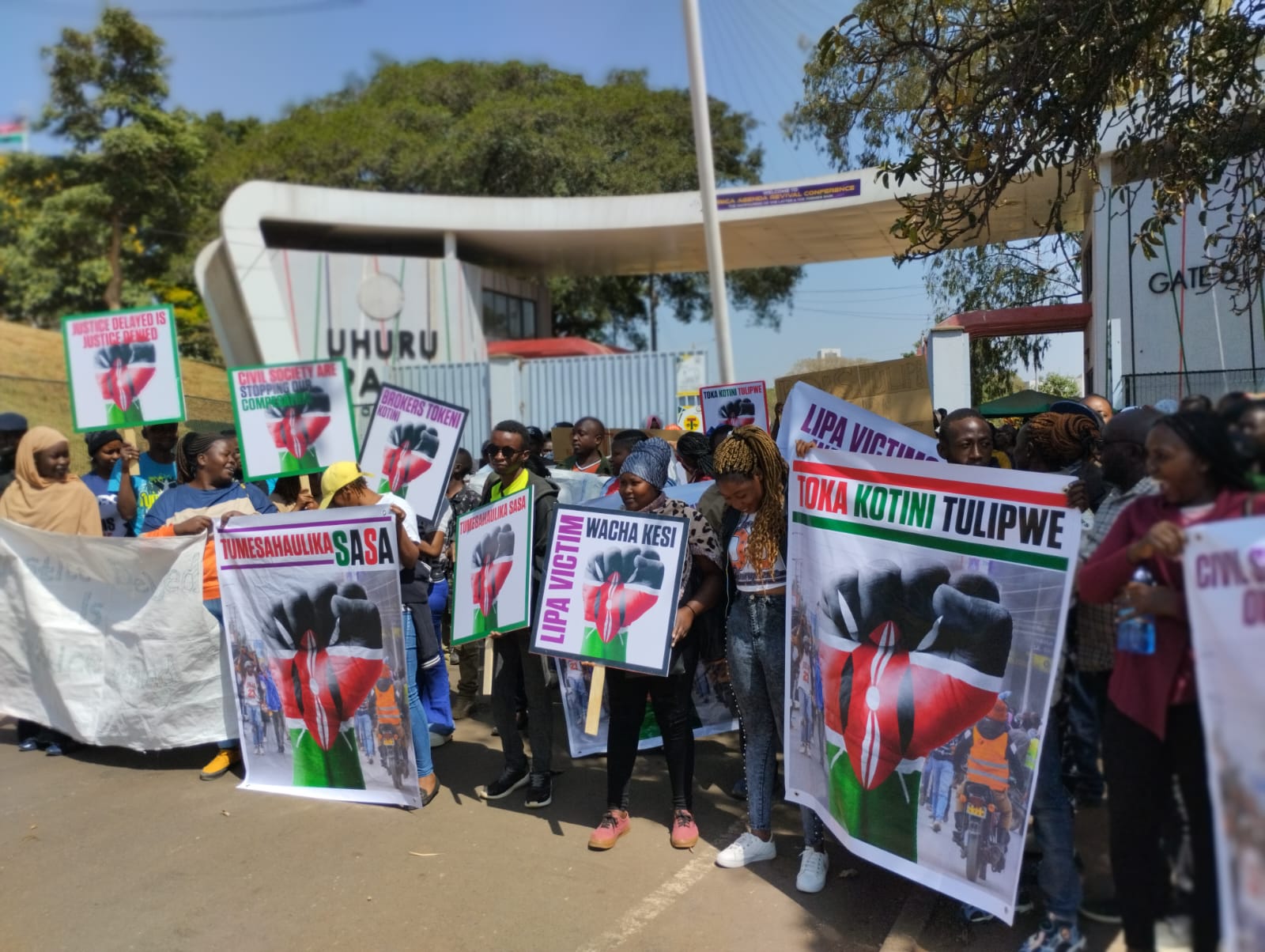
Victims of the Gen Z protests march to call for the withdrawal of a court case that temporarily blocked their compensation in February /FILE
The Kenya National Commission on Human Rights has urged individuals affected by past rights violations, including victims of protests and demonstrations, to come forward with evidence supporting their claims.
In a statement on Friday, the commission said it had officially assumed the lead role in compensating victims of protest-related violence, inviting victims to submit their claims by April 3.
"The commission has initiated internal technical work," KNCHR said in the statement.
It cited mapping areas most affected by protest-related and other human rights violations, and engaging key stakeholders so that a credible framework can be put in place to guide a transparent, accountable and comprehensive reparations process.
"The commission acknowledges the pain, loss and anxiety experienced by victims, survivors and their families as well as the public concern that reparations have taken too long," it added.
The verification process requires victims to submit supporting documents, including P3 forms, medical reports, occurrence book reports and post-mortem reports by the deadline date, through the commission’s official communication channels or by visiting its offices across the country.
The commission has offices in Nairobi, Kisumu, Mombasa, Kitale, Nyahururu and Wajir.
Claris Ogangah, the commission’s chairperson, said compensation alone would not constitute a full reparations programme, and outlined a broader approach that extends beyond financial payments.
"A just and effective reparations programme includes compensation, restitution (restoring rights and status where possible), rehabilitation (medical and psychosocial support), satisfaction (acknowledgement, apology, memorialization and truth-telling) and guarantees of non-repetition (institutional reforms to prevent recurrence of violations)," she said.
"The KNCHR has adopted a clear roadmap for the development of a Reparations Policy and a Reparations Bill in line with its mandate. The roadmap includes the establishment of technical committees that bring together KNCHR commissioners and staff, relevant state institutions and independent oversight bodies, civil society organisations and representatives of victims and survivors."
The commission will submit its report containing the reparations framework to the President.
The process marks the first major step towards implementing a Sh2 billion compensation fund set aside by the Treasury in the first supplementary budget for the 2025-26 financial year.
The commission urged Parliament and the National Treasury to urgently approve and disburse the funds required to facilitate the exercise.
Technical committees bringing together commissioners, state agencies, oversight bodies, civil society organisations and representatives of victims and survivors have been established to guide the process.
Public participation will also form part of the framework development, with consultations to be announced through public notices, the commission's website and social media platforms.
"The commission will continuously update the public on progress through the media and community-level engagements," Ogangah said.
The exercise follows a judgment by the High Court in Kerugoya delivered on December 4 last year, which affirmed the commission’s constitutional mandate under Article 59 of the Constitution and the KNCHR Act, 2011, to design a reparations framework for human rights violations.
The court found that a presidential panel established in August last year to handle victim compensation improperly encroached upon the statutory functions of the KNCHR.
Civil society organisations, legal professionals and victims' representatives had argued that the panel duplicated KNCHR's role, circumvented the Victims Protection Board and potentially enabled unconstitutional expenditure of public funds.
President William Ruto subsequently issued a special Gazette Notice dated January 5, amending the terms of reference for the Panel of Experts on Compensation of Victims of Demonstrations and Public Protests, revoking its authority to verify victims or design compensation frameworks.
The reconstituted panel now serves solely in an advisory capacity to the President.
During a joint parliamentary group meeting bringing together lawmakers, Ruto assured victims that compensation would be concluded by June this year, if the verification and legal process proceed as planned.
"It is our belief that unless something else happens, we should be able to conclude this exercise by June," the President said during the March 10 briefing.
From 2023 to 2025, Ipoa handled 820 cases of alleged police misconduct during public order management, securing convictions in 35 cases involving 49 officers and recommending disciplinary action against 30 officers.