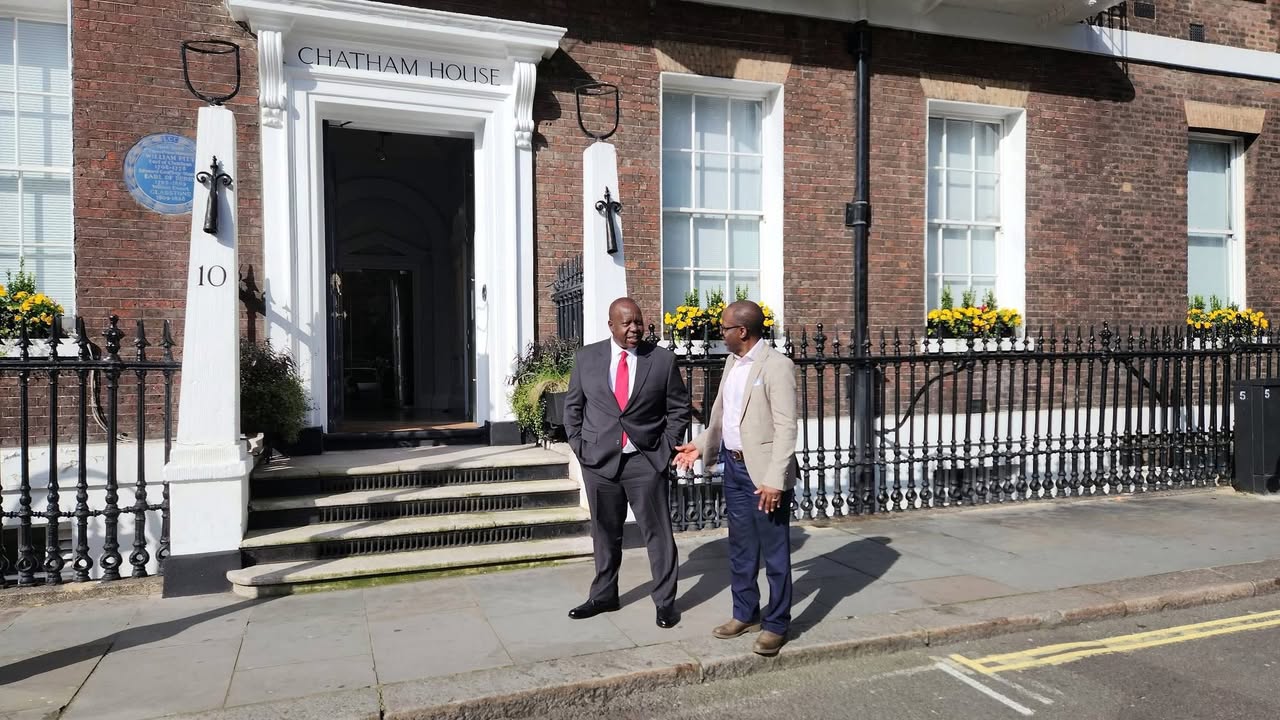
 Jubilee deputy leader Fred Matiang'i during his tour in the UK /FILE
In international diplomacy and policy circles, invitations often speak louder than campaign slogans.
Over the past two weeks, Jubilee leader Fred Matiang’i has delivered major policy addresses at two of the world’s most influential foreign policy institutions: Chatham House in London and the Center for Strategic and International Studies in Washington, DC.
Think tanks such as Chatham House and CSIS are not ordinary speaking venues. They are among the most respected policy forums in the world, regularly hosting presidents, prime ministers, cabinet ministers, senior diplomats and global business leaders.
Invitations to speak at these institutions are extended selectively, usually to individuals whose perspectives are considered relevant to global debates about economics, security and geopolitics.
When a Kenyan leader is invited to speak at such institutions, it signals that the international policy community sees that individual as someone worth listening to.
That is why Matiang’i’s appearances at both institutions have drawn attention among diplomats, analysts and observers of Kenya’s political landscape.
The fact that a Kenyan presidential contender was invited to present a vision for Kenya on two of the most prominent global policy stages says a great deal about how he is perceived internationally.
The contrast with other political figures is also noteworthy. Former Vice President and long-serving politician Kalonzo Musyoka has served Kenya in senior roles, including as Foreign Affairs Minister.
Yet despite those credentials, he has never been invited to address either Chatham House or CSIS. This is not a criticism of Kalonzo; rather, it highlights the reality that invitations to these forums are not automatic. They reflect recognition from international policy communities that a speaker has something substantive to contribute.
In his remarks in London and Washington, Matiang’i used the opportunity to outline a clear vision for Kenya’s next phase of development. His central argument was that Kenya’s future prosperity will depend on three interlocking pillars: stability, economic competitiveness and strong global partnerships.
First, he emphasised that stability and strong institutions are the foundation of economic growth. Investors and entrepreneurs, he argued, can manage risk but cannot manage unpredictability. Countries that build reliable institutions, enforce the rule of law and maintain policy consistency attract investment and create opportunity for their citizens.
Second, the former CS highlighted Kenya’s growing economic advantages. He pointed to the country’s leadership in renewable energy—particularly geothermal power—as a strategic asset that could attract manufacturing investment as global industries transition toward cleaner energy.
He also discussed Kenya’s globally recognised leadership in digital financial innovation and the potential for expanding technology-driven entrepreneurship across Africa.
Trade and infrastructure also featured prominently in his speeches. Kenya’s position as the gateway to East and Central Africa, anchored by the Port of Mombasa and the Northern Corridor transport network, places the country at the centre of regional commerce.
Improving logistics, strengthening regional integration and modernising infrastructure could expand economic opportunity across a region of more than 300 million people.
Finally, the former Interior CS emphasised the importance of international partnerships. Kenya’s cooperation with the United States and other global partners has produced significant benefits in areas such as public health research, security cooperation, education and economic development. In his remarks, he stressed that successful partnerships are those built not on dependency but on mutual capability and shared interests.
For Kenyan voters observing the early stages of the next presidential race, the broader significance of these appearances lies in what they reveal about leadership.
Matiang’i’s speeches at Chatham House and CSIS offered a glimpse of that kind of leadership. They demonstrated not only an understanding of Kenya’s domestic challenges but also a grasp of the global forces that will shape the country’s future.
As Kenya approaches another election cycle, voters will inevitably compare candidates on many grounds—experience, integrity and policy priorities among them. But they may also ask a broader question: which leader is best prepared to represent Kenya in the increasingly complex arena of global diplomacy and economic competition?
On that measure, the fact that Matiang’i has already stood before two of the world’s most respected policy institutions and delivered thoughtful, forward-looking speeches sets him apart.