Cheonggyecheon was a stream and a living waterway running through the heart of Seoul city. The leadership of Seoul had a city to build. And to build fast, visibly and at the scale that post-war industrialisation demanded. But the stream was inconveniently in the way.
So, the city buried it. More than 20 years starting in 1958, it poured concrete over it and built a 5.6km elevated highway on top. They called this progress. And for 30 years, it looked and felt like progress.
Then the rains kept coming. The buried stream had not gone anywhere. It had simply been denied space to flow, and water denied space finds another way; sideways, upward, into basements, into streets, into homes, into lives, into futures that were not yet finished and into the foundations of buildings constructed on the comfortable assumption that building approvals have been granted.
Development had not weighed the stream against the highway and chosen the highway. It had simply not weighed the stream at all. The water did not appear in the calculation. It appeared later, in the consequences. And when they came, were not poetic. They were statistical.
Seoul's flood losses averaged between KRW 2.867 billion and KRW 9.983 billion annually. By the 1990s, the elevated highway was itself rotting to the extent that the United States military reportedly warned its soldiers not to drive on it.
The monument to progress had become a liability. Lives disrupted every rainy season. Property destroyed on a reliable schedule. A city paying, year after year, the compounding interest on a decision that had never factored in the water. Seoul had not made a tradeoff. It had made an omission. And omissions, unlike decisions, cannot be defended. They can only be corrected.
In 2003, Seoul’s mayor did something that traffic engineers, business associations, the prevailing politics and a significant portion of the public declared politically suicidal. He tore the elevated highway down and restored the stream.
Every prediction said it would fail. The project was completed in 27 months. The city absorbed the shock, redesigned its bus routes and reclaimed a corridor that had been choking it for generations. The restored Cheonggyecheon reduced flood risk measurably, lowered urban temperatures and became one of Seoul’s most visited public spaces.
But here is the part of the Seoul story that does not make it into the inspirational summary. The mayor received death threats. Business associations took out newspaper advertisements predicting economic catastrophe.
Opposition politicians called it ideological vandalism. Thousands of people whose livelihoods were organised around the elevated highway faced disruption and were genuinely angry.
The project succeeded not because it was painless. It succeeded because the people responsible for it decided that the long-term cost of leaving the stream buried was higher than the short-term cost of restoring it. And they held that position under sustained, organised, well-funded opposition.
That is the part of the Seoul story that is relevant to Kenya. Not the stream. Not the 27 months. The holding of a position under pressure. Seoul answered that question in 27 months. Nairobi has been answering it in gumboot photographs for many decades.
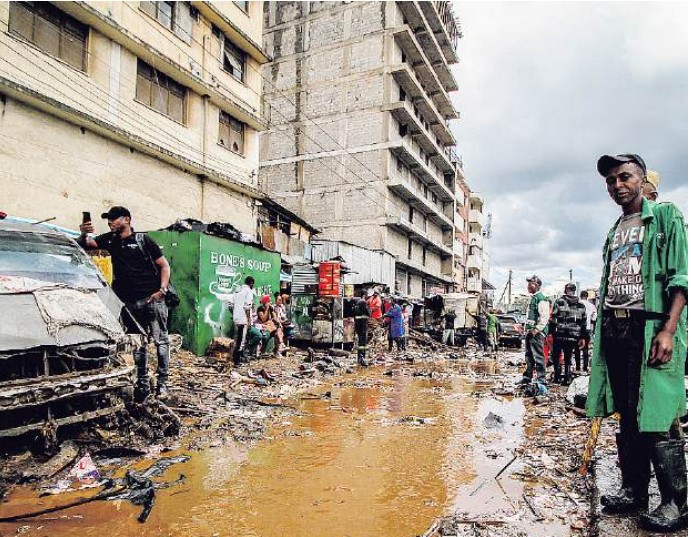
This week, and each time we experience heavy rains, a ritual unfolds in Nairobi with the precision of a liturgical calendar. Seoul’s past problems feel painfully familiar to any Nairobi resident. Floods. People die.
Homes are destroyed. Families lose everything they own, which in many cases is not much and in all cases is everything. We have slowly adjusted our expectations downward until dysfunction feels like weather which is something that happens to you, not something that could be changed.
The photographs appear on the front pages. Officials visit, wearing gumboots, expressing concern. A committee is announced, or an existing committee is reconvened. The rains ease. The water recedes. The report is written, or it is not. A few months down the road, the conversation has moved on.
And with the same predictability as interest on debt, the blame game continues as commentary on WhatsApp groups and in chamas. It’s the budget. It’s poor planning. It’s poor drainage. It’s an encroachment on riparian land. It’s poor leadership. It’s corruption.
And our solution is to change the leadership every election cycle.
Begs the question. Can a better driver fix a broken car?
Nairobi's flooding is not a drainage problem, a weather problem, or a population problem. It is not even, at its root, a budget problem. It is a land problem wearing drainage clothes.
The Nairobi River, Mathare, Ngong, Motoine, are not abstract geography. They are the reason this city exists where it exists. The British established Nairobi in 1899 because these rivers provided water for the Uganda Railway depot. The rivers were the original infrastructure. Everything else was built around them.
What happened to those rivers over the following century mirrors, with uncomfortable precision, what Seoul did to the Cheonggyecheon. They were first used as disposal channels.
Then informal settlements grew along their banks, structures were built on floodplains, drainage channels were blocked, sections of rivers were culverted and buried under roads, fancy apartments, commercial buildings and waste dumping sites. The rivers did not disappear. They were denied their channels. And every rainy season, they claim those channels back.
The Kenyan Water Act specifies a 30-metre riparian reserve on each bank of every waterway. This is not decorative legislation. It is the minimum spatial requirement for a river to function as a river rather than a pipe, to slow, absorb and manage the high-volume flows that the rainy season delivers.
But this reserve has been illegally occupied for decades with the full knowledge of government officials who have the legal mandate to prevent it. And do not.
This is the broken car. The car is a city that has spent 60 years making the same omission Seoul made by not weighing the water in the development calculation, then expressing surprise and concern when the water appears in the consequences.
So, will a new more competent leadership fix it?
Only if the new leadership is willing to do what Seoul's mayor did. Not the ribbon-cutting version of development. The death-threat version. The version where you make enemies.
Because the broken parts of this car have owners. The Nairobi River Regeneration task force found that there are about 4,000 buildings, structures and facilities on riparian land in Nairobi. Every structure in a riparian reserve is generating rent for someone.
Every drainage budget not spent is diverted to something else. Every enforcement action not taken is a conflict avoided with someone who has a patron.
Will they have the grit to name the owner(s), who approved it and demolish them like the Seoul elevated highway? You be the judge.
Any new leadership that does not understand this will arrive at City Hall, inherit the same broken car and spend their term changing lanes while the brakes continue to fail. We will watch. We will share the gumboot photographs.
We will convene the WhatsApp diagnoses. And in the next rainy season, the water will return to the Mathare corridor and the Ngong floodplain and the Nairobi River basin.
Because the water does not read electoral tallies. It reads gradient. It goes where it has always gone; downhill, along the path of least resistance, through whatever channel is available. And the aftermath is not pretty.
Finally, my unsolicited advice is to the next governor of Nairobi. Whoever you are, do not campaign on fixing the floods, the traffic jams, or the waste.
A campaign to fix the systems that produce these failures. There is a difference, and your voters deserve to hear it. Fix these systems and the outcomes diminish.
Fix the outcomes without fixing the systems and you are, at best, a faster bucket in a sinking boat. The floods will return. The jams will thicken. The waste will find the nearest drain. And the water, as it always does, will go exactly where the system tells it to go. Do you have the grit?
To the rest of us, the question for Nairobi is not whether we can find a better driver. It is whether we are ready to fix the car, and whether we understand, finally, that fixing it will hurt before it helps.
The pessimist complains about the wind. The optimist expects it to change. The leader adjusts the sails - John Maxwell