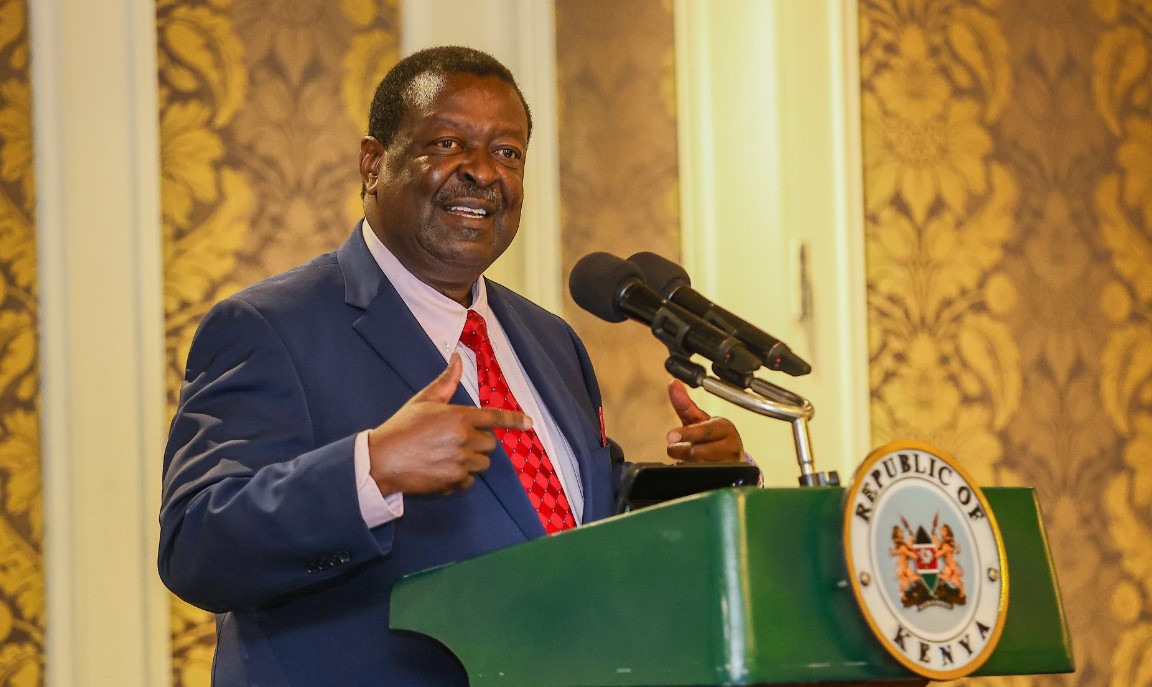
The image of Prime Cabinet Secretary Musalia Mudavadi boarding a flight to a global capital has become a recurring motif of Kenya‘s foreign policy in 2026.
Officially, these journeys are framed as missions of economic diplomacy or strategic partnership.
However, beneath the veneer of high-level shuttle diplomacy lies a growing tension: a foreign policy deliberately designed to be "ambiguous" is being stress-tested by the real and dire plight of its citizens caught in the crosshairs of foreign wars.
The foreign policy stance, recently codified in the Sessional Paper No 1 of 2025, is what officials describe as a pragmatic response to a volatile world.
Tabled in early 2025, this paper serves as a comprehensive update to Kenya's 2014 Foreign Policy.
It is designed to modernise the country's diplomatic approach, moving it away from ‘opaque’ traditional international relations toward a more transparent, citizen-centred and strategic framework.
This includes employing a strategically non-alignment approach—maintaining cordial relations with Washington, Beijing, Moscow and Tel Aviv simultaneously, even when these powers are at odds.
But this has not always worked in the favour of Kenyans.
Despite its proactive stance,this approach faces critical failure points regarding the US-Israel versus Iran conflict for instance.
With more than 500,000 Kenyans in the Middle East, the ‘Diaspora Pillar’ lacks a concrete, rapid-response evacuation framework for a large-scale regional war.
And while the state began evacuating and repatriating citizens from major hubs like Dubai, analysts say Kenyans in more remote or strictly controlled areas of Iran and Lebanon face significant communication blackouts and travel restrictions.
Likewise, this balancing act has been laid bare in the recent past, where families in Nairobi are demanding answers regarding over a thousand young men lured to the front lines of the Russia-Ukraine war.
An intelligence report presented to Parliament reveals that more than 1,000 Kenyans have been recruited to fight for Russia in its war against Ukraine.
At least 89 are currently on the front lines, with 28 missing in action, 39 hospitalised and one confirmed dead.
The recruits, promised salaries of up to Sh350,000 a month for security jobs, were instead given minimal training and deployed to combat zones in places like Donetsk.
The intelligence dossier reveals a deeply disturbing network of collusion involving rogue Kenyan and Russian officials, including airport staff and immigration officers, who facilitated the travel.
While the Russian embassy in Nairobi has denied any official involvement, Musalia has admitted that more than 600 recruitment agencies have been shut down.
He is due to travel to Moscow to negotiate the release of the remaining men—a diplomatic approach he describes as necessary to "rein in" those exploiting Kenyans.
For the families who feel geopolitics is secondary to the immediate need for action, the government's diplomatic posture feels dangerously passive.
On March 5, the families held a protest in Nairobi petitioning Parliament to speed up these negotiations, as many have not heard from their sons since the Iran-related regional tensions began further complicating global travel.
Legally, the state is obliged to protect its citizens abroad.
However, as the Prime CSsaid last year, the tools available are often blunt, urging Parliament to strengthen laws against rogue agencies.
The crisis highlights the gap between policy and practice. While the Sessional Paper aims to boost diaspora diplomacy, it does little to extract a citizen who has been forcibly enlisted in a foreign army.
Ukraine’s Ambassador to Kenya, Yurii Tokar, said that prisoners of war are typically only released at the end of hostilities under the Geneva Conventions, suggesting a long and painful wait for families.
Kenya's position is further complicated by its contradictory global partnerships. It remains a key strategic partner for the United States, hosting the ‘Justified Accord 2026’ multinational military exercise this month.
It is also the only country in the Horn of Africa to have joined a US-led coalition against the Houthis, yet it maintains deep trade ties with Russia and a strategic partnership with the US, its second-largest export destination.
Analysts suggest this is the cost of a multi-alliance approach—while lucrative on paper, it creates a paralysis when a partner state is accused of trafficking Kenyan citizens into a war zone.
Musalia's shuttle diplomacy may keep Kenya amiable on the world stage, but for citizens caught in the fog of war, the ambiguity feels less like strategy and more like abandonment.