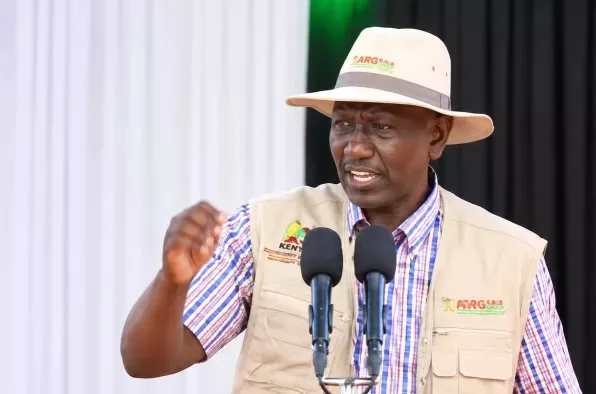
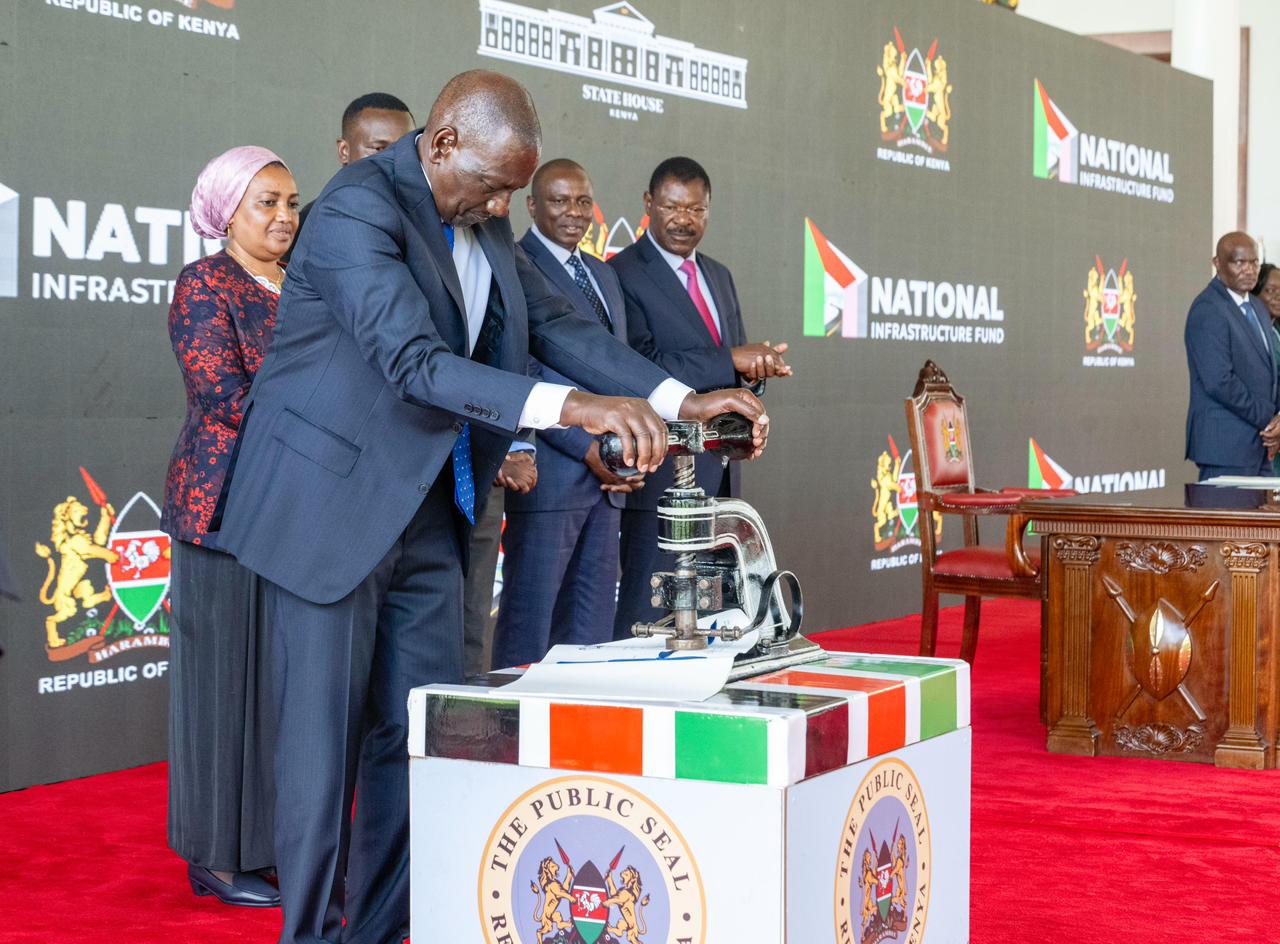
 President Ruto using a desk seal press to put an official stamp to the National Infrastructure Fund bill on March 9, 2026 /PCS
The government recently launched the National Infrastructure Fund and established the legal framework to implement it.
President William Ruto assented to the law in early March, paving the way for the constitution of its board of management and other governance structures. Henceforth, this will be the main avenue for raising resources for national development projects.
Kenya, like other developing countries, has historically relied on external assistance from the First World to fund major development projects. At the initial stages, soon after Independence, the former colonial masters were the first port of call for emerging nations.
In their effort to establish and maintain strategic interests, more developed countries offered development assistance with heavy conditionalities.
These loans often came through the Bretton Woods institutions of the World Bank and the IMF. The two institutions were controlled by the United States and her allies in the NATO and pushed their Cold War agenda.
Then along the way came Japan and most recently China entered the scene with a bang. The Chinese took advantage of the end of the Cold War to entice the Global South with support in trade development.
Initially, this appeared balanced and lucrative but it has proved to be equally expensive as any other commercial loan. Kenya’s ambitious development plan under the Beta policy was at peril if no such innovative initiative was designed.
Massive infrastructure projects such as the Rironi-Mau Summit Road, the Naivasha-Kisumu Standard Gauge Railway and the dualling of Mombasa and Machakos roads would all meet a dead end.
The affordable housing project requires a significant supply of electricity and water. These require injection of huge capital that the government can only obtain at exorbitant cost from the international financial markets.
The National Infrastructure Fund (NIF) in Kenya, signed into law by President Ruto in March is a strategic vehicle aimed at mobilising Sh5 trillion over the next decade to finance major projects — such as roads, dams and energy — through private sector investment rather than increased sovereign debt.
The fund will be capitalised through proceeds from the privatisation of state assets, starting with Sh106 billion from the Kenya Pipeline Company IPO.
The main objective of this state apparatus is to shift national development funding from a debt-driven model to an investment-led model for infrastructure, focusing on commercially viable projects to reduce the debt burden.
It targets initial sources for resourcing from proceeds of privatisation (e.g., KPC, potential Safaricom stake sales), public-private partnershipsand institutional capital (pension funds, etc).
From its blueprint, the initiative aims to undertake mega projects, including 10,000MW of clean energy, 50 mega dams, 2,500km of dual carriageways, 28,000km of roads, SGR expansion to Malaba-Kisumu and JKIA modernisation.
The statutory framework has ringfenced its governance structure as an independent corporate entity with a board of directors to ensure professional management, overseen by a governing council. It has inbuilt fiduciary deterrents that include strict penalties for misappropriation and oversight by the Office of the Auditor-General.
The NIF is designed to operate independently, with a five-year investment policy to protect project funding from political cycles with the broad objective to lower transportation and logistics costs, stimulate job creation, and accelerate industrial growth.
Progressively, national external debt has been growing, diminishing the opportunity for transformative development projects. On December 12, 1963, Kenya’s external relations were defined by a swift transition from British colonial rule to a sovereign state within the Commonwealth, initially as a constitutional monarchy.
The nation adopted a pro-Western, anti-communist foreign policy while navigating Cold War tensions and establishing its diplomatic footprint in major global capitals.
The founding administration inherited a relatively modest debt burden of about Sh1.72 billion (about $240 million at the time). This initial debt was mostly related to development projects and was considered manageable as the economy was growing by 6.5 per cent annually during the first decade, maintaining a stable external balance.
However, a decade later Kenya’s total external public debt was about $845 million. This marked a significant 45.4 per cent increase from $581 million in 1972, driven by the first oil crisis and increased borrowing. Despite this, the debt-servicing ratio remained low, although the era marked the beginning of heavier external borrowing.
Kenya’s total external debt in 1998 was about $6.82 billion. During this period, the country was experiencing a challenging economic environment, with the external debt-to-GNI ratio hovering around 49 per cent.
The government was also managing significant debt arrears, including a notable $70.95 million rescheduling agreement with the Banque Nationale de Paris. In 2003, Kenya’s total external debt was about $3.6 billion in Net Present Value terms.
The total external debt stock for that year was reported to be around $6.72 billion. During this period, the country was experiencing a relatively low, stabilising external debt, with a record low of Sh361.731 billion achieved in May.
As of early this year, Kenya’s external debt stands at about Sh5.46 trillion to Sh5.48 trillion ($41-43 billion), contributing to a total public debt of more than Sh12 trillion.
While the external debt has stabilised due to a stronger shilling, it represents a high-risk factor, with debt servicing consuming more than 71 per cent of government revenue.
It is therefore clear that the national external debt has steadily been rising since Independence. The financing has become expensive to taxpayers and yet the country requires intense investment in transformative development projects.
The answer lies squarely in innovative internal resource mobilisation. NIF has responded appropriately to this challenge. It is commendable that the government has made considerable strides in meeting its debt obligations.
However, the demands for fresh funds to finance development projects is a heavy burden on the shoulders of the current coalition of the broad-based government. The NIF as crafted is a game changer in national reconstruction and renaissance. It speaks directly to the heart and spirit of the pan-African dream.
Envisaged by the region’s founding fathers as emancipation from the shackles of neocolonialism, the ideology foresees a united continent with sufficient resources for consumption and development.
The African continent is arguably the richest in terms of natural resources, including rare minerals used by giant tech companies on the cutting-edge digital economy.
It is these resources that led to its colonisation and later its puppet status in the neocolonial chess game. Control of destiny can only be meaningfully achieved through self-reliance in supporting society’s consumption and development needs.
Economic self-reliance logically assures of true political independence. This was the passionate dream of the Independence leaders. Pan-Africanist ideas first began to circulate in the mid-19th century in the United States, led by Africans from the Western Hemisphere.
The most important early Pan-Africanists were Martin Delany and Alexander Crummel, both African Americans, and Edward Blyden, a West Indian.
The first African-born Prime Minister of Ghana, Kwame Nkrumah, was a prominent Pan-African organiser whose radical vision and bold leadership helped lead Ghana to independence in 1957.
Through the OAU and currently the AU, Pan-Africanism has been at the core of Africa’s economic and political freedom. Agenda 2063 is the continent’s blueprint and master plan for transforming Africa into the global powerhouse of the future.
It is the concrete manifestation of how the continent intends to achieve this goal within a 50-year period. President Ruto is realising and living the dream in this lifetime.