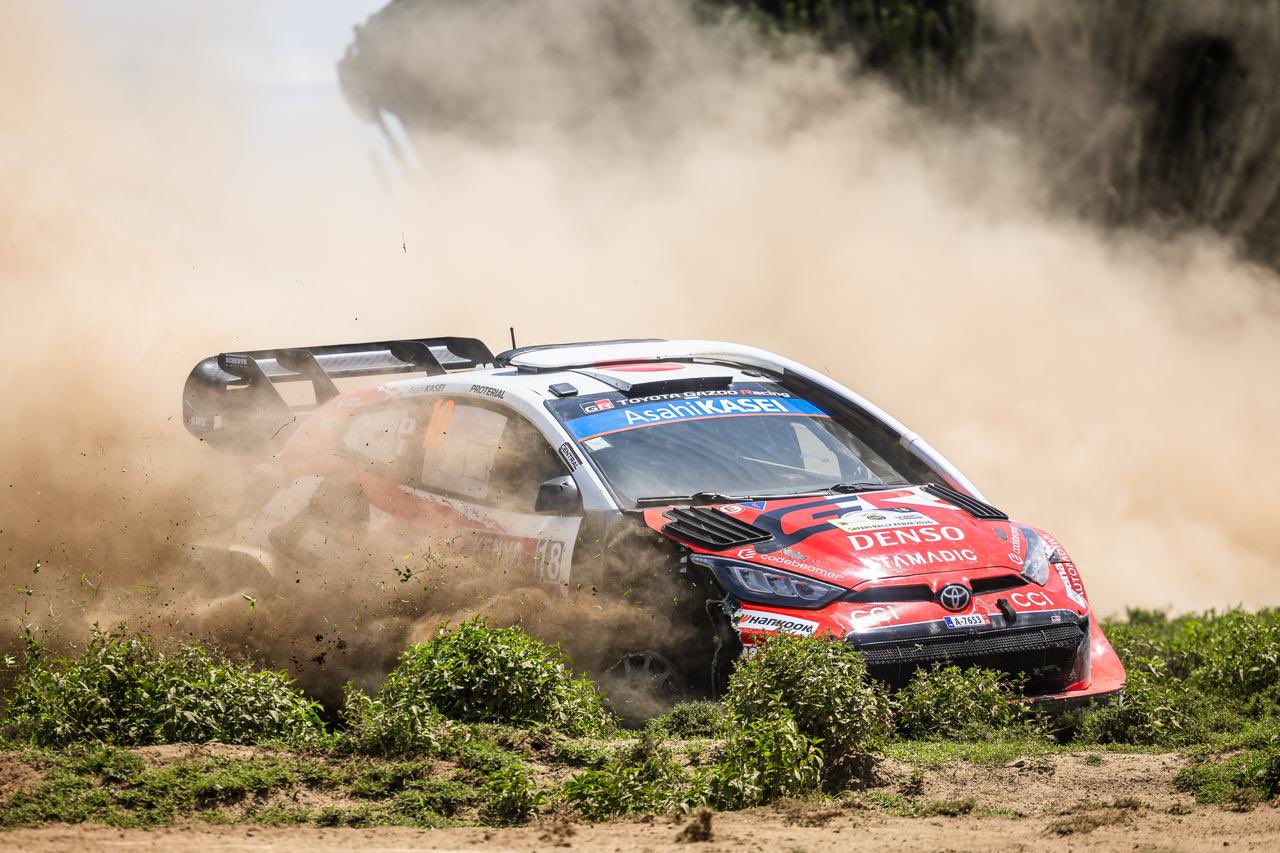
 Takamoto Katsuta in action during day three of WRC Safari Rally/ TAKAMOTO KATSUTA
The legendary Safari Rally Kenya once again proved why it is regarded as the toughest round of the World Rally Championship, with mechanical failures and punishing terrain forcing four drivers into retirement during a dramatic third day of action.
Amid the chaos, Takamoto Katsuta emerged as the man to beat, keeping his composure while several title contenders fell by the wayside.
Toyota Gazoo Racing suffered the biggest blow from the unforgiving Kenyan terrain, losing three of their leading drivers before Saturday’s afternoon loop. Championship leader Oliver Solberg, nine-time world champion Sébastien Ogier and defending champion Elfyn Evans were all forced to retire following mechanical setbacks that cut short their campaigns during the morning stages.
Read Also
The drama also struck Hyundai Motorsport as Thierry Neuville endured a nightmare start to the afternoon loop, suffering three punctures in the opening stage and effectively derailing his charge.
Through the turmoil, Katsuta held his nerve and heads into the decisive final day, the famed Super Sunday, firmly in control of the rally. The Japanese driver leads the standings with a cumulative time of 2:41:00.2, opening up a 1 minute 25 second advantage over Hyundai’s Adrien Fourmaux, who sits second on 2:42:25.7.
Young Finnish driver Sami Pajari occupies third place overall with a time of 2:46:29.3.
Saturday’s action roared into life at SS11 Soysambu, where Solberg set the early pace with a blistering 15:18.9 to top the stage timesheets. Evans followed closely on 15:22.0, while Fourmaux (15:33.9) and Katsuta (15:36.2) remained within striking distance in a tightly contested opener.
At SS12 Elementaita 1, Ogier stamped his authority on the rally with a masterclass run, clocking the fastest time of 11:16.3. Fourmaux followed on 11:24.4, with Neuville posting 11:30.1, Esapekka Lappi recording 11:30.2, and Katsuta completing the top five on 11:35.3.
It was during this stage that Evans was forced into retirement after suffering suspension issues on the rear right side of his car.
Ogier then capped the morning loop in style by winning SS13 Sleeping Warrior 1 with a time of 11:32.3. M-Sport Ford World Rally Team driver Jon Armstrong followed in 11:48.5, while Katsuta placed third with 12:01.7.
However, the demanding Sleeping Warrior stage also claimed more victims, with Solberg and Ogier both retiring after their cars developed alternator problems.
After the morning loop, Katsuta stressed the importance of staying calm as the rally headed into its notoriously unpredictable afternoon phase.
“I think the afternoon is still going to be tricky, but you never know how it will be,” he said.
“Anything can happen today and tomorrow, so we need to stay focused.”
The afternoon loop resumed with SS14 Soysambu 2, where Fourmaux set the fastest time of 15:12.8, narrowly beating Katsuta (15:13.5) and Lappi (15:28.3).
Pajari then bounced back to claim victory on SS15 Elementaita 2, blasting through the stage in 10:45.3. Katsuta followed in 10:50.0, while Fourmaux completed the top three in 11:08.0.
The day’s final test, SS16 Sleeping Warrior 2, was ultimately cancelled after heavy rainfall left the stage dangerously deteriorated.
In an official statement, WRC officials confirmed that deep, water-filled ruts made the route unsafe for rescue vehicles.
With the stage scrapped, attention now turns to the decisive Super Sunday, where crews will tackle SS17 Oserengoni 1, SS18 Hell’s Gate 1, a repeat run through Oserengoni, before the rally reaches its climax at Hell’s Gate with the all-important Wolf Power Stage.