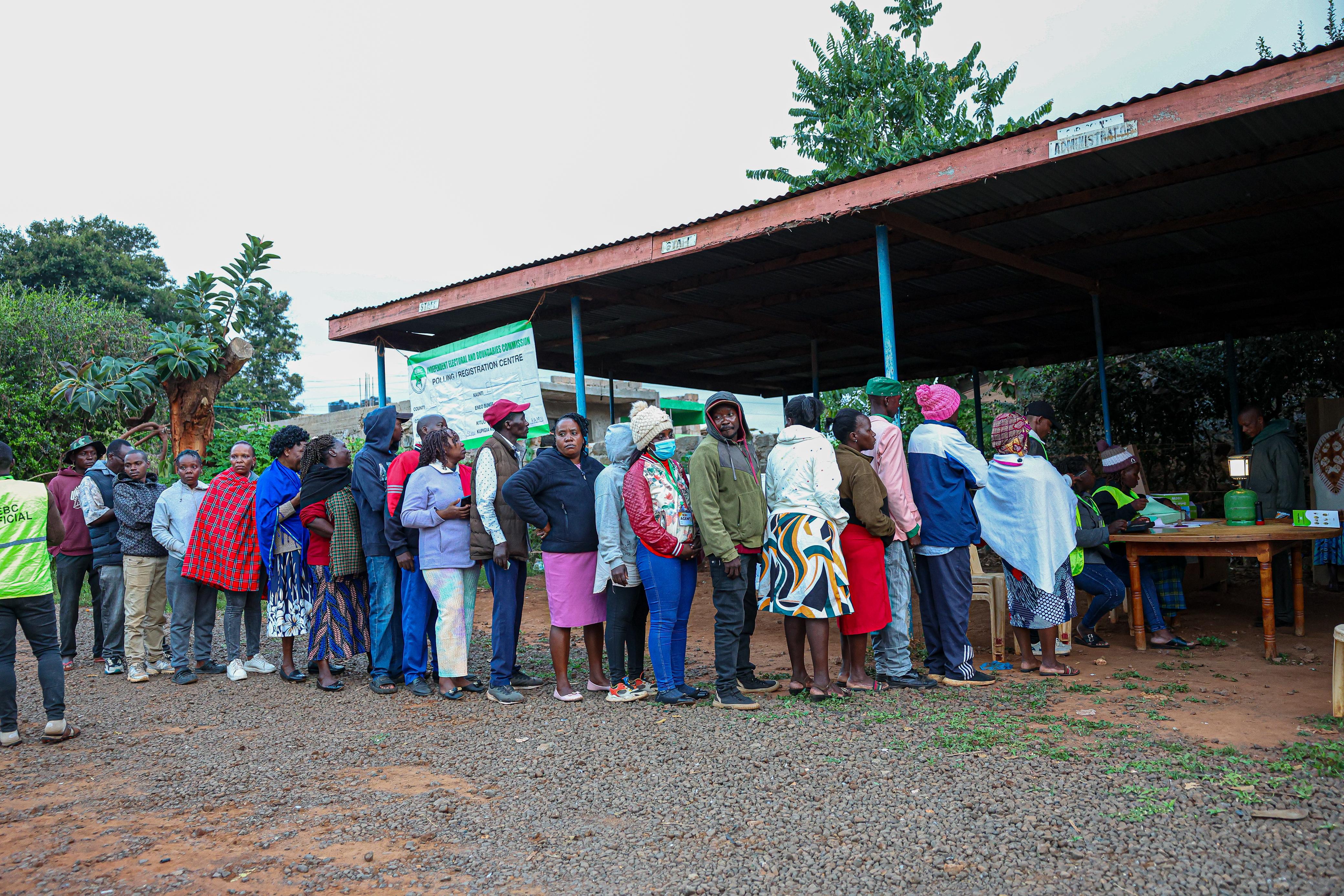
Unlike the system for electing presidents here, when MPs, members of county assemblies and governors are being elected the winner does not have to achieve more than 50 per cent of the votes cast but is just the person who gets the largest number of votes. This is sometimes called the 'first past the post' system, or more formally, the plurality or majoritarian system.
It is used for most elections in the UK, India and Canada, for example. Its advantage is its simplicity. Its disadvantages include that, especially where there are lots of candidates, the winner may have quite a small percentage of the votes and therefore many more people voted against him or her.
The system may also have the result that the body elected - National Assembly, Senate or county assembly - does not reflect the real preferences of the electors. A party may win perhaps 40 per cent of the votes but win far more than 50 per cent of the seats, for example.
Let me say that the constitution does try to avoid some consequences of the FPP system by insisting that Kenya should gradually move towards constituencies of equal size, which means votes of more equal value. On the other hand, the women representatives system (one person for each county whatever the size) ensures that equality of value of votes can never be achieved.
What are electoral systems?
Apart from ours, various other systems are found around the world. I shall briefly describe the main ones.
Most different from ours is probably the “list proportional representation” (list PR). Instead of smallish areas with one or two MPs, a country is treated as a single constituency, or the country is divided into large constituencies with many members each. Each party submits a list (in order of the party’s preference) and voters vote for a list, not for individuals.
Each party actually gets seats on the basis of how many voters chose their list. Often only parties can contest - not individuals - although this is not true of all list PR systems.
(We have a small echo of this in our so-called nominated members in Parliament and county assemblies. The number of these seats a party gets depends on how many constituency or ward seats it has won - although most voters probably don’t really understand that they are voting for a list as well as for an individual.)
This list PR system is used in South Africa. Its main virtue is that it ensures that the legislative agency really reflects the voters’ choices - this is proportionality. If 35 per cent of voters vote for party A that party gets 35 per cent of the seats. It also encourages parties to appeal to all voters, and thus to include women and persons with disability. South Africa achieved at least one third-women MPs without any need for a law to enforce it.
A system used in Ireland also produces a proportional result because each constituency has several members and voters can vote for several - giving their first choice, second choice, etc. (‘single transferable vote’). How the votes are counted is very complex, and mysterious to most voters. Having to rank several candidates can be a challenge for some voters.
Run-offs
The run-off or two-round system is used for the president here: if no-one gets more than 50 per cent at first, the two people with the highest vote totals contest a second round. (By the way, ‘50 per cent + 1’ is not the right description. In theory, two candidates’ vote totals could differ by only one vote, with the winner having only half a vote more than 50 per cent.)
The two-round system is used in France for the president and for MPs, and a court case here in Kenya is arguing it should be used here not only for the president.
This would add considerably to the cost of elections - already about the most expensive in the world, we are told. I looked quickly at the Kenyan results for 2013 (the election most clearly analysed on the IEBC website).
While in some counties the winner in most parliamentary constituencies was clear, in other counties half or fewer of constituencies had such clear winners. In Nairobi only eight of 17 MPs elected had obtained more than 50 per cent of votes cast; in Machakos four out of eight, in Mombasa two out of six and in Trans Nzoia one out of five. There would be a lot of run-off elections.
The hiatus between rounds of elections may be a period of uncertainty and even unrest in some countries.
Another possibility is sometimes called the ‘instant run-off’ - the alternative vote. People do not vote by ticking just one name on the ballot paper. They rank their choices. If no-one gets more than 50 per cent of the votes, the candidate who got the fewest is eliminated. Their votes are allocated to their second choices. This process is repeated until one person gets more than 50 per cent.
This system is used in some elections in Australia, Ireland and the United States. It frees voters to express their true preference as first choice, but then perhaps have a more likely winner as second choice. It can be used by parties to bargain with each other about how to advise their supporters to vote.
It is not a ‘proportional system’; indeed. it may be less proportional than FPP.
People may find the exercise of ranking candidates difficult. They may find it hard to understand why the apparent ‘winner’ after the first round may eventually lose. This was the experience in Fiji when the system was used in 1999.
And there is a general reluctance to change voting systems - one reason why the British electorate rejected the alternative vote idea for parliamentary elections in a referendum in 2011.
The constitution
The Kenyan constitution excludes any possibility of list PR or single transferable vote because it gives every constituency, county, or ward only one MP, senator or MCA.
It prevents a run-off or an alternative vote system for governors - because “The governor is the person who gets the largest number of votes” (Article 180(4)). So, elections of governors can only be conducted on the “first past the post” system.
It does not use this language for election of constituency MPs, women reps or county senators. On the other hand, it does not mention any possibility of run-offs in those elections.
I would argue that the current constitution focuses on getting ‘more than 50 per cent’ for presidents because even the old constitution had the special rule that presidents must get a spread of support across the country. And ensuring that the president really had national support was emphasised in public input to the constitution process. There was no deliberate decision to exclude run-offs for MPs, senators or MCAs.
In fact, there is one situation in which a run-off may be held for seats other than for president: in the unlikely event of a tie between two candidates.
The Election (General) Regulations say, “Where a county governor, parliamentary or county assembly election results in a tie, the commission shall proceed to conduct fresh elections.” (This is not the solution in all countries. In the UK, the returning officer decides by drawing lots or even tossing a coin).
Conclusion
I have no idea what arguments are to be made in the court case mentioned in the media. However, my view at this point is that the constitution does not exclude the possibility of legislation creating a run-off or alternative vote system for MPs, senators and MCAs (but it does for governors, except in the case of a tie).
On the other hand, I doubt that the courts would decide that such a change in electoral laws must be made. The constitution deliberately left the choices of system to Parliament, with public participation - not to the courts.
We shall see what the court decides.