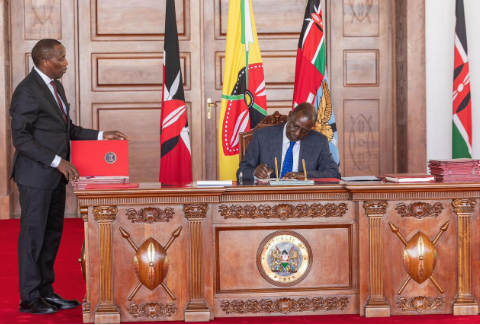
President William Ruto has signed three laws, ushering in reforms seeking to revitalise Kenya’s coffee sector, modernising meteorological services, and improving railway financing.
The Coffee Bill (Senate Bill No. 10 of 2023), the Meteorology Bill, 2023 (Senate Bill No. 45 of 2023), and the Miscellaneous Fees and Levies (Amendment) Bill, 2026 — reflect the government’s ongoing push to restructure key economic sectors.
Coffee sector overhaul
Read Also
The Coffee Bill, sponsored by Kigumo MP, James Murango and co-sponsored by majority leader Kimani Ichung’wah, introduces sweeping changes intended to revive Kenya’s once-thriving coffee industry.
At the heart of the legislation is the reorganisation of the sector through the creation of the Coffee Board of Kenya, which will take over both regulatory and commercial oversight functions currently performed by the Agriculture and Food Authority.
The new board will serve as the central regulator and promoter of Kenya’s coffee industry, processing applications for permits and licences, registering coffee dealers and coordinating sector-wide strategies, policies and funding models.
It will also be responsible for collecting and maintaining industry data, conducting market intelligence and surveys, and promoting Kenyan coffee in both domestic and international markets.
A key component of the law is the strengthening of branding and traceability of Kenyan coffee through support for the Kenya Coffee Mark of Origin, alongside the promotion of regional coffee appellations.
The legislation seeks to deepen research and innovation in the sector. Research currently undertaken by the Coffee Research Institute under the Kenya Agricultural and Livestock Research Organisation will transition to a newly established Coffee Research and Training Institute, expected to focus on advancing agronomic research, farmer training and technology adoption.
Working alongside bodies such as the Kenya Bureau of Standards and the Capital Markets Authority, the Coffee Board will develop industry standards and codes of practice, facilitate technology transfer to county governments, and build capacity among growers, cooperatives and traders.
The board will also regulate coffee marketing and trading, coordinate Kenya’s representation in international coffee forums and promote digital marketing strategies aimed at expanding global demand for Kenyan coffee.
Modernising meteorological services
President Ruto also assented to the Meteorology Bill, 2023, sponsored by Senate Majority Leader Aaron Cheruiyot.
The law establishes a comprehensive legislative framework to regulate meteorological services in Kenya and to coordinate the delivery and monitoring of weather and climate-related services across the country.
It aligns Kenya’s meteorological systems with international obligations under the Chicago Convention on International Civil Aviation and global standards developed by the World Meteorological Organization and Unesco through its Intergovernmental Oceanographic Commission.
A major institutional reform under the new law is the creation of the Kenya Meteorological Service Authority, which will house the existing Kenya Meteorological Department as well as the Institute for Meteorological Training and Research under a new organisational structure aimed at improving efficiency and coordination.
The law also establishes the Meteorology Training and Research Directorate, the successor to the current Institute for Meteorological Training and Research. The Directorate will serve as the designated regional training centre of the World Meteorological Organization, offering certificate, diploma and professional courses in meteorology, operational hydrology and related sciences.
To ensure a seamless transition, the law includes detailed provisions addressing the transfer of court proceedings, assets, liabilities, contracts and staff as the current department and institute wind down and are reconstituted under the new authority.
Experts say the reforms are expected to enhance the quality and reliability of weather forecasting, strengthen climate research and improve Kenya’s compliance with international meteorological treaties and conventions.
Expanding railway financing
The President also signed the Miscellaneous Fees and Levies (Amendment) Bill, 2026, sponsored by Majority Leader Kimani Ichung’wah.
The amendment expands the scope of the Railway Development Levy by revising Section 8 of the Miscellaneous Fees and Levies Act (Cap. 469C). Previously associated primarily with financing the construction and operation of the Standard Gauge Railway, the levy will now support a broader range of railway transport infrastructure projects.
By widening the mandate of the levy, the government aims to mobilise sustainable financing for strategic railway expansion across the country while strengthening the institutional framework governing the management and utilisation of the fund.
The move is expected to support long-term investment in freight and passenger rail networks, reduce pressure on road infrastructure and enhance Kenya’s logistics competitiveness within the region.
Strategic legislative push
The trio of laws signals a coordinated legislative push by the administration to strengthen key economic and institutional pillars — agriculture, climate services and infrastructure.
Together, the reforms seek to revitalise high-value export crops, modernise scientific services critical for aviation and climate resilience, and unlock new funding streams for national transport infrastructure — areas the government has identified as central to Kenya’s economic transformation agenda.