
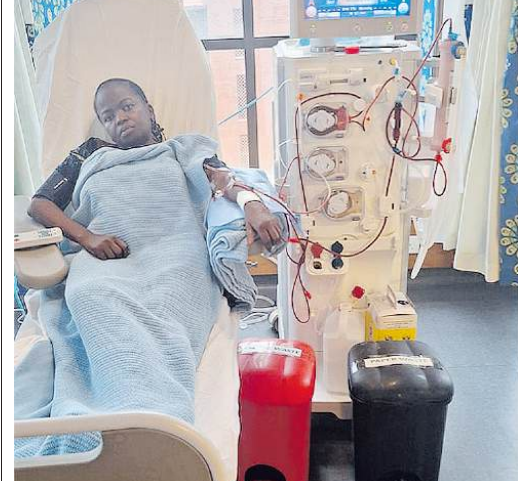
 Mary Wanjiku in hospital/CHARITY CHIGULU
What began as ordinary fatigue for Mary
Wanjiku in 2007 quickly turned into a life-altering medical journey.
At just 21, she began experiencing persistent vomiting and frequent nosebleeds. A medical check-up revealed hypertension, and a year later, she was diagnosed with kidney failure.
“The news devastated me. My life came to a stop,” Wanjiku recalls.
Doctors advised immediate dialysis, but she struggled to accept the reality. “I was in denial,” she says.
After two months in the hospital, she reluctantly began treatment.
At the time, Kenyatta National Hospital (KNH) was the only public hospital offering dialysis, making access difficult for many patients.
Two years later, Wanjiku opted for a kidney transplant after her aunt donated a kidney, giving her a renewed sense of hope.
“I was able to resume my normal life,” she says.
But the relief was temporary. By 2013, complications returned, and she went back on dialysis.
A second transplant in India, this time with her mother as donor, brought new challenges.
“The only hurdle was finances,” she explains.
With family, friends and support from the then National Hospital Insurance Fund (NHIF), she managed to undergo the procedure.
By 2017, she faced another blow: a rare form of tuberculosis affecting her blood severely damaged her kidney function. She has been on dialysis again since 2018.
“I have not urinated for the past eight years,” she says quietly.
The demanding treatment schedule has disrupted her career and personal life, straining relationships and leaving her social circle diminished.
Yet, she remains hopeful for a third transplant, estimating the cost at Sh15 million, of which Sh4 million has already been raised.
Kelvin Mabishi, 26, began experiencing persistent headaches in 2023.
Initially self-medicating, he later discovered he had high blood pressure and subsequent tests in 2024 revealed kidney failure. By the time he sought treatment, his vision had started blurring.
“The doctor told me I shouldn’t even be walking because my kidneys had shut down,” he says.
Kelvin found dialysis daunting and delayed treatment for nearly a month, hoping for another solution. Today, he has been on dialysis for two years.
The treatment has forced him to leave his hotelier job, relying on parents and friends for support.
Doctors recommend three sessions per week, but he can afford only two, covered by the Social Health Authority (SHA). The third session costs between Sh10,000 and Sh11,000—funds his family cannot spare.
Despite the challenges, Kelvin remains determined and urges increased awareness that kidney disease can affect young adults, not just the elderly.
For Mary Mumbi, her journey began in 2008 after a tragic accident. Pregnant with her first child, she slipped while bathing and fell into a coma for two months. Sadly, she lost her baby.
Doctors later revealed her fall had ruptured a kidney, forcing her onto dialysis.
Five years later, her sister donated a kidney, allowing a successful transplant in 2012.
The procedure restored her health, and she later delivered two healthy children.
But in 2019, her kidney function declined again, forcing a return to dialysis.
Today, she depends on her husband and family, struggling to raise the weekly Sh10,000 required for the third dialysis session. She calls for expanded SHA coverage to include more dialysis sessions and support for kidney transplants.
Experts warn that kidney disease in Kenya is widespread and often preventable. Dr Jonathan Wala, president of the Kenya Renal Association, explains that kidney failure may be acute or chronic.
Acute kidney failure can result from severe diarrhoea, childbirth complications, infections or prolonged use of painkillers, while chronic kidney disease develops slowly, often unnoticed in early stages. Uncontrolled diabetes and hypertension remain the leading causes.
By stages four and five, symptoms such as vomiting, swelling and loss of appetite become evident, necessitating dialysis or a transplant.
Dr Wala emphasises early detection: annual kidney function tests for the general population and twice-yearly checks for those with diabetes, hypertension or obesity.
Kidney transplants remain the most effective treatment for end-stage disease, but patients must take lifelong immunosuppressive drugs, costing Sh30,000 to Sh40,000 per month.
Dr Stephen Mutiso highlights the scale of the challenge: one in 10 Kenyans live with some form of kidney disease, with 3.1 million affected by chronic kidney disease.
Only 7,000 patients are currently on dialysis, and 100–150 transplants are performed annually.
Uncontrolled diabetes accounts for 60 per cent of cases, high blood pressure 25 per cent, and repeated painkiller use three–five per cent.
Kidney disease is a leading cause of death in Kenya.
Non-communicable diseases account for 62 per cent of hospital admissions and 43 per cent of fatalities, with chronic kidney disease among the top killers.
Experts stress that parents must pay attention to children suffering from severe malaria, diarrhoea, vomiting, or sepsis, as these conditions can quickly lead to kidney damage.
Globally, 850 million adults live with kidney disease, causing 1.5 million deaths each year—roughly one death every 20 seconds.
If current trends continue, kidney disease could become the fifth leading cause of death worldwide by 2040.
Awareness, early detection and access to dialysis and transplants remain the most powerful tools to prevent tragedy.
For Wanjiku, Mabishi and Mumbi, hope remains their lifeline.
“The hope for a better tomorrow keeps me going,” Wanjiku says.
Across Kenya, thousands of others like her continue the fight—balancing survival, treatment costs and daily life—relying on family, faith and the fragile promise of medical intervention.
Instant analysis
Kidney disease in Kenya is a growing public health crisis, disproportionately affecting young adults and women, as illustrated by the experiences of Wanjiku, Mabishi and Mumbi. Access to dialysis and kidney transplants remains limited, expensive and reliant on family support or partial coverage from the Social Health Authority. Uncontrolled diabetes, hypertension and delayed diagnosis drive most cases, while gaps in awareness and preventive care exacerbate outcomes. Despite the availability of transplants in Kenya, high costs and lifelong immunosuppressive therapy remain barriers. Urgent investment in early detection, affordable dialysis, public education and expanded government support is crucial to reduce mortality and improve quality of life.







