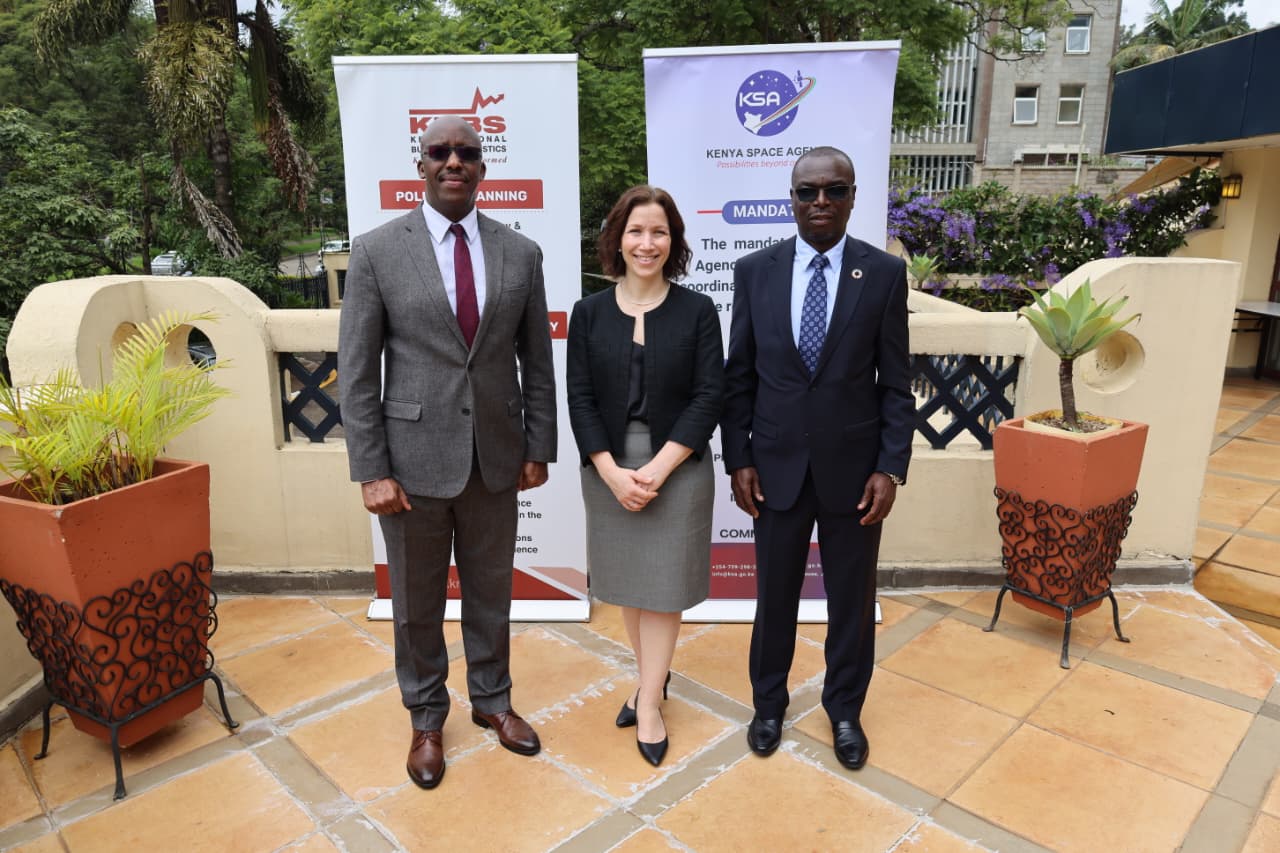
Kenya continues to lag behind its peers in space growth despite the country’s strategic geographical advantages, such as its location along the equator for cost-effective satellite launches.
This was revealed by the Director General, Kenya Space Agency (KSA), Brigadier General Hillary Kipkosgey.
Kipkosgey was speaking during a media briefing at a Nairobi hotel ahead of the upcoming Global Data Festival and Kenya Space Expo & Conference (KSEC).
The expo is scheduled to take place from 2–5 June 2026 at the Edge Convention Centre in Nairobi.
“One of the biggest challenges we face as a state agency is limited funding to propel the growth of this sector. We remain heavily reliant on grants and international partnerships, which are not sufficient to compete with our peers on the continent. We also face a shortage of specialised skills, infrastructure, and substantial investment from both the public and private sectors,” Kipkosgey said.
He further stated that the upcoming expo will create a platform where both local and international investors can easily tap into the country’s space sector for economic development.
The four-day event, organised under the theme ‘Powering Resilience, Innovation, and Partnership through Data and Technology’ has been co-organised by Kenya Space Agency, Kenya National Bureau of Statistics [KNBS] and the Global Partnership for Sustainable Development Data.
Kipkosgey pointed out that “As a country, we are currently working with international partners, such as Italy, to modernise the Malindi space centre, with a new agreement expected to generate revenue through a 50-50 income share plan for third-party activities. I believe that this conference will offer an opportunity for the country to partner with strategic players who can offer both financial support and skills capacity building.”
According to the Global Partnership for Sustainable Development Data Chief Executive Officer Jenna Slotin, there is a need for Kenya to invest more in economic data research.
“For a country to make critical economic decisions that impact the people, then every government organ must invest in data collection and actualisation. For instance, if you want to address the poverty rate without accurate data, then the problem wouldn’t be addressed.”
She alluded to the need for a more harmonised data collection and protection mechanism.
“Data breach is a major problem not only in Africa but globally, hence there is a need for better data infrastructural development and skills training is vital in detecting some of the ways data breaches occur. These are some of the highlight topics that will be featured during the conference,” Slotin affirmed.
Under the Data Protection Act of 2019, Kenya has made significant strides in setting up a legal and regulatory framework to curb data breaches, but faces challenges in enforcement and technical implementation.
The KNBS Director General Dr Macdonald Obudho highlighted that Kenya is seeking global partners to skill up its capacity to handle data breach incidents.
“Constant training and re-skilling is vital in the war against data breaches, hence we are seeking to work closely with global players to help us build local capacity to handle these threats that continue to harm us,” Obudho said.
He also stated that there is a need for multi-agency empowerment of those tasked with enforcement of the Data Act of 2019.