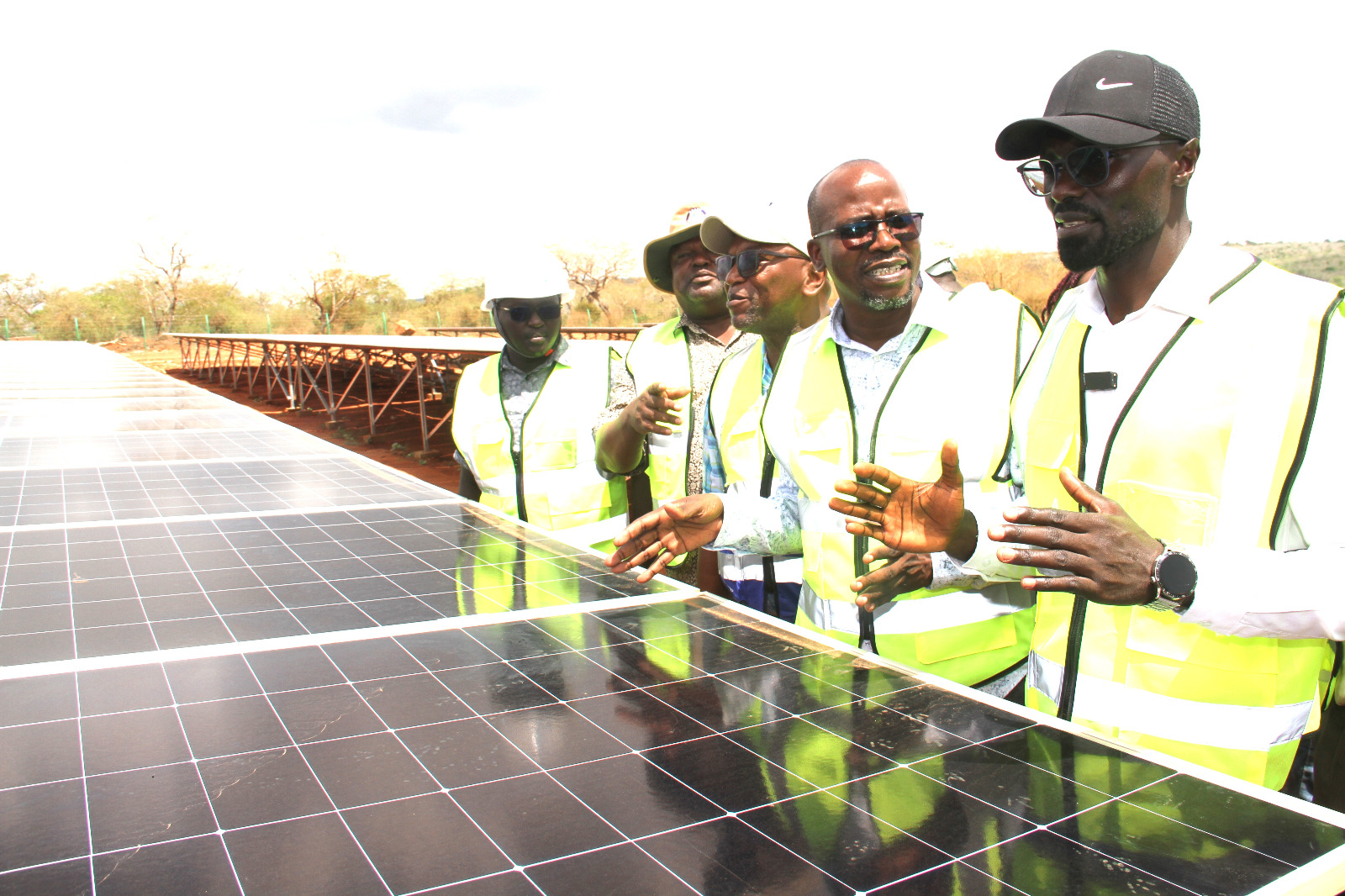
 Water CS Eric Murithi (wearing black cap) gets update on the World Bank-sponsored Water and Sanitation Development Project, Baricho Solarization, from the officials of Coast Water Works Development Agency (CWWDA) during his tour of the project on March 11, 2026/HANDOUT
Residents of Kenya’s Coast region could soon enjoy cheaper and more reliable water supply as the Baricho Solarization Project in Kilifi County nears completion.
Water Cabinet Secretary Eric Murithi said the project is now 90 per cent complete and expected to significantly reduce the high electricity costs associated with pumping water to households across the region.
Murithi made the remarks during an inspection tour of the Baricho water works in Kilifi County, where the government is installing thousands of solar panels to power water pumping operations.
“We have been having problems with the electricity bill because we are in low-lying lands and water has to be pumped,” Murithi said. “Currently, the Coast Water Works Development Agency requires between Sh60 million and Sh70 million every month to pay for electricity.”
The electricity costs, he explained, are currently met by water service providers supplying water to Mombasa County, Kwale County and Kilifi County.
Murithi noted that the solar project was part of a broader government plan to lower operational costs while expanding water access to millions of coastal residents.
According to the Cabinet Secretary, a total of 6,716 solar panels have been installed at the solar farm and the project is expected to be completed within the next week.
Once operational, the solar facility will generate about 4.3 megawatts of power. However, Murithi acknowledged that this will meet only a portion of the overall energy demand required to run the Baricho water supply system.
“It will produce 4.3 megawatts of power, but that is only about 20 percent of the total power requirement,” he said.
The project will allow water from 11 boreholes in Baricho to be pumped to collection points using solar energy, significantly cutting reliance on electricity supplied by Kenya Power.
“We need phase two and phase three of the solarization to address the problem well. We also need to store the power in lithium batteries,” he said.
Murithi explained that the government plans to adopt a hybrid system that combines solar power and electricity from the national grid.
“We will have a hybrid system where we will be pumping using solar while also using electricity from Kenya Power,” he said.
Engineers involved in the project estimate that the solar installation will cut electricity costs by at least 20 percent, easing the financial burden on water utilities.
Chief Executive Officer of the Coast Water Works Development Agency, Hamoud Mguza, said the solar project will play a critical role in addressing one of the Coast region’s most pressing challenges.
“This project will go a long way in addressing one of the most pressing problems in the region,” Mguza said.
However, he stressed that the sustainability of the water supply system depends on consumers paying their water bills.
“The solar system also needs maintenance. We want people to pay their water bills so that we can continue to provide the commodity smoothly,” he said.

![Hamisi Mwaguya [in coulored baseball cap] at the Kings Arena at Khadija estate in Nyali subcounty on Tuesday / BRIAN OTIENO](https://cdn.radioafrica.digital/image/2026/10/340e650a-21d8-475b-b658-a429e82e9367.jfif)