 Mukuru housing
project
/EZEKIEL AMING’A
Mukuru housing
project
/EZEKIEL AMING’A
When it rains in Mukuru, Ann Njoki no longer worries about flooding inside her house.
Just a year ago, rain meant stepping on stones placed across her single-room shack to avoid muddy water that seeped through the floor.
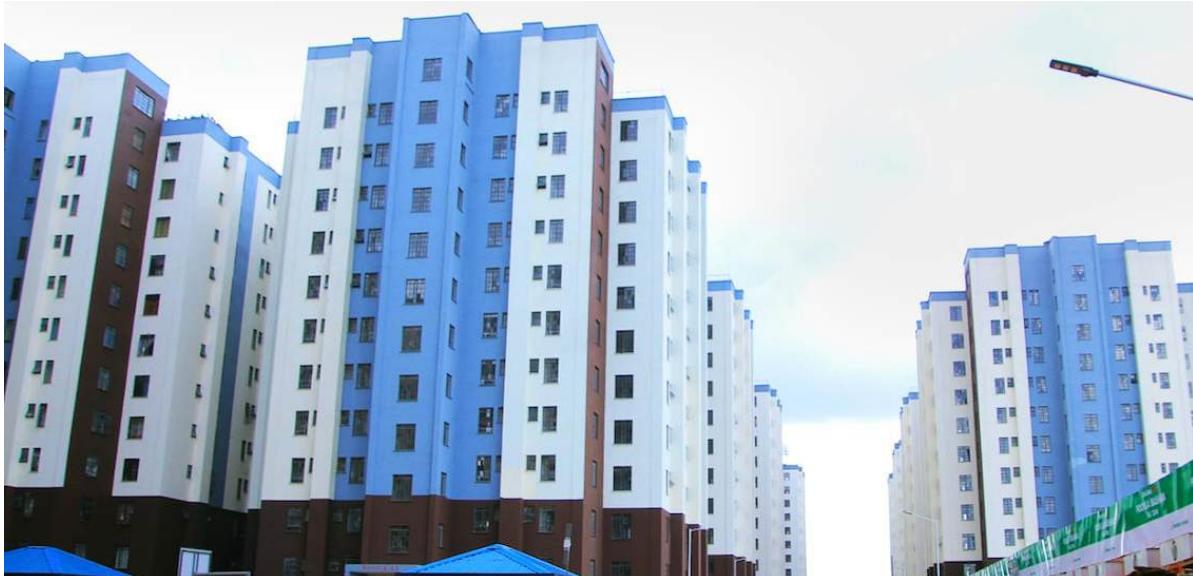
Today, Njoki lives in one of the 1,080 occupied units in the New Mukuru estate, part of the government’s flagship Affordable Housing Programme.
She lives in a clean bedsitter apartment at the New Mukuru estate, with running water, electricity and proper drainage.
“The difference is like heaven and earth,” the mother of one says, watching children play in the wide courtyard below her building.
Njoki is among the first residents relocated from the nearby Riara slum into the newly built apartments under the government’s affordable housing programme.
In the slum, she says, daily life was a constant struggle.
“The first problem was insecurity, then water shortage and no electricity. When it rained you could not walk in shoes because there was no drainage. Rainwater stagnated everywhere,” she recalls.“Even inside my house I had placed stones to step on because of flooding.”
Sanitation was another indignity.
“We had only two latrines serving 24 households. Sometimes you ran there and found them occupied. If you could not wait, you relieved yourself in a basin and poured the waste outside the house.”
President William Ruto commissioned the New Mukuru estate bedsitter units in May last year.
The occupied section consists of five blocks with 216 units each under the social housing category, where residents pay between Sh3,900 and Sh4,200 per month under a rent-to-own scheme.
More units are coming up. The second phase, which will add 5,000 houses, is nearing completion, while later phases will include one-bedroom and two-bedroom apartments.
For Benson Mutua, another resident who runs a small shop within the estate, the change is nothing short of remarkable.
“Where we used to live in Marigu-ini we did not have water, toilets or electricity,” the father of two says.“I will echo [what the] President [has said]: This is Singapore.”
Mutua hopes the growing estate will help him expand his small shop into a supermarket.
The transformation has also created business opportunities for young entrepreneurs like Collins Maina, a 24-year-old pharmacy graduate.
After completing his diploma at Mombasa Medical Training College in 2023, Maina opened a chemist within the estate.
“Water and electricity are always available and the environment is good for business,” he says.
Maina plans to hire an assistant soon and hopes to build his future here.
“I do not have my own family yet, but soon I will invite you to my wedding,” he says with a smile.
New Mukuru estate is designed as a fully integrated urban settlement.
The estate includes an Early Childhood Development Education centre, a planned primary and junior secondary school, a level 4 hospital, a police station, a chief’s office, a market and a shopping mall.
A five-million-litre water tank ensures constant supply.
Residents also enjoy free public Wi-Fi, subsidised internet and piped gas connections.
Geoffrey Odhiambo, a member of the estate management committee who also moved from Riara slum, says the change has dramatically improved their quality of life.
“We have a higher standard of living here. We used to have so many problems in the slum,” he says.
Security cameras now monitor visitors across the estate.
But Odhiambo says the transition has also exposed another challenge.
“Many of us depended on small businesses in the slums to survive. Now unemployment is a big challenge,” he says.“Yes, we have homes, but raising the monthly payments is still difficult for some families.”
The affordable housing programme is one of the government’s most ambitious economic and social projects.
Housing and Urban Development Principal Secretary Charles Hinga says 271,605 affordable housing units are currently under construction across the country, with a long-term target of 800,000 homes.
Since September 2022, nearly 9,000 units have already been completed in Nairobi, Nakuru, Mombasa, Machakos, Homa Bay and Kakamega counties.
The government says the programme aims to increase the number of mortgages in Kenya from about 30,000 to one million by offering affordable monthly payments as low as Sh4,000.
Beyond housing, the project is designed to stimulate economic growth by linking construction projects with micro, small and medium enterprises and the Jua Kali sector.
More than 20,000 institutional housing units for civil servants and disciplined forces are also under construction.
According to Hinga, the programme has already created more than 640,000 jobs since 2022.
Across the Coast region alone, about 20 housing projects are ongoing in Mombasa, Kwale, Kilifi, Taita Taveta, Lamu and Tana River counties.
Regional housing director John Karanja says each project site directly employs more than 600 workers, while many others benefit indirectly as suppliers, transporters and food vendors.
“The ripple effect is enormous,” he says.
At the Buxton Point affordable housing project in Mvita, phase one has already delivered 605 housing units.
For Susan Magana, who works at the site, the project has been life-changing.
“I have been able to pay my bills for the past seven months working here,” she says.
Her colleague Volian Akinyi says she has gained valuable construction skills.
“I came here with little knowledge, but now I can confidently say I have learned a lot,” she says.
Small businesses are also thriving around construction sites.
Food vendor Judy Mueni says she started selling meals to workers seven months ago and has since employed three young women.
In Kisumu, Mary Achieng sells chapati and beans to workers at the Lumumba affordable housing project.
Nearby, Peter Otieno runs a small tea and mandazi stall serving dozens of workers every day.
“The project has brought customers and helped small businesses like mine,” he says.
Inside the construction site, hundreds of young people are earning a living.
One 24-year-old student at Kisumu National Polytechnic says the job has helped him continue his studies.
“What I earn every week helps me buy food and clear some of my debts,” he says.
Despite its economic promise, the programme has faced criticism and legal challenges, particularly over the controversial housing levy.
Democracy for Citizens Party leader Rigathi Gachagua has promised to scrap the levy if elected president in 2027 and transfer the programme to county governments.
But such a move would require repealing the Affordable Housing Act and cancelling numerous contracts already signed with developers, suppliers, financial institutions and homeowners.
It could also halt thousands of ongoing projects and erase hundreds of thousands of jobs created so far.
For residents like Njoki, however, the impact is already clear.
What was once life in muddy alleys and overcrowded shacks has been replaced by concrete apartments, running water and the dignity of a proper home.
For the first time in years, she says, the rain no longer feels like a threat.