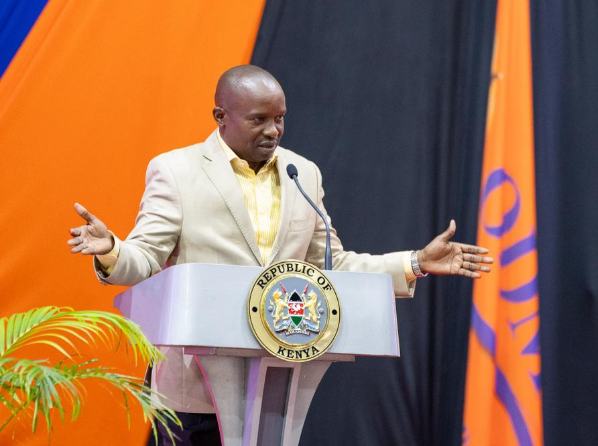
The Agnes Zani-led committee overseeing the implementation of the 10-point agenda and the NADCO report (COIN-10) has made several recommendations to strengthen national unity.
The report, handed over on Tuesday in Nairobi, urges Parliament to expedite and conclude outstanding NADCO Bills within 90 days.
It also seeks the formation of a broad-based mediation committee between the Senate and the National Assembly to fast-track the consideration and passage of outstanding Bills.
Among the Bills are the Constitution of Kenya (Amendment) Bill, 2024, which contains provisions for the entrenchment of the offices of the Leader of the Official Opposition and the Prime Cabinet Secretary.
The other one is the Public Benefits Organisations Act, 2013, to enable civil society organisations to mobilise resources for social programmes, which has been operationalised, and regulations are in progress.
The Constitution of Kenya (Amendment) Bill, 2025, to implement the two-thirds gender rule, which is under consideration by Parliament and legislation to harmonise bicameral relations, has been referred to a mediation committee under Article 113 of the Constitution.
It also seeks the fast-tracking of the Natural Resources (Benefit Sharing) Bill, 2022, to provide a legal framework for equitable distribution of revenues from natural resources among the national government, county governments and local communities.
The Committee says it engaged extensively with stakeholders, including implementing agencies, public forums, and submissions through memoranda.
“Based on these engagements, the committee notes that there is progressive implementation of the Ten-Point Agenda, although several policies, legislative and institutional issues require further action to enhance effectiveness and delivery,” the team states.
To enhance the realisation of constitutional rights under Article 37, the report wants the Kenya National Commission on Human Rights to spearhead legislation to safeguard protestors while protecting livelihoods and property during demonstrations.
It recommends the establish a multi-agency team comprising the National Treasury, Kenya National Commission on Human Rights, and the Law Society of Kenya, under the leadership of the Office of the Attorney-General (pursuant to Section 31 of the Victim Protection Act, 2014), to facilitate reparations for victims of police brutality.
The report recommends that the National Police Service should be resourced and supported to strengthen continuous training and retooling of the police for effective crowd management in accordance with the rule of law.
“To promote timely access to justice, the Independent Policing Oversight Authority (IPOA) should conclude investigations into complaints within six months and publish its findings.”
It adds, “To ensure timely accountability, prosecution and determination of ethics and corruption cases by mandated institutions must be concluded within six months.”
On marginalisation, the team recommended that County Governments should implement the National Policy on Ethnic Minorities and Marginalised Communities, 2025, to promote inclusivity in governance and public participation.
The report asks the Attorney-General to propose amendments to Sections 108 and 109 of the County Governments Act, 2012, to make County Integrated Development Plans (CIDPs) long-term plans (10 years) and sectoral plans medium-term plans (5 years) to ensure completion of legacy projects across electoral cycles.
“To enhance efficiency and credibility in elections, the IEBC should be resourced and supported to develop infrastructure and capacity to hold transparent, credible and verifiable elections as per the Constitution of Kenya.”