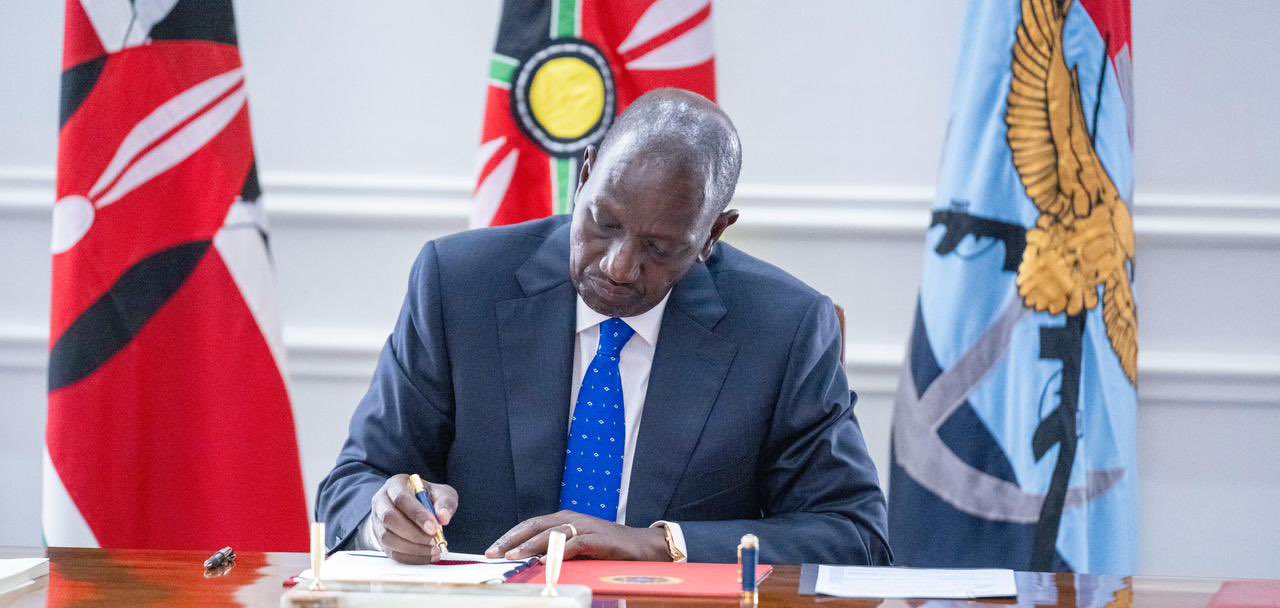
President William Ruto has signed into law the National Infrastructure Fund (NIF) Bill, 2026; a Sh5 trillion kitty described as a catalyst for development.
He signed the Bill in a ceremony at State House, Nairobi, in the presence of private sector leaders and government officials, including National Assembly Speaker Moses Wetang’ula and Treasury Cabinet Secretary John Mbadi.
The Bill was passed last week on Thursday by MPs, marking a pivotal shift in how the country will finance and manage its most ambitious infrastructure development projects.
The new law aims to mobilise nearly Sh5 trillion over the next decade to shift infrastructure financing from a debt-driven model to a sustainable, investment-led approach.
Speaking at the event, President Ruto said the Kenya Pipeline IPO will raise the first fund to be utilised by the Fund.
“Our goal is to leverage this capital at least two times what we will get from the Kenya Pipeline IPO. Over time, this model will enable Kenya to mobilise about Sh5 trillion,” Ruto said.
“I want to assure that the National Infrastructure Fund and other commercially viable agencies will be run on the same principles as the private sector, if not higher. It will not be run by people with political connections or failed politicians but by people subjected to competitive recruitment,” he added.
The President said the establishment of the Fund has been inspired by other successful Funds in countries such as India, Nigeria, Ghana and South Africa.
The new law establishes the National Infrastructure Fund (NIF), which is expected to mobilise resources for key projects across sectors, including transport, energy, water, irrigation and digital connectivity.
“The Fund will help us prioritise what is important to us; package them into investable instruments,” Ruto said while thanking development partners for their input.
The Fund will also support development of highways, railways, ports, agribusiness infrastructure and other strategic national projects. Unlike previous models, which largely relied on borrowing to finance critical infrastructure development, the NIF is designed to attract investments from both public and private sectors.
After debate in the Second Reading and the consideration of amendments at the Committee of the Whole House, Leader of the Majority Party Kimani Ichungw’a thanked the House for supporting the Bill.
He termed it the most consequential legislation ever passed by the House since Sessional Paper No.10 spearheaded by former Minister for Economic Planning Tom Mboya in 1965.
“Speaker, should this Bill pass through the Third Reading stage, it will be the most consequential piece of legislation ever enacted by this House, not only in the 13th Parliament, but in the history of independent Kenya’s National Assembly”, Ichungw’a stated.
The Bill had faced opposition from some members who raised concerns about oversight and the potential for excessive Executive influence, specifically regarding the Treasury Cabinet Secretary.
The law establishes a Governing Council chaired by the Treasury Cabinet Secretary, which includes the Central Bank Governor, the Attorney-General, and six independent members appointed by the President for three-year terms.
The council provides strategic direction and protects the fund’s assets but cannot interfere in day-to-day operations, ensuring board independence.
Day-to-day operations will be conducted by an independent Board of Directors, where the members will be attracted to individuals with a minimum of ten years of experience in the fields of finance, law or engineering.
The Chief Executive Officer will serve as Administrator of the fund, creating a streamlined leadership structure.
The Treasury Cabinet Secretary is required to submit the fund’s Investment Policy to the National Assembly for approval within 90 days, and Parliament may approve, amend, or reject the policy.