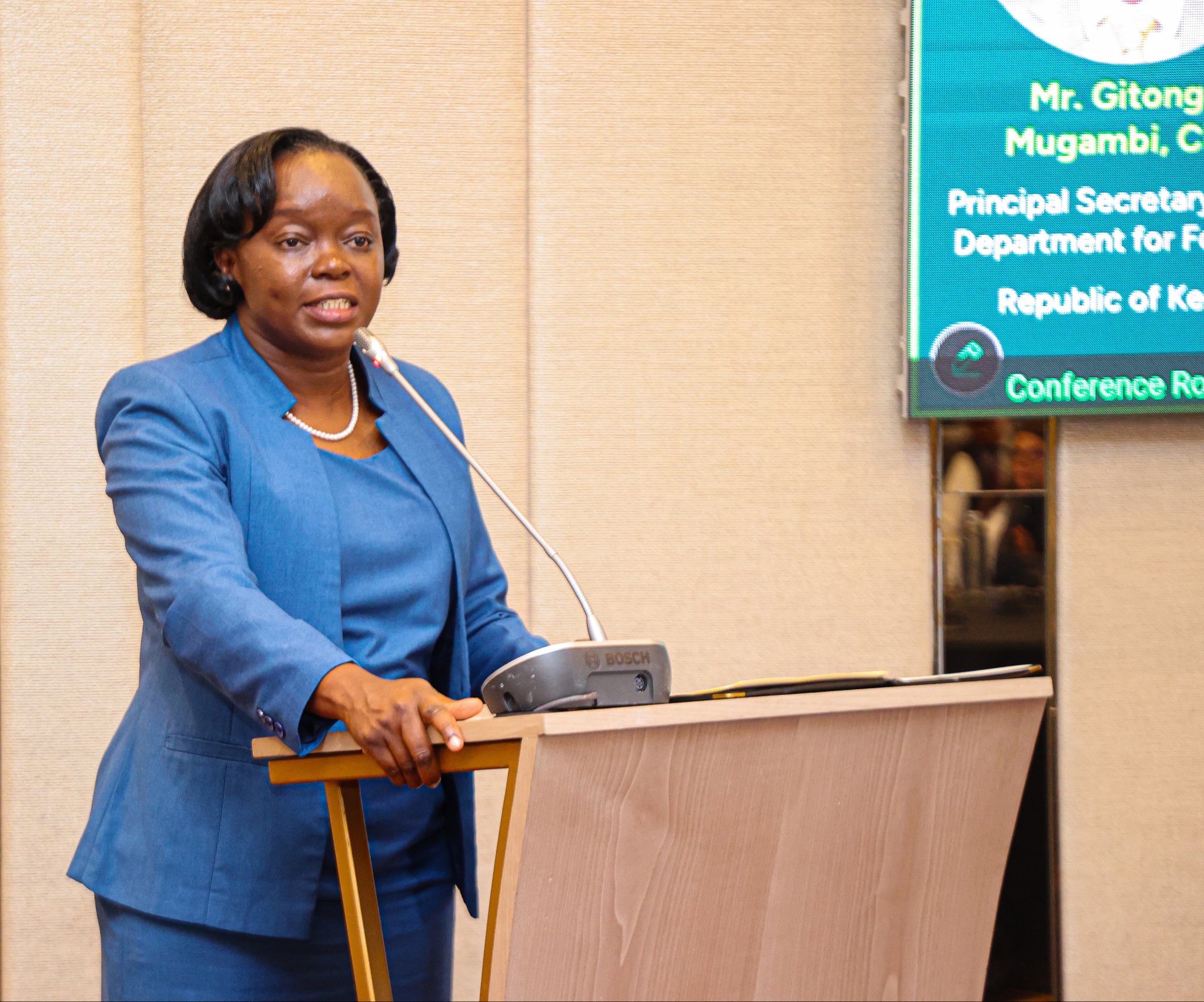
 Environment Cabinet Secretary Deborah Barasa speaking at a past event / HANDOUT
Environment Cabinet Secretary Deborah Barasa has defended the clearing of land at Karura Forest, saying the move is part of preparations to boost seedling production under the government’s 15 billion tree-growing campaign.
Barasa said approximately three acres of land in the forest have been cleared to establish a tree nursery expected to propagate about five million seedlings and to put up temporary accommodation for personnel from the National Youth Service (NYS).
The CS said the initiative is aimed at accelerating the restoration of ecosystems across the country, including drylands, wetlands, coastal regions and both high- and low-altitude areas.
"The 15 billion tree growing campaign is bringing to life the spirit of Professor Wangari Maathai when it comes to the restoration of our ecosystem. It is bringing to life all the forests across the country, talking about the dry lands, wet lands, coastal, high, and low lands. We need a lot of seedlings. We need to mobilise and strategise all the forest stations to produce 2 million to 10 million seedlings, one of them being Karura forest,” she said during an interview at NTV.
She noted that the success of the national programme depends on the availability of large numbers of seedlings, prompting the government to mobilise forest stations across the country to significantly increase production.
According to the CS, the nursery at Karura will help supply seedlings for tree planting efforts across the country.
Barasa explained that the temporary structures for NYS personnel are necessary to provide the human resources required to raise and manage the millions of seedlings targeted.
We have cleared around two to three acres at Karura Forest to propagate around 5 million seedlings to plant across the country. We need temporary homes for NYS. For us to achieve two to ten million seedlings, we need human resource capacity to do that. These are temporary homes. The land being cleared at Karura Forest is to put up the temporary homes together with the nursery,” she added.
She said that the land cleared at Karura Forest will host both the nursery and the temporary housing to support the large-scale seedling propagation needed for the national tree-growing programme.
On March 6, the Friends of Karura Forest (FKF) called on the Kenya Forest Service (KFS) to consult the Community Forest Association (CFA) before implementing any new projects in Karura Forest, warning that uncoordinated actions could undermine citizen-led conservation efforts.
Speaking during Wangari Maathai Day celebrations on Tuesday, FKF Chairperson Professor Karanja Njoroge highlighted the role of participatory forest management under the Kenya Forest Act in Karura’s transformation.
“We exist under the Kenya Forest Act, which allows forest stations to be governed through participatory management. Any initiative must be discussed with the CFA first,” Njoroge said.
He traced the forest’s history to January 1998, when Nobel Laureate Professor Wangari Maathai challenged land allocations that threatened Karura Forest. Njoroge noted that the CFA, registered in 2009, has helped turn Karura into one of Kenya’s most visited urban forests, attracting 75,000 to 80,000 visitors monthly.
The forest supports 123 employees and 315 community members who earn a living from it, funds scholarships for local children, and underpins community development initiatives.
“Karura is not just a forest; it is a source of livelihood for many people. Ignoring the CFA in planning risks undoing 17 years of volunteer and pro bono effort,” Njoroge said.
Board member Sansi Dietz emphasized that participatory management has transformed Karura from a “no-go zone” into a safe and thriving environment, adding that existing tree nurseries within the forest and at KFS headquarters are sufficient for replanting indigenous species.
FKF’s concerns come amid KFS plans to house National Youth Service (NYS) personnel in the forest to raise two million tree seedlings.