

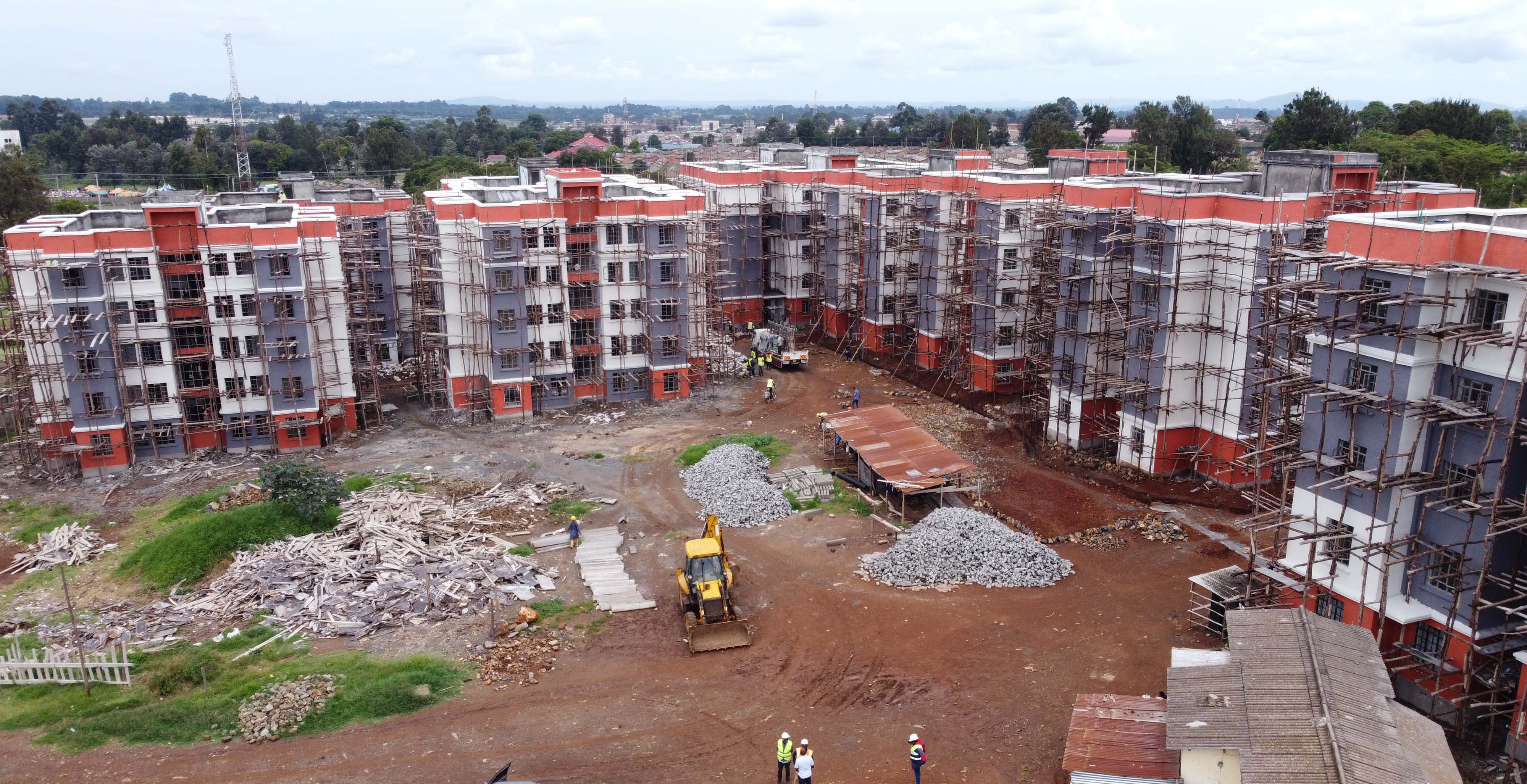
 Ongoing affordable housing project. People need alternative places to own homes away from ancestral land /FILE
One of the most traumatic discoveries I made when I first moved to the city was that all food was for sale. Needing money for everything I ate conflicted sharply with my rural upbringing in Kenya.
I grew up in a large family. My late father owned 1.7 acres of land. Part of it was planted with coffee, the golden crop that paid school fees for much of my generation in central Kenya.
On a rotational basis, we grew maize, beans, bananas, sugarcane and potatoes on the remaining land. Fruit trees were scattered throughout, with patches of vegetables in between, turning the modest farm into a green buffet.
The land also supported a few cows, providing milk for sale and for brewing good African tea.
This simple food-production ecosystem was replicated across the neighbourhood and beyond. We grew up with abundant food. As far as I can remember, the only items we bought for the kitchen were salt, cooking oil and sugar. This explains the culture shock I experienced when I moved to Nairobi.
Household food security in rural areas forms the foundation of family progress. When food is produced at home, income is redirected to education, health and clothing. This translates into better living standards and improved prospects for children. I am a product of this reality.
Then something drastic happened. My father’s generation passed on. We grew up and subdivided the land. Everyone ended up with a small plot, and life became complicated.
After building a homestead, the remaining land could hardly produce enough food for a family. The few inherited coffee bushes no longer made commercial sense, and there was no space for cattle rearing. Nutrition declined and incomes fell.
The result has been the rise of food-insecure households living in what are rapidly becoming rural slums — a phenomenon that did not exist a few years ago.
Houses can no longer be designed freely because of shrinking plot sizes. We now have classroom-shaped buildings packed tightly together. Since every inch of land must be used, access roads have become narrow footpaths that cannot accommodate ambulances or fire engines.
There have been cases where firefighters have watched homes burn because they could not access them. These narrow paths are also shared by growing families, leading to bitter disputes and toxic coexistence.
The shrinking farm prospects have also contributed to rural–urban migration. With opportunities in rural areas near zero, young people move to towns in search of non-existent jobs. They survive on casual labour that barely sustains them, let alone helps families back home.
Some turn to crime. Others sink into alcoholism. In parts of the Mt Kenya region, it is now common to find entire youthful populations drunk throughout the day.
This reality calls for a fresh look at the government’s affordable housing programme.
The core problem is land subdivision into unproductive units. Further fragmentation must be discouraged. People need alternative places to own homes away from ancestral land.
Imagine if my extended family had settled in affordable housing in Makenji near Kenol or Thika. My father’s land would have remained intact for food production and income generation.
This model could work across the Mt Kenya region, where fertile volcanic soils are ideal for food production for both rural and urban populations. With modern technology and improved husbandry, small farms could become centres of prosperity.
What is needed is reliable irrigation instead of rain-fed farming. The construction of dams and the Sh15 billion tree-planting programme would support this by protecting water towers and guaranteeing supply.
Affordable housing would also enable crop specialisation. Today, villages grow many crops in tiny quantities, making trade uneconomical. If villages focused on one crop per season, they would produce volumes attractive to markets.
This would encourage contract farming, cottage industries and predictable incomes, enabling residents to meet housing obligations.
Globally, food production is now recognised as central to survival. Food imports drain foreign exchange. In Europe, farmers are subsidised to grow food. Middle Eastern countries lease land in Africa. China and Indonesia are consolidating housing while maximising farmland. Egypt has pioneered farming villages along the Nile.
In such a model, people live in structured settlements and farm nearby land. Services such as schools, healthcare, sewerage and security become easier to provide.
For villagers, affordable housing offers decent, dignified living conditions. In Kenya, most homeowners rely on mortgages and Sacco loans. Affordable housing provides access to ownership for those outside the formal economy.
It also creates intergenerational assets and collateral for business growth.
With this approach, villages like Jasho could achieve higher incomes, better living standards and contribute to national economic stability.
Maina is theeditor-in-chief, Kenya Broadcasting Corporation, [email protected]





