Mention the words midlife crisis, and like an incantation, they conjure up this image of an older gentleman, he has dyed his hair black, cashed in his savings and traded in his wife of 25 years for a pretty young thing he met in a club with loud music, where everyone else was under the age of 30.
This is a cliché and not an entirely complete picture of midlife crisis.
Midlife crisis is nuanced; it’s complicated and, at the same time, easy to understand. It’s confusing and then it’s not, because often when you are middle-aged, conflicting thoughts and emotions share the same headspace with moments of utter clarity.
But let’s start with the easy stuff, by defining what midlife crisis is, technically speaking.
Midlife crisis is a period of psychological distress experienced during the middle years of adulthood. It is a stressful time, rife with emotional turmoil, where a midlifer experiences feelings of deep dissatisfaction and unhappiness.
Not all middle-aged people go through midlife crisis, however. Of those who do, most do not blow up their lives chasing after fading youth and younger women, like our cliché older gentleman. Midlife crisis is not even an official medical diagnosis, nor a clinical term in psychology. It is a cultural phenomenon. This is not to say the experience is any less emotionally and psychologically real.
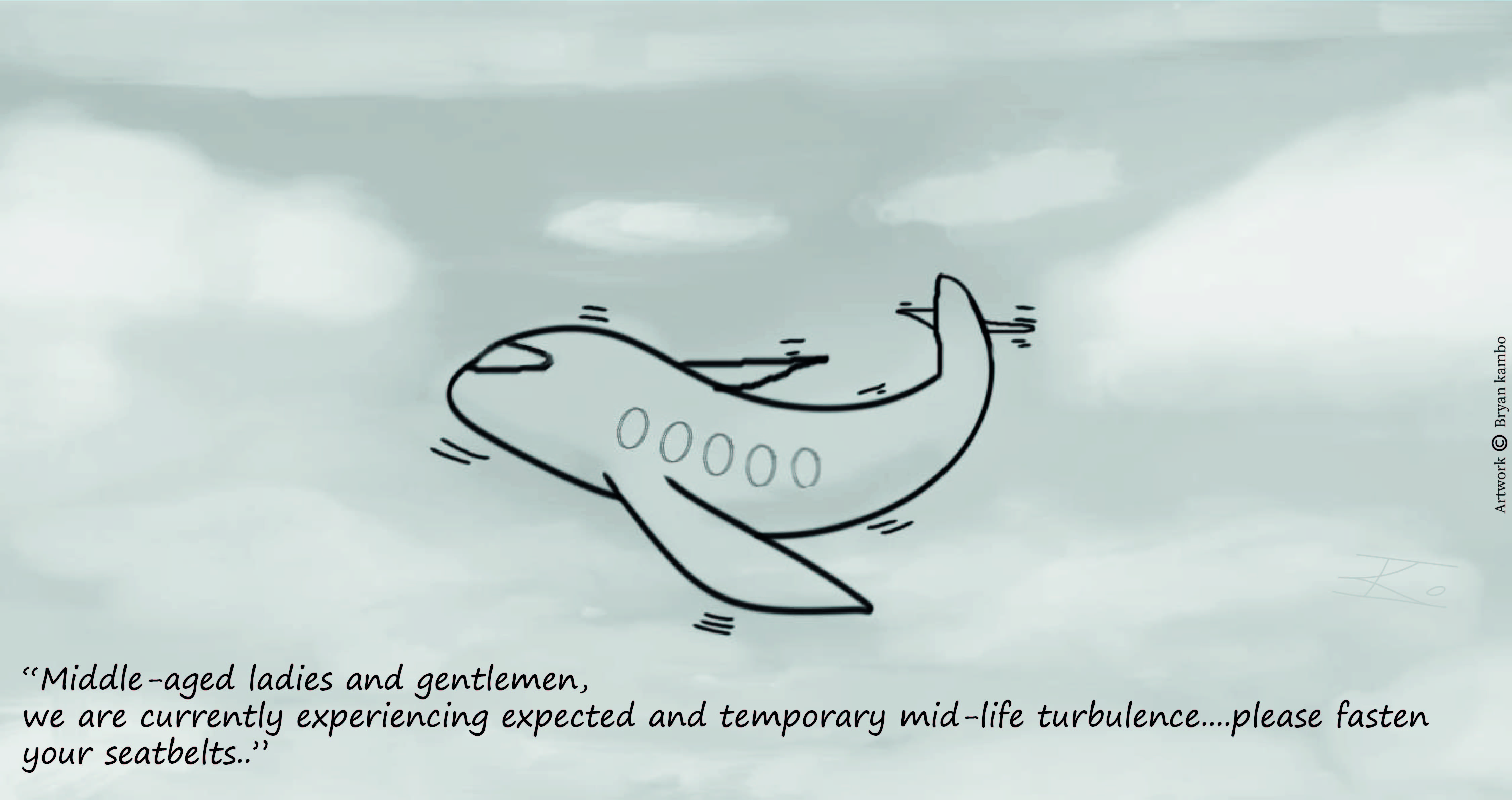
And though they call it crisis, it is more a period of turbulence rather than a crisis as in calamity, catastrophe and disaster.
So what brings on all this turbulence? There are two explanations.
One theory postulates that during the course of a human being’s life, life satisfaction, what many call happiness, follows a U-shape curve. That is to say, we’re happiest in our teens but as the years roll by, happiness/life satisfaction dips all the way down until it bottoms out at middle age. There it lingers bowl-shaped for a while before it starts going up again the older we get past middle age, and we are happiest all over again at old age. They call this the U-Shape life satisfaction theory.
The other explanation is from psychoanalyst Elliott Jaques, who coined the phrase midlife crisis back in the 1960s, and explained it thus: it is at middle age that one comes face to face, for the first time, with one's own mortality.
When you’re middle-aged, it does indeed dawn on you that your death is inevitable and not distant. This leads to existential questions swirling in your mind, questions about one’s purpose and your place in the world. You reflect deeply, re-examining the past, with regret or nostalgia. You examine the present, the disparity between what you dreamed of becoming, and what you have become.
The trigger to all these thoughts is the significant life changes that occur at midlife. Your children morph into young adults, your parents into geriatrics, your retirement is no longer in the distant future and you are creaking and squeaking in places on account of ageing wear. This transition from young heading to old leaves a midlifer feeling dislocated, obsolete, wandering, for what comes after you have gone through school, work, marriage, and kids?
Answer: Acceptance.
Accept the passing of your youth, grieve if you must but accept. Accept yourself, your place in the world, because whether or not your dreams came true, here you are. Acceptance is taking life as it comes, not pushing back against it. Acceptance makes it possible for middle age to be minimally turbulent.
And the trick to all this accepting is to want what you have, see the beauty in your half-century’s worth of family, friends, knowledge, experiences, memories, laughs and cries. It’s corny, I know, but it’s this, or you’re the old hair-dye guy hanging out with people half his age.
And once you accept, turn your attention to making better use of the time you have left (in years, you hope). This calls for a shift in focus from the goal-oriented busyness that harried you in your youth, to the slower-paced loving what you do more (process) than what you get (results). It is in the intrinsic value of process that life resides and, fortunately, with age comes the patience for process.
If you’re middle-aged and you happen to be feeling a little despondent because you are getting older, look at it this way…
The great thing about getting older is that you don’t lose all the other ages you’ve been – Madeleine L’ Engle.
Think on that.