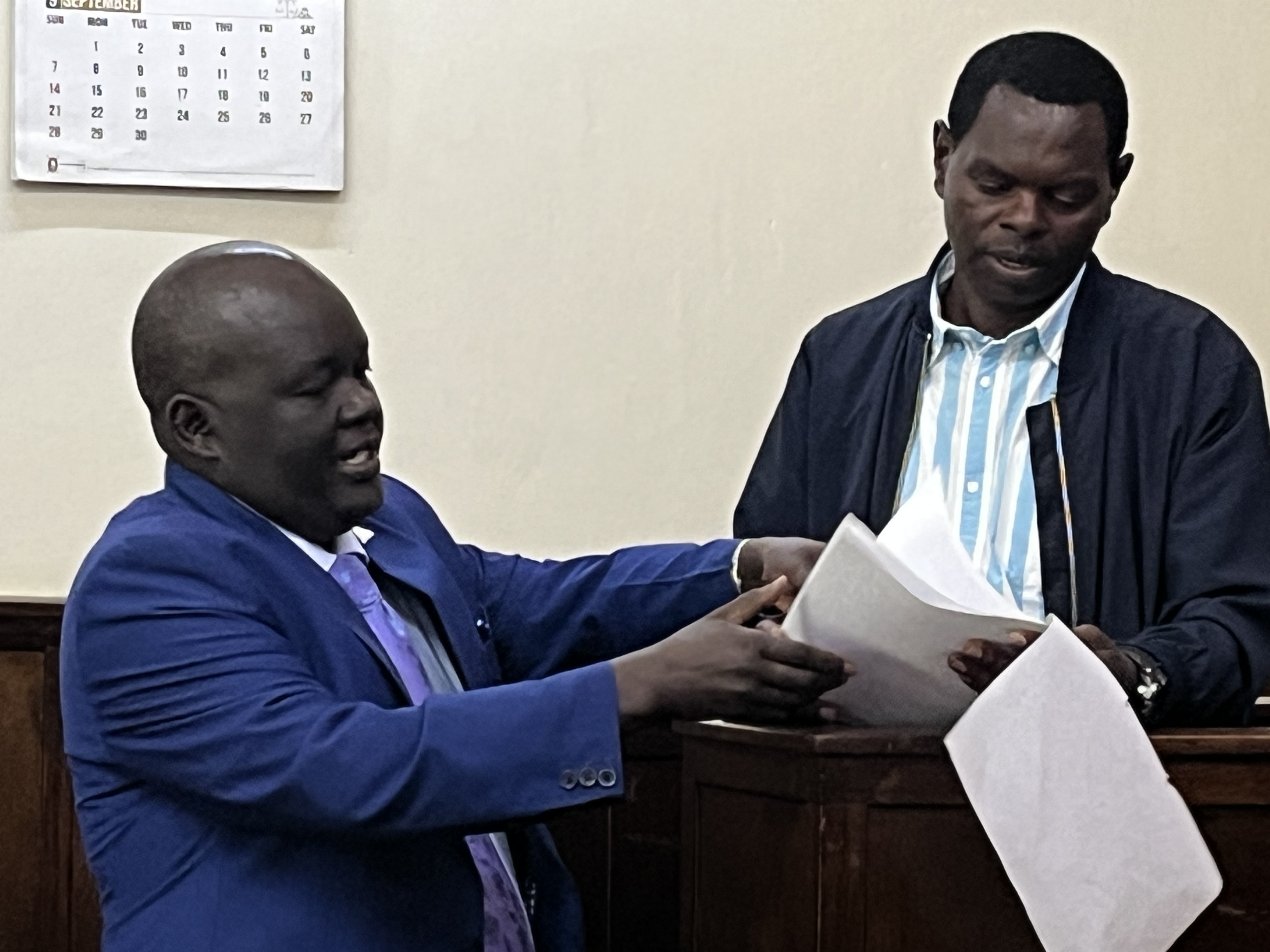
 Retired athlete Daniel Komen (r) testifying before court assisted by his Lawyer Christopher Mitei
Retired athlete Daniel Komen’s wife has lost a case in which she sought to overturn her husband’s decision to sell their land.
Komen sold the land valued at over Sh220 million to his colleagues, prominent runners including marathon star Eliud Kipchoge.
High Court judge Reuben Nyakundi ruled that Joyce Kimosop failed to provide evidence that the land sold by her husband formed part of their matrimonial home or qualified as matrimonial property.
Kimosop told the court that spousal consent was not sought when Komen sold the land in question, which she valued at over Sh300 million.
Komen, a former 3,000m world record holder, testified before Justice Nyakundi that he did not involve his wife in the transaction because the land belonged solely to him.
The disputed property, L.R No 8638/26, lies southeast of Eldoret along the Nairobi highway.
Komen said he bought the land more than two decades ago from farmer Mzee Kwambai Chesire using money earned from international competitions and a bank loan.
Among the buyers were Kipchoge, 2007 World steeplechase champion Brimin Kipruto, former London Marathon winner Felix Limo and businessman Peter Sang.
Kimosop, a senior lecturer at Moi University, said the land was matrimonial property and asked the court to nullify the sale.
She sued her husband alongside the four buyers, arguing that she was neither consulted nor gave consent.
Justice Nyakundi ruled, however, that the alleged lack of spousal consent — which formed the mainstay of Kimosop’s claim — was unproven.
He cited rebuttal evidence from Komen and his colleagues indicating that she was not kept in the dark regarding the sale and purchase agreement relating to the suit property.
The judge said a clear reading of the Matrimonial Property Act denotes that matrimonial matters can only be between a person and a spouse or former spouse.
He noted that although the case had been transferred to his court as a matrimonial cause, it was unusual in that it involved third parties who, in his view, ought not to have been joined.
Nyakundi further observed that testimony from both Kimosop and Komen showed that the suit property was not the actual site on which their matrimonial home had been developed.
The court found nothing on record to demonstrate that the contract of sale was tainted by fraud, misrepresentation, duress or mistake that would warrant it being declared null and void.
The judge ruled that Kipchoge and his colleagues bought the land legally.
“In my view, the defendants are bona fide purchasers for value within the tenured legal system of Kenya and that is the very reason they secured registration and title under the Land Registration Act and the Land Act 2012,” Nyakundi said.
He added that, in his considered view, Komen had the right and power to dispose of the suit property in the circumstances of the case and that no cogent evidence had been presented to show he acted contrary to the values and principles of governance guiding their marriage.
“There is indeed no evidence that this property sold by the 5th defendant (Komen) had qualified within the definitional evidence of matrimonial property that could not be interfered with by way of sale,” he said.
According to Judge Nyakundi, exhibits presented before the court showed that the suit property was acquired during the subsistence of the marriage between Komen and Kimosop.
However, he noted that what remained in contention was the nature of Kimosop’s contribution. He reiterated that Komen had the power to dispose of the property.
In court papers, Kimosop claimed she was shocked to discover the land had been sold for just Sh10 million—barely 10 per cent of its actual value—and that the buyers had already taken possession.
“I took several bank loans to fund the purchase and development of the property, which was our only family home. My husband never mentioned the sale and I was surprised when strangers occupied it,” she told the court.
She married Komen in 1998 and they have three children. She argued that the land was bought jointly but registered in Komen’s name in trust for the family.
She asked the court to determine whether, as a wife, she had the constitutional right to be involved in transactions concerning family property and whether the sale violated her rights.
Komen admitted that the couple took a joint loan to complete the purchase and that his wife managed and developed the land while he competed abroad.
However, he described her contribution as minimal.
Kipchoge and his colleagues defended their purchase in court filings.
Kipchoge said they entered into a sale agreement with Komen in October 2011 for Sh10 million after confirming that the land was registered in his name.
They later agreed to buy an additional 80 acres for Sh25.6 million.