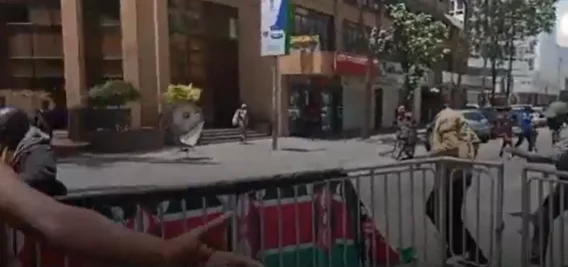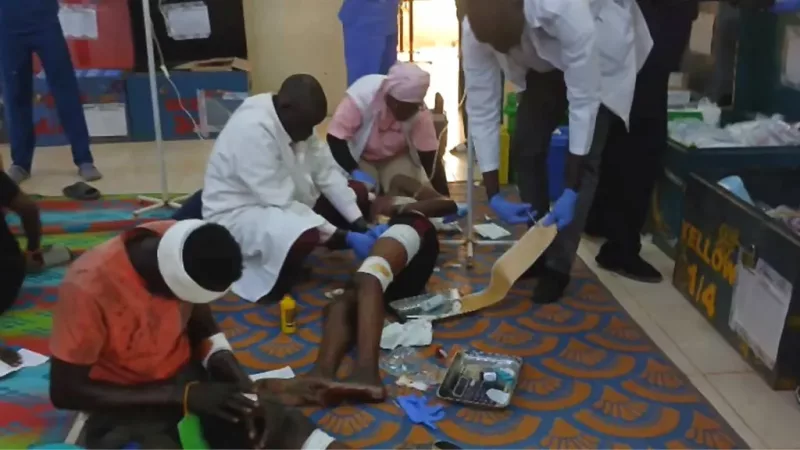
When Abdulahi Ali stepped onto Uhuru Highway on the afternoon of February 18, 2026, he did not know he was walking into an ambush.
The businessman was crossing the busy Nairobi artery when a gang riding motorcycles pulled up beside him.
Within moments, he was stabbed in the ribs. As he collapsed onto the tarmac, bleeding, the attackers grabbed his Volkswagen Tiguan keys, his wallet with money in it, identification cards and other personal items.
They vanished into traffic.
“It is by good luck that I am alive. They could have killed me,” Ali said from his hospital bed. He spent a week in hospital.
His car remained parked near City Hall for days as he looked for an expert to cut a spare key.
On the day he was attacked, police recorded 56 similar complaints across Nairobi. Victims were mostly assaulted in the city centre, Kilimani, Westlands, Pangani, Thika Road, Riverside Drive and Baba Dogo.
Ali’s ordeal, officers say, was not an isolated incident but part of a broader and troubling surge of crime in the capital.
Authorities say there is a recurring pattern where thugs operate in teams of between two and four riders on motorcycles who strike during the day and at dusk.
Those targeted are often pedestrians and motorists in traffic or on poorly lit streets. They pounce and disperse quickly into the flow of vehicles.
Some gangs are armed with machetes, knives and other crude weapons. Others operate on foot in congested areas where motorcycles cannot easily manoeuvre.
Victims have been left with serious injuries, and in a few cases, dead.
In Kilimani, anger boiled over after a series of robberies.
Two suspected criminal riders were lynched by a mob. Police later confirmed that three other suspects were arrested and five motorcycles recovered.
Interior Cabinet Secretary Kipchumba Murkomen says at least 845 mob justice incidents have been recorded across the country since January 2025. Of these, 579 resulted in deaths and 266 in injuries.
Kiambu county recorded the highest number of cases at 90 with 58 deaths and 32 injuries. Nairobi had 85 incidents with 55 deaths and 30 injuries.
Embu registered 51 cases (33 deaths, 18 injuries), Kisumu 45 (36 deaths, nine injuries), Kirinyaga 39 (28 deaths, 11 injuries), Kakamega 32 (19 deaths, 13 injuries). Marsabit, Taita Taveta and Tana River counties each recorded one fatal incident.
“These cases often involve violent attacks, public humiliation and fatalities even before suspects can be formally investigated or prosecuted,” Murkomen said.
He attributed the trend to mistrust in the criminal justice system, noting that some members of the public perceive investigations and court processes as slow or ineffective.
“The release of suspects often reinforces the perception that the justice system is ineffective, prompting communities to take the law into their own hands,” the minister said.
Murkomen cited the spread of crime-related content and so-called “instant justice” videos on social media as fuelling mob justice.
Police maintain that the surge in violent street robberies and machete attacks in Nairobi is real and intensified operations and investigations are underway. The officers acknowledged that the problem is tied to wider social and economic pressures, including unemployment, youth marginalisation and organised crime networks.
The pattern mirrors previous cases involving machete-wielding youth gangs sometimes referred to as “Panga Boys,” which operated in coastal and urban towns in the past. The robbed and assaulted victims with crude weapons.
Inspector-General of Police Douglas Kanja has directed his officers to fast-track responses to reported incidents and to intensify patrols in identified hotspots.
Police spokesperson Michael Muchiri said authorities are analysing CCTV footage from major incidents and have made arrests in several cases.
“We continue to use all means possible to address these issues. We are determined to address the menace and urge for continued support,” Muchiri said.
Operations in Nairobi and other regions have resulted in arrests of suspected gang members and the seizure of weapons and narcotics, suggesting that some of the street crimes may be linked to broader organised criminal networks.
In parts of the Coast region, police commanders have directives officers to use lethal force against armed gangs where legally justified — a move that has sparked debate about proportional force and public safety.
In Nairobi, the Thika Road corridor between the city centre and Outer Ring Road, as well as Westlands, Chiromo, Kileleshwa and Kilimani have been identified as hotspots.
Downtown areas, sections of Muthaiga and outer estates have also featured in reports.
Police say gangs exploit traffic congestion and poorly lit streets. Their speed and ability to blend into regular motorcycle traffic make immediate containment difficult.
Security analysts say the resurgence follows a familiar script: youth-driven gangs operating in urban pockets where unemployment and marginalisation intersect with opportunistic criminality.
But authorities emphasise that public cooperation remains critical.
They caution that while personal safety is paramount during an attack, formal reporting after the incident is equally important.
Many victims fail to record official statements, weakening investigations and prosecutions.
Residents are advised to avoid isolated areas, especially at dusk or late at night, to refrain from openly displaying phones and valuables, and to use verified transport during quiet hours.
Police also encourage participation in neighbourhood watch initiatives and community security groups, and urge members of the public to inform authorities when suspects are apprehended rather than resorting to mob action.
They say mob justice undermines the rule of law and risks harming innocent people.
As patrols intensify and investigations continue, the unfolding situation presents a deeper challenge.
Beyond arrests and crackdowns lies the hard task of restoring public trust in the justice system while addressing the economic and social conditions that allow violent street crime to take root.
For survivors like Ali, the statistics are abstract. What remains vivid is the sudden roar of motorcycles, the flash of a blade, and the fragile line between survival and tragedy on a city street.