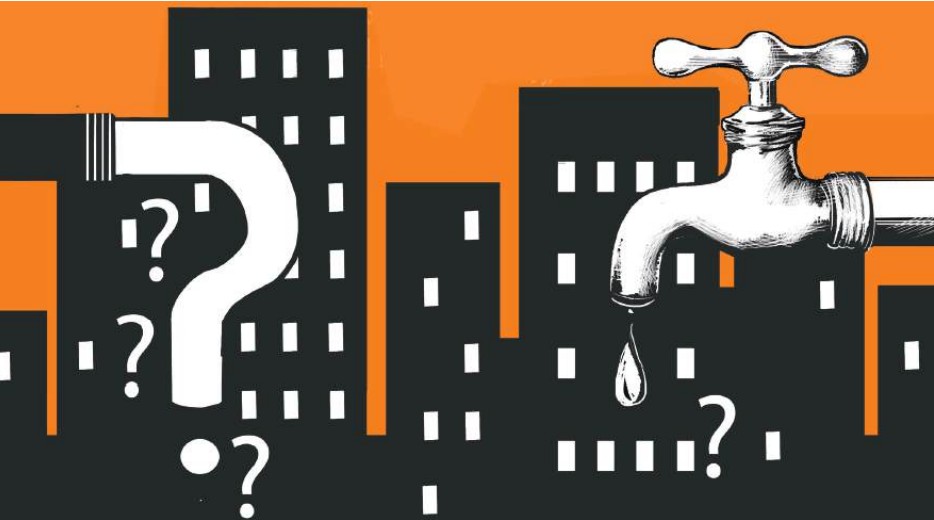
If you are of the Gen Z cohort and have parents who were lucky enough to grow up in middle-class residential estates in Nairobi, you may be tired of hearing your parents say, “The water in Nairobi taps used to be so pure and clean you would drink it without hesitation, direct from the tap. Why do we nowadays have to buy drinking water, and only get tap water that you must first boil if you want to be safe – that is if you get water in your taps at all?”
And that remark is often followed by the declaration, “This country has gone to the dogs!”
I use this example to illustrate how we often end up in despair, solely because we have asked the wrong question.
It is true that in the colonial era and in the decades immediately after Independence, the water supply in Nairobi, as in most of our larger towns, was really no different from the tap water of any European city, for example.
But such scientifically purified water, by design, was only available to the chosen few. Initially, only to those urban centres that had a sizable population of white settlers and administrators.
Colonial-era infrastructure was designed to provide a good living for the white settler community, and also partially for those indigenous Kenyans whose labour was needed to move that economy forward. For most of the geographical entity we call Kenya, clean tap water was an unheard-of luxury.
And so, with the arrival of Independence, as a popularly elected government responded to the needs of ordinary Kenyans, there was an effort to extend the supplies of clean water to just about every corner of the country (with the perennially marginalised Northern Kenya being the exception).
With the typical Kenyan tendency towards corruption and incompetence, some of the water treatment plants were bound to be supplied with chalk instead of chlorine, leading to the water gushing out of local taps having a full complement of the microbes that the chlorine would have killed.
There have also been anecdotal accounts of “6-inch” water pipes being laid out, for a village population that could only be adequately served by a “12-inch” water pipeline. And also of the pipes used being of such inferior quality as to guarantee massive loss in the water that flowed through them.
All the same the real question when it comes to water supplies in Kenya would be, “How many Kenyans currently have access to tap water, however unsatisfactory the supply of water may be?”
Once you look at it this way, you see that the rapid population growth Kenya had from the 1960s onwards was bound to make it difficult for the Ministry of Water to make water available for everyone, despite the Jomo Kenyatta-era vision of “Water for all by the year 2000”.
Likewise, regular readers of this column may be aware that my contribution to the ongoing debate on what it would take for Kenya to be “the next Singapore” took the form of a question.
I did not bewail the fact that there is no clear path to industrialisation. Instead, I asked, “Why have we not taken full advantage of our country’s enormous potential for generating low-cost geothermal power?”
For the first building block of any attempt at industrialisation – and that is what we really mean when we speak of “Singapore” – is cheap electricity, ideally from a “green” source like the hydroelectric power dams we have in various parts of Kenya, and geothermal power available almost without limit, in the Olkaria area of the Rift Valley.
If you accept that our frequent water shortages as well as the doubtful quality of the water supplied to our taps, is but a manifestation of the failure of water supply systems to keep up with our rapidly growing population, then you can hope that we may in the near future be back to sparkling clean water in all taps, just as was the case in colonial times.
And if our government were only more focused on exploiting our geothermal energy potential, we could then realistically dream of industrialisation.