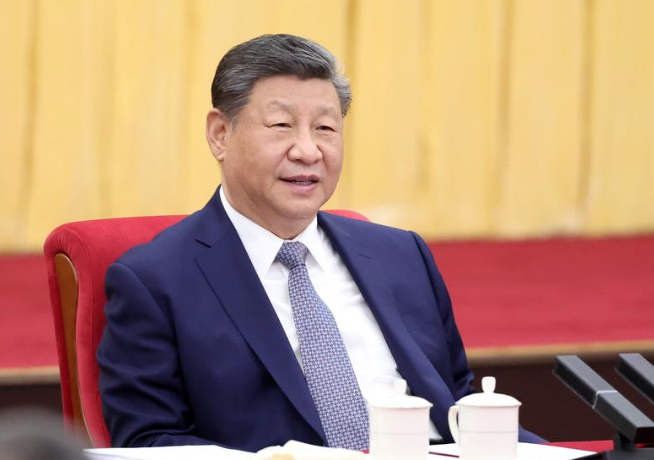
 Chinese President Xi Jinping, also general secretary of the Communist Party of China (CPC) Central Committee and chairman of the Central Military Commission, visits national political advisers from the Chinese Peasants and Workers Democratic Party, the Jiusan Society, the sector of medicine and health, and the sector of welfare and social security, who attended the fourth session of the 14th National Committee of the Chinese People's Political Consultative Conference (CPPCC), in Beijing on March 6, 2026. Xi attended their joint group meeting and heard their comments and suggestions /Xinhua
The military attacks launched by the US and Israel against Iran have caused widespread havoc in the Middle East region, resulting in thousands of casualties, significant damage to infrastructure and massive oil market disruptions. Moreover, the war has no legal or moral ground and therefore is condemned by the majority of the international community. As a result, confidence in the rules-based international order and global governance is crumbling.
In response to the escalating crisis, countries across different regions have called for restraint, emphasising the need to uphold principles of sovereignty, territorial integrity and multilateral diplomacy. Against this backdrop, China and Pakistan have jointly advanced a Five-Point Initiative aimed at restoring peace and stability in the Gulf and Middle East region.
This Five-Point Initiative, presented by China's Foreign Minister Wang Yi and Pakistan's Deputy Prime Minister/Foreign Minister Mohammad Ishaq Dar in Beijing in late March this year, is a timely and necessary intervention. It signifies that countries in the Global South are no longer passive observers to issues affecting the global community.
First, the initiative proposes immediate cessation of hostilities. Meaning, all parties involved in the war must silence their missiles, stealth bombers and drones. They must allow for humanitarian assistance to all war-affected areas. Second, there is need to initiate peace talks as soon as possible. Dialogue is supreme. Acts of aggression and imperialist remarks will further escalate the conflict.
Third, attacks on civilians, critical infrastructure, including energy, desalination and power facilities, and peaceful nuclear infrastructure, such as nuclear power plants, must stop. As the Chinese saying goes, “A kingdom that has once been destroyed can never come again into being; nor can the dead ever be brought back to life”.
Fourth,to avert a catastrophic disruption to the world economy, the initiative calls on the parties to protect the security of ships and crew members stranded in the Strait of Hormuz, allow the early and safe passage of civilian and commercial ships, and restore normal passage through the Strait as soon as possible.
Last but not least, the primacy of the United Nations Charter must be adhered to by all parties.This will advance the practice of true multilateralism. Politics of unilateralism and hegemonic tendencies have no space in today’s world. Countries need to utilise multilateral institutions guided by the purposes and principles of the UN Charter and international law.
In essence, the Five-Point Initiative calls for an immediate cessation of hostilities, the start of peace talks as soon as possible, the security of nonmilitary targets, the security of shipping lanes and the primacy of the United Nations Charter.
As important countries in the Global South, China and Pakistan, through the initiative, have jointly advanced a structured and actionable framework for de-escalation and conflict resolution, articulating a rational and balanced position aimed at building broader international consensus and mobilising collective efforts to reduce tensions and restore sustainable peace and stability in the affected region.
Undeniably, this initiative is the first systematic policy and propositions proposed by the international community for restoring peace and stability in the Middle East region. It stands out in comparison with strategic solutions proposed by other countries,specifically because it is rooted in the Global Security Initiative (GSI) and Global Governance Initiative (GGI) launched by President Xi Jinping as broader frameworks for enhancing sustainable international security and global governance.
Launched in 2022, the GSI calls for adherence to the principles of common, comprehensive, cooperative and sustainable security, while GGI, introduced in 2025, reflects on the principles of sovereign equality, respect for international law, multilateralism, practical action and a people-centred approach to reform global governance.
Collectively, these Initiatives are critical as they significantly alter the global power balance by promoting a multipolar world free from unilateralism and imperialism, towards a model-based system anchored on coexistence, mutual respect, sovereign equality and shared responsibility.
Thus, as the international community continues to be confronted by traditional and non-traditional security challenges such as the ongoing conflict in the Middle East, both GSI and GGI are more than lofty words.
They offer a stabilising anchor in this turbulent world and show the pathway towards peace, security and sound global governance founded on fairness and justice. They speak for the Global South countries, which form the majority of the international community, rather than the club of the rich and powerful, and therefore find wide resonance in the Global South.
Dennis Munene is the executive director of China-Africa Center at the Africa Policy Institute