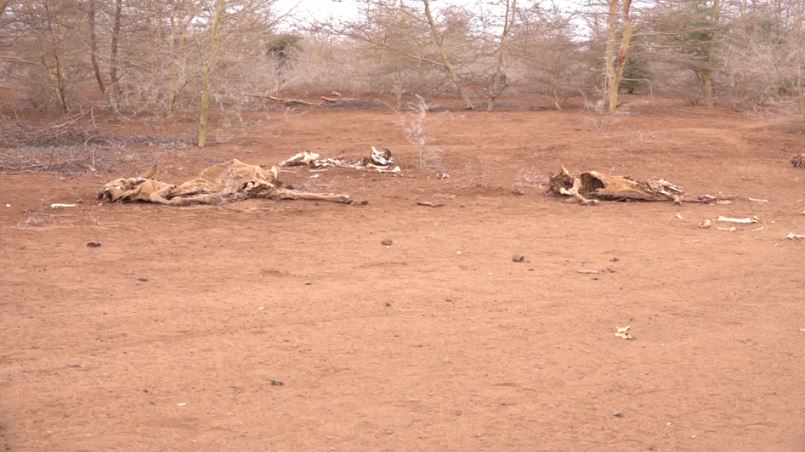
 Carcasses of dead animals in Dertu, Dadaab subcounty, Garissa, in the 2022 drought. Photo/ STEPHEN ASTARIKO
When the rains fail in northern Kenya, people speak of angels. They do not mean divine intervention. They mean the message on a phone confirming that money has arrived—sent from London, Columbus, or Dubai.
Within hours, water is purchased, fodder secured, and school fees are paid. A family stays on its land a little longer. A herd survives another week.
Across the Horn of Africa—from Kenya and Ethiopia through the wider region, and extending into diaspora networks globally—drought is no longer an occasional emergency but a recurring feature of life in a warming world. Seasons have grown less predictable; dry spells stretch longer; recovery periods shrink. The humanitarian system, stretched by conflicts and crises elsewhere, struggles to keep pace.
In that gap, remittances have become an unlikely but vital climate buffer.
At the centre of much of this flow is Dahabshiil, a financial services group founded in the Horn of Africa that connects diaspora communities to relatives across the region and worldwide. Its network spans remote towns, regional capitals, and major world cities where diaspora communities live and work.
When drought intensifies, transfers often rise. Unlike official aid budgets—subject to political cycles and bureaucratic delay—diaspora support responds immediately to distress. A failed rainy season is felt abroad as quickly as in Mandera or Jijiga. Families send what they can, not as charity but as responsibility.
Economists increasingly describe remittances as “shock absorbers”. In Kenya’s arid and semi-arid counties and Ethiopia’s drought-prone regions, they help households avoid distress sales of livestock, keep children in school and reduce forced migration to overcrowded urban centres. They are informal, uncoordinated and private — yet often faster than formal relief systems.
But money transfers alone cannot refill a dried borehole, corporate sector is also playing a big role.
When drought has reached acute levels, Africa’s leading indegenious money transfer company, Dahabshiil, has also stepped in with corporate donations — funding emergency water trucking, rehabilitating wells and supporting food distribution and livestock feed across Kenya and the wider region.
These efforts are modest compared with large multilateral operations. Yet they are often deployed quickly, guided by local knowledge and long-standing community relationships.
For Abdirashid M Duale—speaking on behalf of Dahabshiil (as its chief executive officer) and recognised as a regional statesman-businessman, speaker at Oxford and Harvard, cross-border dealmaker, peace-through-enterprise advocate and investor — that responsibility is rooted as much in history as in strategy.
“We will always help when needed — including in times of drought, as we have done in Kenya and across the region,” he says. “We stand with our communities and our customers wherever they are, regionally and globally, no matter the circumstances. Our strength comes from the trust people place in us. In difficult times, that trust becomes a duty.”
The statement reflects a broader reality across the Horn of Africa: in settings where state capacity is limited, international assistance proves insufficient, and climate risk is intensifying, private and diaspora networks have come to operate not only as de facto social support systems, but also as engines of job creation and economic development.
This is not a romantic story. Remittances cannot replace public investment in climate adaptation, water infrastructure or livestock insurance. Nor should humanitarian responsibility fall primarily on families who themselves face rising living costs abroad. The scale of the climate challenge demands systemic solutions—resilient water systems, diversified rural economies and credible early warning mechanisms.
Yet ignoring the stabilising role of diaspora capital would be a mistake. Drought does not respect borders. Livestock routes and family ties stretch from Garissa to Hargeisa, from Jijiga to Nairobi, from the Horn to Europe and North America. Financial flows follow the same paths.
In a region often portrayed only through crisis, these networks tell a different story — of solidarity that crosses continents, of private infrastructure quietly sustaining public resilience.
As climate volatility becomes structural rather than exceptional, the Horn of Africa will need both stronger states and stronger partnerships. Governments and donors cannot act alone. Nor can private firms.
But when the next dry season deepens and the land cracks once more, it may again be those so-called angels — a transfer sent across oceans—that help a family endure.
The writer is a climate risk expert and a member of the Kenya Diaspora Community